
died 362 or 363·Feast 63 days before Easter (moveable feast)
St. Sargis the General
Cappadocian general martyred in Sassanid Persia
Overview
Sargis the General, known in Armenian as Sourb Sargis Zoravar and in Greek as Sergius Stratelates, was a Cappadocian commander in the Roman Army who gave his life for the faith in 362 or 363. Constantine the Great appointed him General in Chief of the Cappadocian territory bordering Armenia, and he was famed for piety as much as for valor, teaching the gospel among his troops and encouraging the raising of churches. When the emperor Julian the Apostate turned against the Christians in 361, Sargis laid down his command and fled with his son Martiros, first to Armenia and then to the Sassanid Empire of Shah Shapur II. There his military gifts won him command of the Persian army, and his victories, including the repulse of Julian's invading forces, he credited openly to God. Betrayed by soldiers who had not accepted baptism, he was summoned before Shapur and ordered to sacrifice in a Zoroastrian fire temple. His refusal cost his son, their fourteen companions, and finally Sargis himself their lives. Today he ranks among the most beloved saints of Armenia, honored as patron of youth and love with a moveable feast kept sixty-three days before Easter.
The Complete Life
A Greek of Cappadocia in Imperial Service
The record of Sargis' beginnings is sparse, and the Armenian tradition itself acknowledges how little can be known of them. He lived in the fourth century and was a Greek by nation, a man of Cappadocia, the rugged inland region of Asia Minor where Christian life ran deep from apostolic times. What standing he held came through the favor of the emperor Constantine the Great, who appointed him General in Chief of the Cappadocian territory marching with Armenia, a frontier command demanding both administrative gifts and martial skill. The tradition ascribes to him the qualities such a post would require: piety, faith, and valor. Whatever his origins, he rose high enough in imperial service to be a marked man when the policies of the empire changed. The chief account of his life, the History of the Life of Saint Sargis the General, was compiled long afterward from a Syriac life procured at the monastery of Mor Bar Sauma in Melitene, lightly emended by Patriarch Nerses Shnorhali, who sent it to a monk of Haghpat after Georgians had begun questioning the saint's origins.
§ Life
Command Becomes Ministry
Sargis' command became, in the telling of his tradition, a kind of ministry. He was reputed for piety, faith, and valor, and he used his position to foster the growth of the spirit among those he led, teaching the gospel and encouraging the raising of churches. The turning of his life came with a change of emperors. Constantine's nephew Julian, remembered by Christians as the Apostate, took the throne in 361 and set in motion a persecution of the Church throughout the Roman dominions. Deeply troubled, Sargis turned to prayer, and his tradition records a vision in which Christ called him, as once he called Abraham, to leave country and clan for a land that would be shown him, where a crown of righteousness was prepared. In obedience he laid down his military position and authority and set out with his son Martiros, taking shelter in Armenia, where King Tiran gave them his protection. As Julian marched with his troops toward Antioch in Syria, slaughtering Christians on the way, Tiran urged the general and his son to move on again, out of Armenia and into the Sassanid Empire.
§ Life
Commander of Persia, Preacher of Christ
In Persia the fugitive general found that his reputation had traveled ahead of him. Shah Shapur II, hearing of Sargis' skill as a commander, gave him command of the Sassanid army, and he repaid the trust with victories, among them the defense of the kingdom against the invading forces of Julian. For every success he gave the credit to God, and he urged the soldiers serving with him to trust the Maker of heaven and earth, so that their hearts would stand firm in every shock. His preaching bore fruit: some of his men were baptized by priests who traveled with the army. But not all of his soldiers accepted the faith, and those who had not been baptized went to Shapur and reported the beliefs their commander held and spread. The shah, realizing that the man he had raised to high command was a Christian, summoned Sargis, his son Martiros, and the fourteen soldier companions who had recently received baptism, intending to put the sincerity of their faith to the test before his court. The summons to the palace was framed, in the tradition's telling, as a test of faith.
§ Life
The Fire Temple and the Crown
The test Shapur devised was the imposition dear to Zoroastrian Persia: the general, his son, and their fourteen companions were ordered to take part in a ceremony in a fire temple and offer sacrifice there. Sargis refused. Worship, he answered, belongs to the one God, the Holy Trinity who made heaven and earth; fire and idols are no gods at all, and a human hand can destroy them. Then he went further, destroying the objects of the fire temple itself. The crowd that gathered fell upon him and his son in fury, and the shah, outraged, ordered Martiros killed before his father's eyes and the fourteen companions beheaded. Sargis was thrown into prison, but reports that the prisoner drew strength from his Lord only hardened the king's resolve, and he ordered the general's execution. At the place of death Sargis prayed, and the tradition tells that an angel came down to him with the assurance that the gate of the Kingdom of Heaven stood open. He made a last plea that those around him accept Christ, and was killed. Those present saw a mysterious light shining above his body.
§ Martyrdom
Patron of Armenia's Lovers and Youth
The loyal followers who remained recovered the martyr's body, wrapped it in clean linen, and sent it in time to Assyria, where it rested until the fifth century. Then Saint Mesrob brought the relics home to Ushi in Armenia, raising over them the monastery that bears the saint's name. When the church of Ushi village was excavated in 1999, the relics came to light once more, and the museums of the Mother See of Holy Etchmiadzin received them into their collection. In Armenia today Sargis ranks among the most beloved of saints, honored as patron of love and youth in something of the way other cultures honor Saint Valentine. His feast is moveable, falling between 11 January and 15 February with the date of Easter, and is preceded by the five-day Fast of Catechumens, established by Saint Gregory the Illuminator and now commonly called the Fast of Saint Sargis. Saint Sarkis Cathedral in Yerevan bears his name, many churches across the historic Armenian lands were dedicated to him, and his cult passed even into Kurdish folklore. On his eve the faithful set trays of flour at their doors hoping for the print of his horse's hoof, eat salty biscuits to dream of a coming spouse, and share the fruit-and-nut pastry known as Saint Sarkis Halva.
§ Veneration
Timeline
- 361
Julian the Apostate becomes Roman emperor and begins harassing the Christians of the empire, unsettling the general's position
§ Life
- 362
Executed in Persia with his son Martiros during the Forty-Year Persecution of Shah Shapur II, after refusing to sacrifice in a fire temple
§ Martyrdom
- 400
Saint Mesrob carries his relics from Assyria back to the village of Ushi in Armenia, where a monastery is raised over them
§ Veneration
- 1999
Excavation of the church at Ushi village uncovers his relics, which enter the museums of the Mother See of Holy Etchmiadzin
§ Veneration
In Their Own Words
It is time for you to leave your country and your clan, as did Abraham the Patriarch, and go to a country which I will show you. There you will receive the crown of righteousness prepared for you.
We should worship one God – the Holy Trinity, which has created the earth and the heaven. Whereas fire or idols are not gods and the human being may destroy them
Be strong. Do not fear the killers of your body; for the gate of the Kingdom of Heaven is open for you
The Record
- Patron of
- patron of youth and love
- Symbols
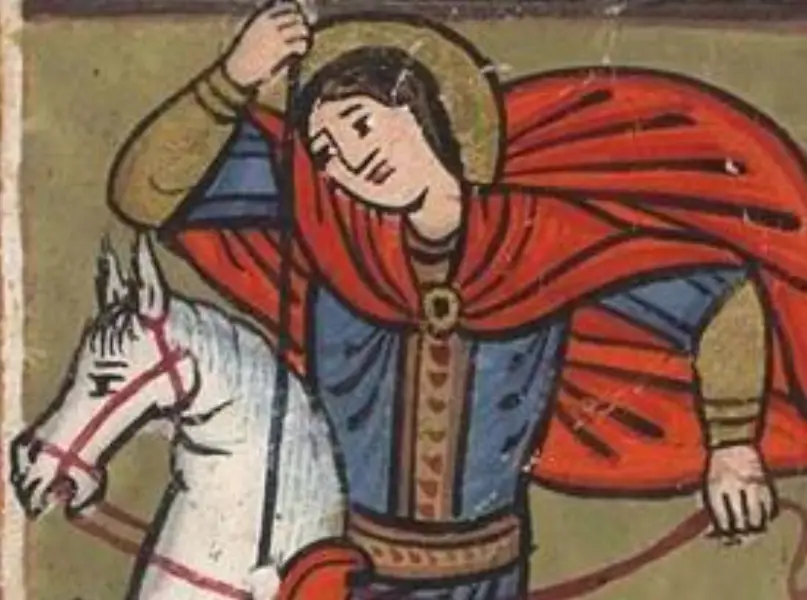
- depicted on a white horse
- Canonization
- Pre-congregation; venerated as a martyr by the Armenian Apostolic Church and the Assyrian Church of the East
Prayer
Bibliography
Show 6 sources
- Cowe, S. Peter. "Armenian Hagiography", in The Ashgate Research Companion to Byzantine Hagiography (Routledge, 2011), Vol. 1, pp. 312–13.
- Thierry, Jean Michel. Monuments arméniens du Vaspurakan (Libraire Orientaliste Paul Geuthner, 1989), p. 508.
- Partamian, Stepan (27 March 2011). "St. Sarkis The Greek".
- "St. Sarkis the Warrior and His Son, St. Mardiros". Armenian Apostolic Church Library Online.
- Peeters, Paul, ed. Bibliotheca Hagiographica Orientalis (Brussels, 1910), p. 231.
- Kalajian, Robyn. "St Sarkis Day – The Armenian version of Valentine's Day", The Armenian Kitchen, February 11, 2014.
Profile text adapted from the Wikipedia article, licensed CC BY-SA 4.0.
Pray with this saint every day
Save St. Sargis the General to your favorites, read the full profile, and get feast-day reminders in the Saints app.
Get the Saints AppFree on the App Store for iPhone and iPad