
493 – 568·Feast October 2
St. Saturius of Soria
Hermit of Santa Ana and patron of Soria
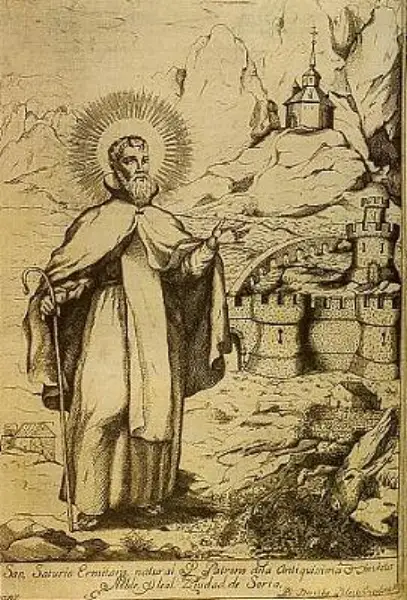
Overview
Saturius of Soria, honored in Spanish as San Saturio, was a hermit whose hidden life of prayer made him one of the great figures of his city. Born at Soria in 493, he cared for his parents through their old age, and only after their death did he follow the desire that had long governed him. He gave his patrimony to the destitute and, at forty, withdrew to a cavern on the Santa Ana hill, known also as Peñalba, where he lived in complete austerity and ceaseless mortification for the rest of his days. His reputation for holiness drew visitors in search of counsel, among them Prudentius of Armentia, who became his companion for the final seven years of his life and later buried him; Prudentius went on to become bishop of Tarazona. Saturius died in 568. Declared patron of Soria in 1628, he was inscribed in the canon of saints in the following century, and the cave where he lived remains a goal of pilgrims, while his hermitage found its way into the literature of Gustavo Adolfo Bécquer.
The Complete Life
A Son of Soria
Saturius was born at Soria in the year 493. Of his family and upbringing the tradition tells little, but it preserves the choice that defined his early manhood: when his parents needed him, he did not leave them. He cared for his father and mother through their last years, discharging the duty of a son with a devotion that the Church would later read as the first mortification of a life given to self-denial. Only when they had died did he act on the longing that had waited behind his filial obligations. His inheritance he gave away entire to the poor, keeping nothing for himself, and so passed at a stroke from being a householder of Soria to being a man deliberately without possessions. In an age that measured a man by his lands and name, the gesture was a complete break, made without drama or recorded word. It was as such, unencumbered and unclaimed by any worldly tie, that he prepared for the retreat that would make his name endure in his city and far beyond it. Poverty accepted freely became the seal of that first renunciation.
§ Introduction
The Cave on the Hill
At the age of forty Saturius withdrew from the city of his birth to a cavern on the Santa Ana hill, known also as Peñalba, and there he remained for the rest of his life. The move completed the renunciation he had begun when he distributed his patrimony to the poor: solitude, prayer, and austerity became the whole order of his days. The tradition speaks of complete austerity and of mortifications of the flesh, the disciplines by which a hermit subdued body and will to the service of God. Such a life, hidden and unrecorded in its daily details, won precisely the kind of fame that sanctity seeks: his reputation for holiness spread abroad, and those in need of counsel began to seek out the cave on the hill. Among those who came was Prudentius of Armentia, a man of learning and judgment who would one day sit in the episcopate. For wisdom of a spiritual and practical kind, the hermit of Santa Ana had become a source to which others turned, and the city below learned to be proud of the silence above it.
§ Introduction
Companionship and a Quiet Death
The last chapter of Saturius' life was shaped by an unexpected companionship. Prudentius of Armentia, who had sought the hermit out for his advice and wisdom, did not merely visit and depart; he stayed, and for the final seven years of the old man's life he lived at his side. The arrangement joined two very different callings, the hidden contemplative and the future bishop, and it kept Saturius' last years from being solitary in the ordinary sense. When the hermit died in 568, it was Prudentius who buried him, the last office of a friend. Prudentius himself would go on to the bishopric of Tarazona, and the memory of the master he had served went with him into the Church's wider honor. Thus the cave that had received one man in silence ended by sending forth a legacy measured in a saint, a bishop, and a shrine, a course unusual for a hermit who owned nothing and had sought no one's notice. To bury a confessor was, in the eyes of the early Church, a privilege and a witness, and Prudentius performed it as both.
§ Introduction
Patron and Saint of the Canon
Honor came to Saturius slowly and by formal steps. In 1628 the Church formally named him patron of Soria, the city of his birth, more than a millennium after his death. His cult received the Church's definitive recognition when he was inscribed in the canon of saints, a step dated 1753 in the record's summary of his cult and 1743 in its account of it. Either way, the recognition belongs to the era in which the Holy See regularized the cults of ancient local saints, confirming what the devotion of Soria had never doubted. His feast is kept on 2 October. Veneration of the saint has never rested on documents alone: the cave on the hill of Santa Ana where he lived and died is still an object of pilgrimage, and the hermitage of San Saturio that commemorates him stands among the landmarks of the city that claims him as its own. Centuries of local remembrance, the pilgrimage to the cave, and the city's attachment to its hermit all testified to a holiness that outlived every attempt to fix it in a single date.
§ Veneration
The Hermit in the City's Memory
Soria has never let go of its hermit. As patron of the city he presides over its religious identity, and the hill of Santa Ana, where his cave is still shown, remains a goal of pilgrims. The hermitage of San Saturio is among the familiar monuments of Soria and entered the wider literary imagination when Gustavo Adolfo Bécquer mentioned it in El Rayo de Luna, one of the best known of Spanish Romantic tales. Few saints of the early Spanish Church are so closely woven into the fabric of a single place: born there, converted to penitence there, hidden for decades on the hill above the town, and finally claimed by it as protector. The line of his influence runs from the silence of the cave to the devotion of the city and into art and letters. His feast on 2 October keeps the memory alive year by year. Visitors still climb to the cave, and the story of the man who gave away everything to live in prayer remains part of what Soria tells about itself. In that yearly return the city repeats its oldest act of gratitude.
§ Veneration
Timeline
- 493
Born at Soria
§ Introduction
- 533
Distributes his patrimony among the destitute and, at forty, withdraws to a cavern on the Santa Ana hill, known also as Peñalba
§ Introduction
- 561
Prudentius of Armentia, who had sought his wisdom, joins him as companion for the final seven years of his life
§ Introduction
- 568
Dies in his hermitage after decades of austerity; Prudentius lays him to rest
§ Introduction
- 1628
Officially declared patron saint of Soria
§ Veneration
- 1753
Officially inscribed in the canon of saints of the Catholic Church
§ Veneration
The Record
- Patron of
- Soria
- Canonization
- Inscribed in the canon of saints by the Catholic Church, dated 1743 in the article body and 1753 in the infobox
Prayer
Bibliography
Show 2 sources
- "Hermitage of San Saturio", Portal de Turismo de Castilla y León.
- Amadó, Ramón Ruiz. "Diocese of Osma." The Catholic Encyclopedia Vol. 11. New York: Robert Appleton Company, 1911.
Profile text adapted from the Wikipedia article, licensed CC BY-SA 4.0.
Pray with this saint every day
Save St. Saturius of Soria to your favorites, read the full profile, and get feast-day reminders in the Saints app.
Get the Saints AppFree on the App Store for iPhone and iPad