
died c. 257·Feast November 29
St. Saturnin of Toulouse
Apostle to the Gauls and first Bishop of Toulouse
Overview
Saturnin, remembered in French as Saint Saturnin or Sernin and in Latin as Saturninus, was the first Bishop of Toulouse and one of the seven bishops whom Pope Fabian sent from Rome to Christianize Gaul, probably in 250 or 251, during the consulate of Decius and Gratus. His fellow missionaries carried the gospel to Tours, Arles, Narbonne, Paris, Clermont, and Limoges, while Saturnin took charge of Toulouse. Born in the third century at Patras in Greece, he preached in the city until his refusal to sacrifice to the pagan gods cost him his life. Seized near the capitol, whose priests blamed his frequent presence for the silence of their oracles, he was bound by the feet to a bull and dragged through the town until the rope broke. He died about 257, and Christian women gathered his remains and laid them in a deep trench, beyond the reach of profanation. A wooden oratory later rose over his grave, a larger church followed in 402, and in time the Romanesque Basilica of Saint-Sernin, one of the defining buildings of southern France. His feast is kept on 29 November.
The Complete Life
Origins Clothed in Legend
The earliest account of Saturnin, the lost Acts of Saturninus, has survived only as reflected in the historians who used it, above all Gregory of Tours, and it clothed the first bishop of Toulouse in a genealogy more splendid than probable. The martyrology drew on it to make him son of Aegeus, ruler of Achaea, and of Cassandra, herself born of Ptolemy, the King of the Ninevites. The same ancient Acts placed him in the first century, numbered him among the seventy-two disciples of the Lord, and set him at the Last Supper, claims that belong to the legend-building of the early Gallican Church rather than to sober chronology. What the tradition records with more constancy is his Greek origin: the account followed by the Church gives Patras, in Greece, as his birthplace and the third century as his time. In that setting he was marked out for the episcopate, consecrated a bishop, and given, as the old story tells, Papulus for his companion, with Honestus numbered among his disciples. These companions would share the hardships of the mission to Gaul.
§ Background
Sent to a Broken Land
Saturnin's calling joined the apostolic office of a bishop to the hardihood of a missionary. The legend surrounding his consecration has the Apostle Peter himself setting him apart and assigning him Papulus, afterwards honored as Saint Papulus the Martyr, as his companion in the work. The decisive commission, however, came from Rome. Pope Fabian, who governed the Church from 236 to 250, determined to restore the Christian communities of Gaul, which the persecutions of Decius had very nearly wiped out, and sent out seven bishops for the task, probably in 250 or 251, during the consulate of Decius and Gratus. Saturnin was one of the seven, styled ever after one of the Apostles to the Gauls. His assignment was Toulouse, while his fellow missionaries went to the other great cities of the land. Whatever the truth of his legendary ancestry, he arrived at his see as a founding bishop, charged with planting and ordering a church where the Christian name had been very nearly extinguished by persecution. Such work demanded patience as much as courage, and both would soon be tested at Toulouse.
§ Background
Bishop of Tolosa
At Toulouse, Saturnin is styled the first Bishop of Tolosa, the founder of its episcopal line. The Acts of the saint, as they were remembered, described a bishop whose mere passage through the city disturbed its spiritual order: the pagan priests held his constant passing responsible for the silence of their oracles, as he made his way to the Christian church, his road lying past the capitol, where an altar of the old worship stood. The detail opens a small window onto a missionary's life in a proud Roman city, the daily walk through hostile streets to a hidden congregation, the irritation of a priesthood that watched its authority drain toward the God of the Christians. From Toulouse his influence was carried through the Gallican Church at large; later panegyric would bring his disciples into the story of the first churches at Eauze, Auch, Pamplona, and Amiens. His own Acts, the Passio antiqua, were already old enough when his successors rewrote them that they rank among the oldest documents of the Gallican Church. Whatever embellishments the later texts added, that core memory of a bishop whose presence unsettled the old worship remained fixed.
§ Background
Dragged by the Bull
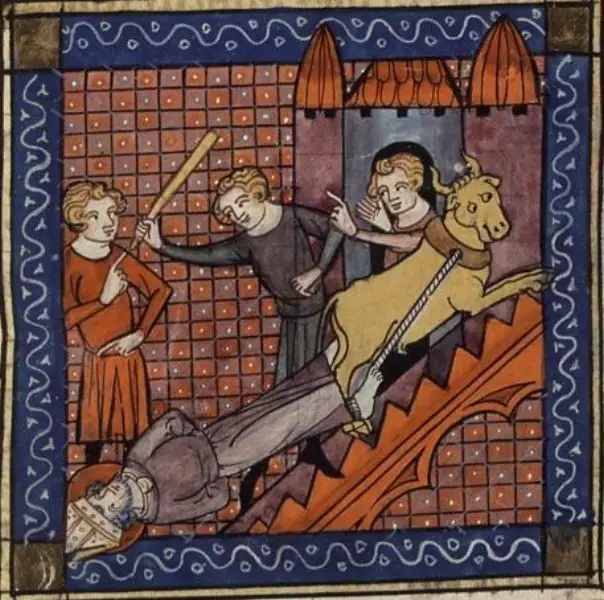
The confrontation that ended Saturnin's life came, according to the Acts, on one of those ordinary passages before the capitol. The priests of the city, blaming him for the silence of their oracles, seized him one day and demanded sacrifice to the images. On his unshaken refusal they condemned him to a death devised for its humiliation: bound by the feet to a bull, he was dragged about the town until the rope broke. The animal ran on and stopped, it was said, at the place afterwards called Matabiau, the killing of the bull. Christian women, remembered as les Puelles, gathered up the martyr's remains and laid them in a deep trench beyond pagan reach, a trench so deep that some have conjectured it was in fact a mithraeum. He died about the year 257. The street of the Bull and the church of Our Lady of the Bull still trace the path of his passion through the topography of Toulouse. Every year on 29 November the city recalls the bishop who would not burn incense and the beast that made his death a legend.
§ Background
From Deep Ditch to Great Basilica
Saturnin's grave became one of the great sanctuaries of Gaul. His successors at Toulouse, Hilary and Exuperius, saw him buried with greater honor once the faith could keep its rites openly, raising a plain wooden oratory above the old crypt where les Puelles had laid him. As pilgrims pressed upon the cramped site, Bishop Silvius began a larger church, which Exuperius finished in 402; the body was translated to it, and the place of reburial at the crossing before the altar held the relics until 1284. That church now forms the crypt of the Romanesque Basilica of Saint-Sernin, one of the buildings that define the Romanesque style of southern France, while the nearby Gothic church of Notre-Dame du Taur commemorates the road of his martyrdom. The rewritten Acts, embellished with pious legend, tied his memory to the young churches at Eauze, Auch, Pamplona, and Amiens. His name took root across the map of two lands, in the many French villages called Saint-Saturnin and Saint-Sernin, the Pamplona borough of Burgo de San Cernin, the Catalan towns of Sant Sadurni, and even Llansadwrn in Anglesey.
§ Notre-Dame du Taur
Timeline
- 250
Sent out from Rome as one of seven missionary bishops dispatched by Pope Fabian to rebuild the broken Christian communities of Gaul
§ Background
- 257
Seized at Toulouse after refusing to sacrifice to the idols, he is bound by the feet to a bull and dragged to his death
§ Background
- 358
Under Bishop Hilary of Toulouse the martyr receives more honorable burial, a simple wooden oratory rising over his crypt
§ Notre-Dame du Taur
- 402
Bishop Exuperius completes a larger church on the site, and the saint's body is translated into it
§ Notre-Dame du Taur
- 1284
The relics rest at the crossing before the altar of the basilica until this year
§ Notre-Dame du Taur
In Their Own Words
he was given for his companion Papulus, later to become Saint Papulus the Martyr
The Record
- Patron of
- Toulouse, France
- Symbols
- a bishop's mitre·a bishop being dragged by a bull·a bull
- Canonization
- Pre-congregation; venerated as a martyr from the earliest centuries of the Gallican Church
Prayer
Bibliography
Show 3 sources
- "CATHOLIC ENCYCLOPEDIA: St. Saturninus". www.newadvent.org. Retrieved 2020-02-07.
- "Lives of the Saints, November 29, Saint Saturninus". 2002-01-09.
- "Saint Saturninus of Toulouse". CatholicSaints.Info. 2009-10-10.
Profile text adapted from the Wikipedia article, licensed CC BY-SA 4.0.
Pray with this saint every day
Save St. Saturnin of Toulouse to your favorites, read the full profile, and get feast-day reminders in the Saints app.
Get the Saints AppFree on the App Store for iPhone and iPad