
died 304·Feast November 29
St. Saturninus of Carthage
Carthaginian martyr beheaded in Rome under Maximian
Overview
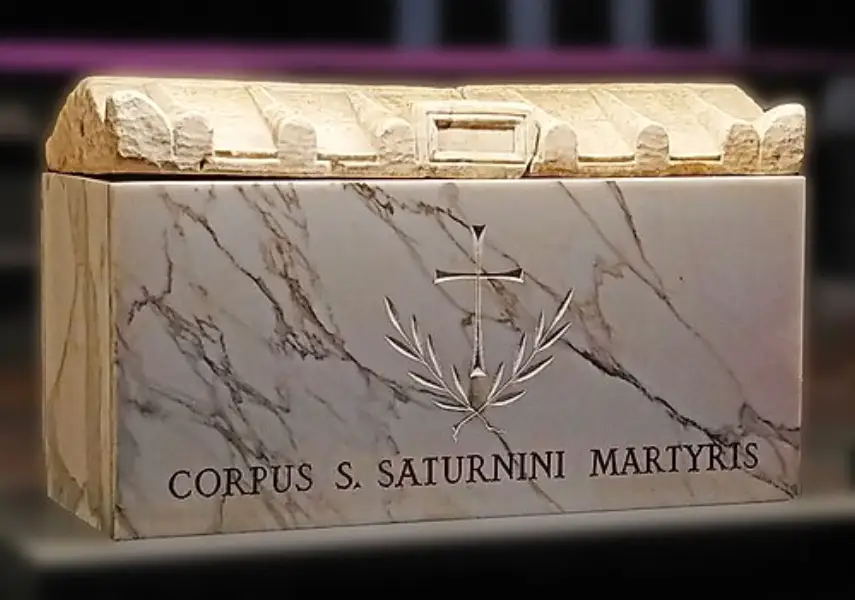
Saturninus of Carthage was a North African martyr whose passion is known through the inscription Pope Damasus I dedicated to him in Rome. A Christian of Carthage, he was tortured for his faith in his homeland and then exiled to the capital, where, according to the martyrology's summary of his case, he overcame further atrocious tortures, converted even the tyrant Gratian, and at last was beheaded, in 304, under Maximian. Filocalus' Chronograph of 354 records that his body lay in the Catacomb of Trasone on the via Salaria, where it had been buried on 29 November. In later centuries his remains were translated to the church of San Saturnino in Rome, and his sarcophagus now rests beneath the high altar there. The Roman Martyrology, which preserves the Damasan tradition of his trial and death, keeps the memory of this African confessor who crossed the sea between two worlds and sealed his witness in the city of his exile.
The Complete Life
From the Rack of Carthage to Rome
The passion of Saturninus is preserved in the inscription that Pope Damasus I raised in his honor, one of the epigraphic monuments by which the fourth-century papacy recorded the martyrs of Rome. A Christian of Carthage, he suffered the rack for his faith in his own land; instead of yielding, he was sent into exile at Rome, where the persecution pursued him with new torments. The Roman Martyrology's summary places his first tortures under the emperor Decius, while the record of his death belongs to the reign of Maximian. Under his torments he converted the man the text calls the tyrant Gratian to the Christian faith, a victory over his judges won not by argument but by endurance. For this obstinacy the sentence of death followed, and in the year 304 Saturninus was beheaded, gaining the martyr's crown the tradition had promised him. Between the African confessor and the Roman executioner stands the whole drama of an age in which a man condemned in one province could be carried across the sea to die in another. His grave would soon become one of the noted tombs of the via Salaria.
§ Introduction
The Tomb on the via Salaria
Saturninus was laid to rest in the Catacomb of Trasone, on the via Salaria. Filocalus' Chronograph of 354 noted his grave there and fixed the commemoration of his burial to 29 November, a date the Church has kept for him ever since. The standing of the Carthaginian martyr in Rome is attested above all by Pope Damasus I, who dedicated an inscription to him, as he did for the martyrs whose tombs he adorned throughout the city. In later centuries the relics were translated to the church of San Saturnino in Rome, where the saint's sarcophagus lies beneath the high altar. Thus the martyr of Carthage, killed in a Roman persecution, ended with his shrine in the city of his exile: an African saint of the Roman calendar, honored in the martyrology promulgated after the Second Vatican Council, his story carried from the rack of his homeland to the via Salaria and into the universal memory of the Church. The inscription made his name part of the pilgrim's map of the Roman graves, read by the faithful who came to pray among the dead.
§ Introduction
Timeline
- 304
Beheaded at Rome under Maximian after torture in his homeland and exile to the capital
§ Introduction
- 354
Filocalus' Chronograph records his burial in the Catacomb of Trasone on the via Salaria on 29 November
§ Introduction
In Their Own Words
under the emperor Decius was tortured for his faith on the rack in his homeland and then exiled to Rome, where, after overcoming other atrocious tortures, he converted the tyrant Gratian to the faith and finally was beheaded and obtained the crown of martyrdom
The Record
- Canonization
- Pre-congregation; honored as a martyr, with a dedicatory inscription by Pope Damasus I
Prayer
Bibliography
Show 2 sources
- "Entry". Santi e Beati (in Italian).
- Martirologio Romano. Riformato a norma dei decreti del Concilio ecumenico Vaticano II e promulgato da papa Giovanni Paolo II. Città del Vaticano: Libreria editrice vaticana, 2004, p. 914.
Profile text adapted from the Wikipedia article, licensed CC BY-SA 4.0.
Pray with this saint every day
Save St. Saturninus of Carthage to your favorites, read the full profile, and get feast-day reminders in the Saints app.
Get the Saints AppFree on the App Store for iPhone and iPad