
c. 1174 – 1235·Feast January 27
St. Sava
First Archbishop of Serbia and Enlightener of the Serbs
Overview
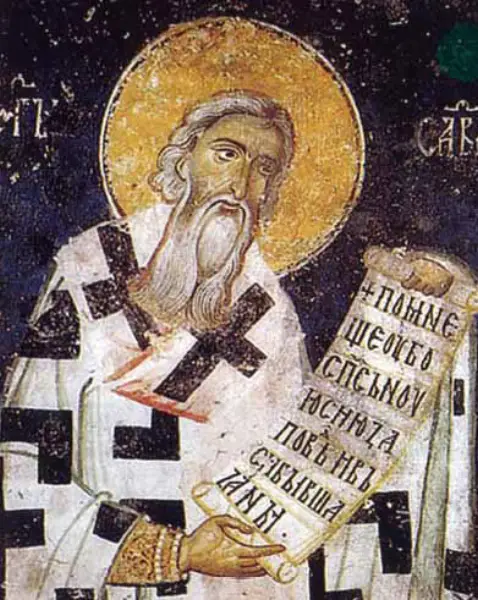
Saint Sava, known as the Enlightener, was born Rastko Nemanjić, the youngest son of the Serbian Grand Prince Stefan Nemanja, founder of the Nemanjić dynasty. As a youth he governed the province of Hum, showing a mildness and love of the poor that foreshadowed his renunciation of the world. Around 1192 he left his court for Mount Athos, took the monastic name Sava, and with his father — who followed him into monastic life — restored the monastery of Hilandar, making it the great spiritual center of the Serbs. After bringing his father's relics home to Studenica and making peace between his quarreling brothers, he devoted his energies to awakening faith and learning among his people. On August 15, 1219, at Nicaea, Patriarch Manuel I raised him to lead the newly independent Serbian Church as its first archbishop, and in that same year he promulgated the Zakonopravilo, the oldest known Serbian legal code, securing both religious and political independence for his nation. He founded bishoprics, monasteries, and schools, wrote the first Serbian hagiography, and made two pilgrimages to the Holy Land. He died at Tarnovo in Bulgaria on January 14, 1235, and remains Serbia's most revered national saint.
The Complete Life
A Prince of the Nemanjić
The boy christened Rastko first saw daylight at Miščiće, a village of the Deževa Valley close to today's Novi Pazar, in either 1169 or — as most historians judge — about 1174. His father was Grand Prince Stefan Nemanja, the architect of the medieval Serbian state, and his mother was Ana; as the youngest of three sons born after a long pause in the family, he was said to be especially dear to his parents. At court he and his brothers Vukan and Stefan received the Byzantine education that shaped the Serbian elite, absorbing the political and religious culture of Constantinople. While still a boy he was given practical training in rule: made Prince of Hum, the coastal province between the Neretva and Dubrovnik, around 1190, he kept his own court with magnates and officials, a genuine school of administration. His biographer Teodosije remembered the young ruler as mild and gentle, kind to all, cherishing the poor, and devoted to monastic life. He showed, the sources insist, no appetite for fame, wealth, or the throne — an indifference that made his next act, when it came, both shocking and inevitable.
§ Early life
Flight to the Holy Mountain
In the autumn of 1192, after barely two years of government, Rastko slipped away to Mount Athos, the monastic republic that Athonite visitors had long preached to the Serbian court. At the Russian monastery of St. Panteleimon he received the habit and the name Sava, then moved to the Greek house of Vatopedi, where he spent seven years steeped in Greek theology and church administration. His father pursued him with pleas to come home; the young monk answered by inviting the ruler to abdicate and follow Christ himself. Remarkably, the counsel prevailed. Nemanja summoned an assembly at Studenica, gave the throne to his middle son Stefan, and on the following day took the vows of a monk under the name Simeon, arriving on Athos in the autumn of 1197. Father and son then turned builders. Sava obtained from Emperor Alexios III the ruined monastery of Hilandar, restored it with his father as a haven for Serbian monks, and wrote it a typikon; he also founded the hermitage at Karyes with its chapel of Sabbas the Sanctified, and after his father's death on February 13, 1199, carried on alone as the rising spirit of Athonite monasticism.
§ Mount Athos
An Autocephalous Church for Serbia
In the winter of 1205–1206 Sava brought his father's relics back from Athos to the Studenica monastery and used the occasion to end a bitter dynastic struggle between his brothers Vukan and Stefan — saving the young state from crisis and completing the canonization of his father as Saint Simeon. As hegumen of Studenica he wrote its typikon, winning the monastery an independence from the bishop of Raška that foreshadowed a greater independence to come. After his brother Stefan accepted a royal crown from Rome in 1217, Sava withdrew again to Athos, whether in disagreement or in preparation; what followed settled the question of Serbia's soul. On the feast of the Dormition, August 15, 1219, Patriarch Manuel I of Constantinople consecrated him in Nicaea as first Archbishop of the autocephalous Serbian Church, with the blessing that future archbishops be consecrated by their own bishops. Returning home, Sava organized a national hierarchy at the assembly of Žiča, consecrating disciples as bishops and seating them in border dioceses from Prevlaka to the Lim. In the same year he issued the Zakonopravilo, a nomocanon uniting civil and canon law, giving the Serbs their first written constitution and both forms of independence at once.
§ Autocephaly and church organization
Teacher, Legislator, Founder
Sava's spirituality was pastoral and constructive rather than speculative: he sought, in the words of his biographers, to enwisen and educate his people in Christian law, morality, love, and mercy. His tools were books and buildings. His typika for Hilandar, Karyes, and Studenica adapted the disciplined monastic order of Athos and Constantinople to Serbian conditions; his greatest labor, the Zakonopravilo compiled at Thessaloniki around the time of his consecration, codified Byzantine law for a young church and became the fountainhead of all later Serbian legislation, down to Dušan's Code. As a writer he stands at the head of Serbian literature: his Hagiography of St. Simeon of 1208, warm and unpretentious, is the first Serbian biography, and a letter sent from Jerusalem to his disciple Spiridon opens the history of Serbian prose epistolary art. He was likewise the church's great ktetor, founding or endowing churches and monasteries wherever he went — three chapels at Vatopedi, Hilandar itself, Žiča as the first archiepiscopal seat, the Church of the Holy Apostles at Peć, and houses in Palestine and Sinai for Serbian pilgrims. Through clergy he trained by example, he raised the cultural level of an entire people.
§ Works
Pilgrim to the Holy Places
After his nephew Radoslav was crowned, the aging archbishop set out in 1229 for Palestine, fulfilling the pilgrim's longing of a lifetime. He toured nearly all the holy places, endowing them with precious gifts, and was warmly received by Patriarch Athanasius II of Jerusalem. From his host he obtained two monasteries for Serbian monks — St. John the Theologian on Mount Sion and St. George's at Akkon — and at Mar Saba he received the treasures he carried home to Hilandar: the famous three-handed icon of the Mother of God, the Trojeručica, and the crosier of Sabbas the Sanctified. Four years later, after Radoslav's fall and Vladislav's accession, having named his pupil Arsenije Sremac as successor, he undertook a second and vaster pilgrimage: from Budva by way of Brindisi to Acre, surviving a pirate attack, redeeming a Jerusalem monastery from the Saracens, visiting Alexandria and the Egyptian holy places, and keeping Lent in the Sinai. Falling ill on the voyage home, he reached Constantinople, then turned toward Tarnovo, where the Bulgarian emperor Ivan Asen II and Patriarch Joakim welcomed him. There, having distributed his final gifts, he died on January 14, 1235, between Saturday and Sunday.
§ Second pilgrimage and death
The Relics of the Father of Serbia
Sava was buried with honor in the Holy Forty Martyrs Church at Tarnovo, but the Serbian Church could not leave its father in a foreign land. At Archbishop Arsenije's urging, King Vladislav pressed his father-in-law Ivan Asen II until the emperor consented, and on May 6, 1237, the relics were carried from Tarnovo to the Mileševa monastery amid the highest church and state honors, the king, bishops, and nobles bearing the saint with psalms and songs. Sava was soon canonized, and his remains were regarded as miraculous; his grave drew Orthodox and Catholic pilgrims and even Muslims, who sixteenth-century travelers reported both respected and feared the tomb. The relics sanctified Serbian statehood — Tvrtko of Bosnia was crowned in their presence in 1377, and Stefan Vukčić Kosača styled himself duke of Saint Sava in 1448. The Ottoman burning of the relics on the Vračar plateau in Belgrade on April 27, 1594, meant to break Serbian resolve after the Banat uprising in which rebels marched under Sava's image, had the opposite effect, deepening the devotion. His preserved hand is venerated at Mileševa, and the titanic Church of Saint Sava now rises over the place of the burning.
§ Relics
Apostle of the Serbs
No individual has entered the consciousness of the Serbian people as Saint Sava has, from his own century to the present day. He is honored as Equal-to-the-Apostles, Apostle of the Serbs, and Illuminator, the father of Serbian education and literature; schools celebrate his feast of Savindan, January 27, and he is likewise venerated by Greeks, Bulgarians, Romanians, and Russians, and even by Catholics — Catholic authors from Ragusa and Bosnia wrote of him, and a hymn in his honor has been sung in Serbian in the Sistine Chapel before Pope Francis. Nearly every Serbian church bears his fresco, most often as an archiereus beside his father Simeon, from Studenica and Mileševa to Peć, Dečani, and Hilandar, and even in the Moscow Kremlin. Poets from Jovan Jovanović Zmaj to Desanka Maksimović and Matija Bećković have addressed him; his divine services, written from the reign of King Vladislav onward, call him a lighthouse of love and fortification of the church. Above all stands the Church of Saint Sava in Belgrade, begun in the 1930s and completed in 2004 above the ashes of what the Ottomans had burned, and now ranked among the biggest churches on earth — the measure of a nation's gratitude.
§ Sainthood
Timeline
- 1174
Rastko Nemanjić, the future Sava, is born at Miščiće in the Deževa Valley, youngest son of Grand Prince Stefan Nemanja.
§ Early life
- 1190
Rastko is made Prince of Hum, a province between the Neretva river and Dubrovnik.
§ Early life
- 1192
Rastko abandons his court and departs for Mount Athos, where he becomes a monk under the name Sava.
§ Mount Athos
- 25 Mar 1196
Stefan Nemanja abdicates at an assembly in Studenica and the next day takes monastic vows as Simeon.
§ Mount Athos
- 1197
The former ruler Nemanja, now the monk Simeon, arrives on Mount Athos to join his son.
§ Mount Athos
- Jul 1198
Emperor Alexios III issues a charter granting the ruined monastery of Hilandar to Simeon and Sava for Serbian monks.
§ Mount Athos
- 13 Feb 1199
Sava's father, the monk Simeon, dies on Mount Athos.
§ Mount Athos
- 1199
Sava compiles the Karyes Typikon and the Hilandar Typikon and becomes ktetor of three further Athonite monasteries.
§ Works
- 1204
Sava receives the rank of archimandrite on Mount Athos.
§ Mount Athos
- 1206
Sava returns to Serbia carrying his father's relics to the Studenica monastery and reconciles his quarreling brothers.
§ Mount Athos
- 1208
As hegumen of Studenica, Sava writes the Studenica Typikon and the Hagiography of St. Simeon.
§ Enlightenment
- 1217
Sava leaves Studenica for Mount Athos, perhaps in disagreement with his brother Stefan's coronation by a papal legate.
§ Enlightenment
- 15 Aug 1219
In Nicaea, Patriarch Manuel I ordains Sava to head the newly independent Serbian Church as its first archbishop.
§ Autocephaly and church organization
- 1219
Sava promulgates the Zakonopravilo nomocanon, the oldest known constitution of Serbia, and erects the first Serbian bishoprics.
§ Autocephaly and church organization
- 1229
Sava makes his first pilgrimage to Palestine, endowing the holy places and acquiring monasteries for Serbian monks.
§ First pilgrimage
- 1234
Having named Arsenije Sremac his successor, Sava sets out on his second pilgrimage to the Holy Land.
§ Second pilgrimage and death
- 14 Jan 1235
Sava dies in Tarnovo, the Bulgarian capital, while returning home from Jerusalem.
§ Second pilgrimage and death
- 6 May 1237
His relics are translated with the highest church and state honors from Tarnovo to the Mileševa monastery.
§ Second pilgrimage and death
- 1377
Tvrtko, ban of Bosnia, receives his royal crown beside Sava's remains at Mileševa.
§ Relics
- 27 Apr 1594
Grand Vizier Koca Sinan Pasha has Sava's relics burned on the Vračar plateau in Belgrade during the Banat uprising.
§ Burning of relics
- 2004
The Church of Saint Sava in Belgrade, begun in the 1930s over the site where the relics burned, is completed.
§ Burning of relics
In Their Own Words
You have accomplished all that a Christian sovereign should do; come now and join me in the true Christian life.
The Record
- Major works
- Karyes Typikon (1199)·Hilandar Typikon (1199)·Studenica Typikon (1208)·Hagiography of St. Simeon (1208)·Zakonopravilo (Nomocanon or Krmčija), the first Serbian legal code·Psalter-holding laws, translated from Greek·Letter from Jerusalem to hegumen Spiridon, the first work of Serbian epistolary literature
- Patron of
- Serbia·Serbs·Serbian schools and education·Serbian medicine
- Symbols
- ktetor·teacher·theologian·legislator·diplomat·writer
- Canonization
- Canonized by the Serbian Orthodox Church soon after his death; his cult has been continuous since the thirteenth century
Prayer
Bibliography
Show 7 sources
- Vlasto, Alexis P. (1970). The Entry of the Slavs into Christendom: An Introduction to the Medieval History of the Slavs. Cambridge: Cambridge University Press. ISBN 978-0521074599.
- Fine, John Van Antwerp Jr. (1994) [1987]. The Late Medieval Balkans: A Critical Survey from the Late Twelfth Century to the Ottoman Conquest. Ann Arbor, Michigan: University of Michigan Press. ISBN 0472082604.
- Obolensky, Dimitri (1974) [1971]. The Byzantine Commonwealth: Eastern Europe, 500–1453. London: Cardinal. ISBN 978-0351176449.
- Speake, Graham (2018). A History of the Athonite Commonwealth: The Spiritual and Cultural Diaspora of Mount Athos. Cambridge: Cambridge University Press. ISBN 978-1108425865.
- Ćirković, Sima (2004). The Serbs. Malden: Blackwell Publishing. ISBN 978-1405142915.
- Mileusnić, Slobodan (2000) [1989]. Sveti Srbi (in Serbian). Novi Sad: Prometej. ISBN 8676394784.
- "Saint Savva I, first Archbishop of Serbia". www.oca.org. Retrieved 2024-12-09.
Profile text adapted from the Wikipedia article, licensed CC BY-SA 4.0.
Pray with this saint every day
Save St. Sava to your favorites, read the full profile, and get feast-day reminders in the Saints app.
Get the Saints AppFree on the App Store for iPhone and iPad