
c. 255 – c. 288·Feast January 20
St. Sebastian
Roman soldier-martyr who survived the arrows
Overview
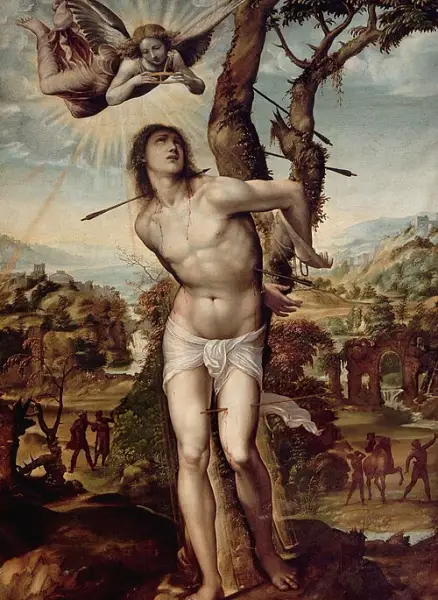
Sebastian was an early Christian martyr, honored since the fourth century and remembered as a soldier, healer, and saint. According to the traditional accounts, he was a man of Gallia Narbonensis educated at Milan who entered the imperial army at Rome in 283 under Emperor Carinus, joining it precisely to aid persecuted Christians. His courage raised him to captain of the Praetorian Guard under Diocletian and Maximian, who did not know he was a Christian. While serving in secret he converted many prisoners and officials, among them the prefect's son Tiburtius and the official Nicostratus and his wife Zoe. When his faith was discovered around 286, the emperor ordered him bound to a stake and shot with arrows by Mauritanian archers; left for dead, he was found alive and nursed back to health by the widow Irene of Rome. On recovering, he confronted Diocletian with his cruelties and was beaten to death with cudgels, his body cast into the sewer. The matron Lucina buried him in the catacombs by the cemetery of Callixtus, where the basilica of San Sebastiano fuori le mura now stands. In the Middle Ages he became one of the great protectors against plague, and today he is patron of archers, soldiers, athletes, and many cities worldwide.
The Complete Life
A Saint Reconstructed from Ancient Sources
What can be known of Sebastian comes to us through layers of very early testimony. The oldest is the Chronograph of 354, the great calendar compiled by the calligrapher Furius Dionysius Filocalus, which records a martyr venerated at Rome on January 20. Half a generation later, between 386 and 390, Ambrose of Milan preached on Psalm 118 and mentioned Sebastian as a holy man who had come from Milan and was already honored as a saint in that city. The full narrative of his life belongs to the fifth century, in the Passio Sancti Sebastiani composed by an anonymous author — possibly Arnobius the Younger — a text long misattributed to Ambrose himself. From the later Acta Sanctorum entry and the briefer fourteenth-century Golden Legend, the hagiographers assembled the biography still generally told: a native of Gallia Narbonensis, born around 255, who was brought to Milan for his education and made his way to Rome, where the empire's capital and its persecutions awaited him. The historical figure behind the legend is thus seen dimly, but the antiquity of his cult is beyond dispute.
§ Life
The Secret Christian in the Praetorian Guard
In 283 Sebastian took the extraordinary step of entering the Roman army under Emperor Carinus — not for advancement, the tradition insists, but to stand beside the Christians being tried and tortured, to comfort and strengthen them from within the ranks. His bravery brought promotion under the joint emperors Diocletian and Maximian, until he stood among the captains of the Praetorian Guard, the emperor's own troops, concealing his faith with prudent silence. His hidden apostolate was prolific. When the deacon twins Marcus and Marcellianus lay in prison under sentence of death, their own parents came to beg them to sacrifice to the gods; Sebastian's words converted the parents instead. He won the prefect's son Tiburtius, the official Nicostratus and his wife Zoe — a woman mute for six years, who recovered her speech upon declaring her faith — and sixteen prisoners whom Nicostratus gathered to hear him. Even the prefect Chromatius believed, freed his captives, resigned his office, and retired to Campania. The harvest of one soldier's hidden courage was a company of martyrs and confessors whom the Roman Church would honor for centuries.
§ Life
Two Martyrdoms
Around 286 the secret could no longer be kept: Sebastian's Christianity was detected, and Diocletian, feeling personally betrayed by a guard he had trusted, ordered him led to a field, bound to a stake, and shot with arrows by picked archers from Mauretania. The Golden Legend tells how the archers kept shooting until he bristled like a hedgehog, then abandoned him as a corpse. The arrows, however, had failed in their work. Irene of Rome, the widow of Castulus, arrived meaning only to take up the corpse for burial, and discovered that life lingered; she bore him home and tended him until his strength returned — an episode the painters of the seventeenth century would render almost as celebrated as the shooting itself. A lesser man would have fled. Sebastian instead took his stand by a staircase the emperor must pass and denounced Diocletian's cruelties against the Christians to his face. Astonished to hear a dead man speak, the emperor recovered and ordered him seized, beaten to death with cudgels, and thrown into the common sewer. Lucina, a Christian matron admonished in a dream, quietly took up the body and laid it to rest in the underground cemetery by the gate of Callixtus, on the spot where his basilica rises today.
§ Martyrdom
From Catacomb to Basilica
Sebastian needed no formal canonization: his cult is among the oldest in the Roman Church, attested within a lifetime of the last persecutions by the Chronograph of 354. His tomb became a place of pilgrimage. In 367 Pope Damasus I erected the Basilica Apostolorum over the place where Peter and Paul had first been laid, and where Sebastian's remains were venerated; that church — San Sebastiano fuori le mura as it is now called — received its early seventeenth-century rebuilding at Scipione Borghese's expense and continues as his chief shrine. His relics traveled widely in the troubled early Middle Ages: in the reign of Louis the Pious, Pope Eugenius II entrusted the body to Abbot Hilduin of St. Denys, who conveyed it to France and deposited it at the abbey of Saint Medard at Soissons on December 8, 826. Sebastian's cranium reached Ebersberg in Bavaria in 934, where a Benedictine abbey was founded around it and became one of the great pilgrimage sanctuaries of southern Germany — its silver-encased relic, by a startling medieval custom, served as the cup presenting consecrated wine to the faithful on his feast.
§ Location of remains
Plague Saint, Athletes' Patron, Endless Subject
Sebastian's medieval fame rested on a striking association: the martyr whose body had survived arrow wounds became the intercessor against the plague, whose buboes the wounds were thought to resemble. Paul the Deacon records that Rome was freed from a pestilence by him in 680; the Golden Legend tells of a Lombard plague stopped by an altar raised in his honor at Pavia. Formerly one of the Fourteen Holy Helpers, he drew immense devotion in the Late Middle Ages, especially after the Black Death. He became, too, one of the most painted saints in Western art: represented first in the Ravenna mosaics of 527–565 and a Roman mosaic of about 682, he drew the brushes of Botticelli, Perugino, Titian, Mantegna, El Greco, Rubens, and Guido Reni seven times over, while the theme of Saint Sebastian Tended by Saint Irene inspired La Tour, Ribera, and Ter Brugghen. His image carried into modern culture — d'Annunzio and Debussy, Thomas Mann, Derek Jarman, R.E.M., and Damien Hirst have all invoked him — and his pierced, beautiful body has been embraced by the LGBTQ community as an emblem of desire and endurance. He remains patron of archers, athletes, a holy death, and cities from Rio de Janeiro to Negombo.
§ In art and literature
Timeline
- 255
Sebastian is born at Narbo Martius in Gallia Narbonensis, according to the traditional dating.
§ Saint Sebastian
- 283
Sebastian enters the Roman army under Emperor Carinus in order to assist persecuted Christians.
§ Life
- 286
His Christian faith is detected; Diocletian has him bound to a stake and shot with arrows, but he survives and is healed by Irene of Rome.
§ Martyrdom
- 288
After confronting Diocletian over his persecutions, Sebastian is beaten to death with cudgels in Rome; Lucina buries him in the catacombs of Callixtus.
§ Martyrdom
- 354
The Chronograph of 354 records Sebastian as a martyr venerated in Rome on January 20.
§ Life
- 367
Pope Damasus I builds the Basilica Apostolorum, today San Sebastiano fuori le mura, over the site of Sebastian's tomb.
§ Location of remains
- 680
The chronicler Paul the Deacon relates that Rome is freed from a raging pestilence through Sebastian's intercession.
§ As protector against plague
- 8 Dec 826
Pope Eugenius II gives Sebastian's body to Abbot Hilduin, who deposits it at Saint Medard Abbey in Soissons, France.
§ Location of remains
- 934
Sebastian's cranium is brought to Ebersberg in Germany, where a Benedictine abbey becomes a major pilgrimage site.
§ Location of remains
In Their Own Words
And the archers shot at him till he was as full of arrows as an urchin is full of pricks, and thus left him there for dead.
The Record
- Patron of
- soldiers·against plague·archers·pin-makers·athletes·cyclists·disabled people·a holy death·LGBTQ people·Rio de Janeiro, Brazil·Negombo, Sri Lanka·Qormi, Malta·Acireale, Caserta, and Petilia Policastro, Italy·Melilli, Sicily·San Sebastián, Palma de Mallorca, Lubrín, and Huelva, Spain·Rome, Italy
- Symbols
- bound to a post, pillar, or tree·pierced by arrows
- Canonization
- Pre-congregation; venerated as a martyr since at least the fourth century
Prayer
Bibliography
Show 7 sources
- "How did St Sebastian become an enduring, homo-erotic icon?". The Independent. UK. 10 February 2008.
- Fr. Paolo O. Pirlo, SHMI (1997). "St. Sebastian". My First Book of Saints. Holy Mary Immaculate – Quality Catholic Publications. pp. 22–23. ISBN 971-91595-4-5.
- Acta S. Sebastiani Martyris, in J.-P. Migne, Patrologiae Cursus Completus Accurante (Paris 1845), XVII, 1021-58; abbreviated in Jacobus de Voragine, Legenda Aurea.
- Löffler, Klemens (1913). "St. Sebastian". Catholic Encyclopedia.
- "St Sebastian". www.ewtn.com.
- Barker, Sheila, The Making of a Plague Saint, ch. 4 in Piety and Plague: from Byzantium to the Baroque, Ed. Franco Mormando, Thomas Worcester, Truman State University, 2007, ISBN 978-1-931112-73-4.
- Boeckl, Christine M (2000). Images of Plague and Pestilence: Iconography and Iconology. Truman State University. pp. 76–80. ISBN 978-0-943549-85-9.
Profile text adapted from the Wikipedia article, licensed CC BY-SA 4.0.
Pray with this saint every day
Save St. Sebastian to your favorites, read the full profile, and get feast-day reminders in the Saints app.
Get the Saints AppFree on the App Store for iPhone and iPad