
died c. 119·Feast July 29
St. Serapia
Syrian slave and martyr, converter of St. Sabina
Overview
Serapia, also honored as Seraphia or Seraphima of Syria, was a slave and martyr of the early second-century Roman Church. Born at Antioch in the late first century to Christian parents, she fled the persecution unleashed by Emperor Hadrian and made her way to Italy. There she consecrated herself to God by a vow of chastity, sold what property she had and gave the proceeds to the poor, and took service in the household of Sabina, a wealthy Roman widow whom her example brought to the Christian faith. When Sabina retired with a few devout companions to a country estate near Vendina in Umbria, Serapia was part of that hidden community of prayer and charity. Summoned before the authorities in Hadrian's reign and ordered to worship the Roman gods, she refused. Attempts to violate and to burn her failed; condemned by the judge Virilis, she was scourged with rods and beheaded with the sword, around the year 119. Her mistress buried her in the family tomb and soon followed her to martyrdom. The Aventine basilica of Santa Sabina originally bore the dedication of both saints, and her feast is kept on July 29.
The Complete Life
A Christian Daughter of Antioch
Antioch, among the mightiest cities of the early Church, was Serapia's birthplace toward the close of the first century, where the disciples of Jesus were first called Christians. Her parents were themselves believers, so the faith was her inheritance from childhood — no small distinction for a girl who would end her life as a slave in Italy. The peace of her early years did not last. When Emperor Hadrian's persecution began to press upon the Christians of the East, Serapia joined the stream of refugees who fled westward, and made her way to Italy to begin a new life among strangers. The move transformed her circumstances entirely: an Antiochene Christian of the diaspora, she would pass the rest of her days in the capital of the empire that was persecuting her people. Yet her faith, tested by flight and exile, showed itself hardy. What she had received at her mother's knee in Syria she would soon pass on, in her turn, to one of the noblest women of Rome.
§ Saint Serapia
Chastity, Poverty, and Service
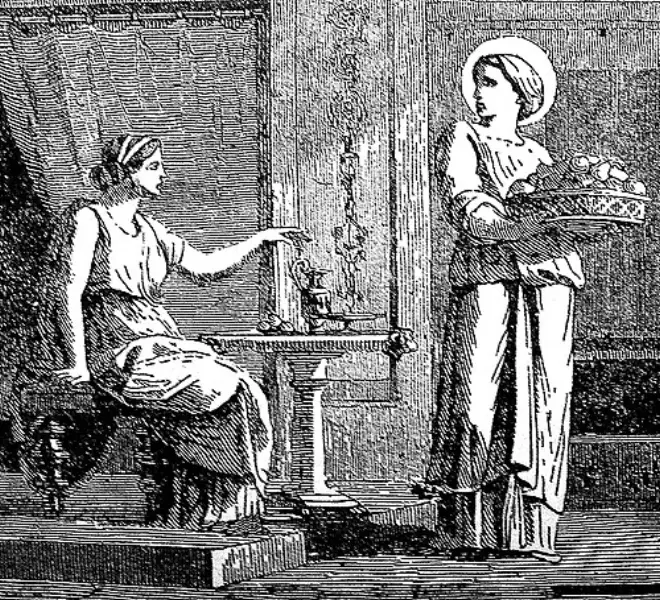
In Italy Serapia arranged her life around three deliberate choices. First she bound herself to Christ by a vow of chastity, consecrating her whole person to God. Then she divested herself: whatever property she possessed she sold, and the proceeds she distributed among the poor, choosing evangelical poverty in a world that prized a slave's earnings for their master. Finally she entered the service of Sabina, a wealthy Roman widow, and took up the duties of her household as a field for holiness. Her quiet fidelity had an effect no preaching could have achieved: Sabina herself embraced the Christian faith through the example of her servant. Together the two women withdrew with a small company of devout friends to one of the widow's country seats near Vendina in Umbria, where the household gave itself to devotion and works of charity. A runaway from persecution had become the spiritual mother of a Roman patrician, and the two women's lives were now so entwined that neither martyrdom nor the centuries would separate their names.
§ Saint Serapia
Trial and Martyrdom
Under Hadrian the persecution reached Serapia in her Umbrian retreat. Hauled before the authorities, she was commanded to offer homage to the gods of Rome, the ritual act that would have dissolved every accusation. She refused. Enraged, her accusers handed her over to two men with orders to defile her, but both assailants collapsed unconscious before they could touch her. The governor, refusing to see the hand of God in the deliverance, ascribed it to sorcery, and the tortures turned physical: her executioners strove to burn her alive with torches. At the order of the judge Virilis she was finally beaten with rods and put to the sword by beheading, dying around the year 119. The sequence of her passion — the refusal, the failed assault, the attempted burning, the rods and the blade — became one of the classic narratives of the virgin martyrs, retold in collections of the saints from the early modern Bollandist age onward. She had fled Hadrian's persecution once; the second time she did not run, and it was the second meeting that made her a martyr.
§ Saint Serapia
One Tomb, One Basilica, Two Saints
Sabina did for her servant what Serapia had once done for her soul: she took the martyr's body and buried it in her own family tomb, the resting place reserved for the mistress herself. Not long after, Sabina followed her in the same confession and the same fate, and the two women were honored side by side from the beginning. The great basilica of Saint Sabina on the Aventine Hill, built in the fifth century on the site of the widow's house, originally bore a dedication to both saints together — a rare public memorial of the bond between a Roman lady and her Syrian slave, who entered heaven as equals. In art Serapia is shown holding a tablet or book, the emblems of her wisdom, and she often stands beside Sabina. Her story seized the seventeenth-century imagination: for Philip IV of Spain, about 1639, Claude Lorrain composed his Landscape with the Burial of St Serapia, a canvas that now counts among the treasures of the Museo del Prado. Her feast of July 29 is kept by Catholics and Orthodox alike.
§ In art
The Record
- Patron of
- patron of the Aventine basilica dedicated jointly with St. Sabina
- Symbols
- tablet·book·depicted alongside St. Sabina
- Canonization
- Pre-congregation; venerated as a martyr since antiquity in the Catholic and Orthodox Churches
Prayer
Bibliography
Show 5 sources
- Landscape with the Burial of St Serapia, Museo Nacional del Prado
- "Virgin Martyr Seraphima (Serapia) of Antioch", Orthodox Church in America
- Fell, Charles. "Saint Serapia", Lives of the Saints London. Thomas Meighan, 1729, p. 320
- Donnelly, Eleanor Cecilia. "Saint Serapia, Martyr". Short Lives of the Saints 1910. CatholicSaints.Info. 19 April 2021
- Lecanu, Auguste François (1865). Pictorial half hours with the saints. Transl.
Profile text adapted from the Wikipedia article, licensed CC BY-SA 4.0.
Pray with this saint every day
Save St. Serapia to your favorites, read the full profile, and get feast-day reminders in the Saints app.
Get the Saints AppFree on the App Store for iPhone and iPad