
c. 500 – c. 583·Feast July 1
St. Serf
Apostle of Orkney and Abbot of Culross
Overview
Serf, also called Serbán or Servanus, was a saint of Scotland whose memory is rooted above all in western Fife. Tradition remembers him as the apostle of Orkney, though the claim carries little historical weight, and as the founding father of the town of Culross. The legends that grew around him are extravagant: they make him a royal prince who reached the highest office in the Western Church before abandoning it for a life of mission among the Picts. Whatever the historical core, the picture the tradition preserves is of a monastic founder and spiritual father whose influence stretched across central Scotland, from an island in Loch Leven to the streets of Culross and the church at Dunning. He is bound by legend to the young Kentigern, whom he raised as a foster-son, and his death at Dunning, with his body carried to Culross for burial, forms the closing scene of his medieval Life. His feast is kept on 1 July, and his name remains one of the commonest dedications for churches in Fife, Edinburgh and the central belt.
The Complete Life
A Prince of Legend
The hagiographic tradition surrounding Serf is so extravagant that the modern scholar David Hugh Farmer dismissed it as a farrago of impossibilities, yet it preserves the shape medieval Scotland gave to its apostle. In the legend Serf was the son of Eliud, a king of Canaan, and his wife Alphia, herself the daughter of an Arabian king. The royal couple was childless for many years before two sons were born to them, of whom Serf was the younger. Such parentage marked him out as a child of destiny in the manner of many early saints' lives, and the tale travels onward in the same heroic key. Carrying a reputation for sanctity already established, the young man made his way to Rome, where the story claims he was elected to the papacy and occupied the Holy See for seven years. However little of this can be trusted as history, the legend insists from the first that Serf belonged to the universal Church before he belonged to Scotland, and that his later mission among the Picts was the freely chosen second act of a man who had held the highest office Christendom could give.
§ Legends
The Call to Scotland
The legend moves Serf from Rome to the mission field through Gaul and Britain, after which he returned to Scotland and came into contact with Adomnán, abbot of Iona. The chronology is impossible as it stands, for Adomnán died in 704 and cannot have met a man who died in 583, and the same tradition would place Serf's activity in the late seventh century; the medieval compilers were weaving a saint of the first age of Scottish Christianity into the world of later Iona. But the encounter fixes the geography of his story. Adomnán showed him an island in Loch Leven, thereafter known as St Serf's Inch, lying within the Pictish kingdom of Fib, the later Fife. There Serf established a religious house and remained seven years, and the island became the first fixed point of his Scottish vocation. Centuries later the site carried a priory of Augustinian canons, founded from St Andrews Cathedral Priory at the initiative of King David I around 1150, and known from the fifteenth century as Portmoak, until the Reformation-era crown granted it to St Leonard's College in St Andrews.
§ Legends
Culross and the Dragon of Dunning
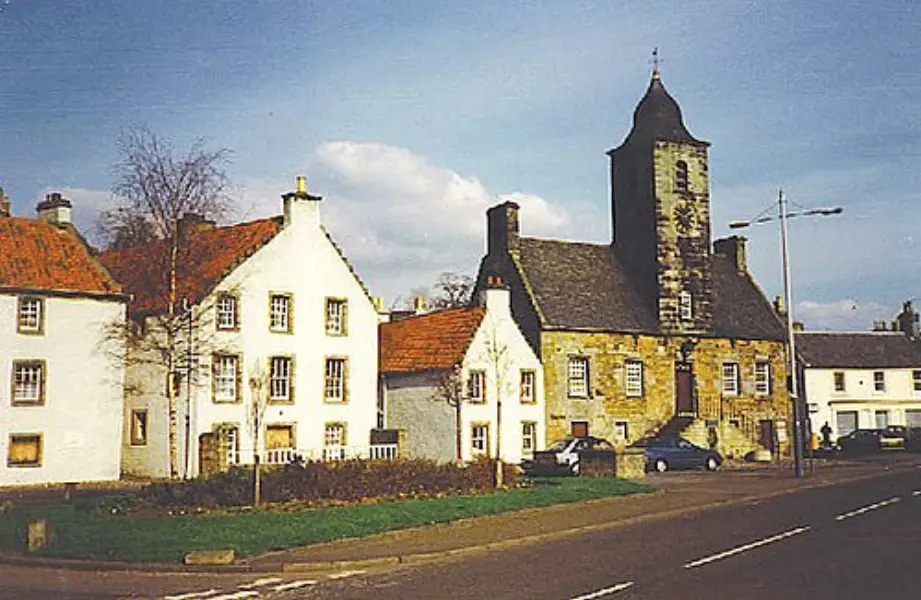
The true centre of Serf's ministry, and perhaps of his historical activity, was Culross, the town on the Firth of Forth that tradition says he founded. From that base his work radiated across central Scotland, and the density of churches bearing his name in Fife, Edinburgh and the surrounding country testifies to how deeply the dedication took root. The legend dresses the mission in marvels: the tradition tells how at Dunning, in Strathearn, his pastoral staff brought down a dragon, a story in the family of to the international family of saint-versus-serpent stories and marks the conversion of a pagan place. The same legendary cycle binds him to the future apostle of Glasgow. When Theneva, a British princess, was discovered to be pregnant before marriage and cast from a cliff by her kin, she survived, found an unmanned boat, and was carried across the Firth of Forth to land at Culross. Serf took her in, and when her son was born he became the boy's foster-father. The child was Kentigern, better known as Mungo, and under Serf's roof the legend places the making of Scotland's greatest missionary bishop, who as a boy even restored his master's pet robin to life after jealous classmates had killed it.
§ Serf and Mungo
Death at Dunning
The medieval Life closes Serf's story with unusual tenderness. After many miracles and divine virtues, and after founding many churches, the old man gathered the brethren, gave them his blessing of peace, and breathed his last in the cell at Dunning as the Kalends of July began, the very date his feast would keep. His followers and the provincial multitude then bore his body to Cuilenross, the Culross he had founded, and buried it honourably there amid psalms, hymns and canticles. The scene gives him two holy places in death as in life: the strathearn cell where he died and the Forth-side town that claimed his grave. Tradition settled on the traditional year 583 for his death, though the same tradition's entanglement with Adomnán makes the chronology uncertain, and some scholars would set his floruit a century later. What the death notice preserves is the picture of a spiritual father surrounded by a community of disciples and honoured by an entire province, whose removal was felt as a loss to be mourned in song and repaired by pilgrimage to his tomb.
§ Legends
An Ancient Cult
Serf belongs to the early saints whose recognition predates any formal process of canonization. He was never canonized by a pope; his status rests on the ancient and unbroken veneration of the Scottish church, which placed him among its apostles from an early date. He is honoured today in the Eastern Orthodox Church, the Roman Catholic Church and the Scottish Episcopal Church alike, a breadth of acceptance that reflects how deeply his memory entered Scottish piety. The keeping of his feast on 1 July aligns deliberately with the date his Life gives for his death at Dunning, so that the liturgy repeats each year the day the tradition fixed for his passing. Medieval Scotland counted him among its missionary founders, and the later Augustinian priory on his island in Loch Leven carried his name forward into the institutional church of the twelfth century. For a figure whose biography is woven of legend, this consent of the churches is the firmest fact about him: the communities of Fife and Strathearn kept his day, built on his name, and passed him on intact.
§ Saint Serf
Name on the Land
Serf's memory remains unusually visible in the landscape of central Scotland. Churches across Fife, Edinburgh and the central belt frequently bear his name, from the medieval foundations of the cult to an ordinary parish church on Shettleston Road in the east end of Glasgow, and schools in the area carry it as well. Culross still remembers him as its founder, and the chapel there is known both as St Mungo's and as St Serf's, preserving in a single building the legendary household of the foster-father and the foster-son. At Dunning in Strathearn, where the dragon fell and the saint died, the local church keeps the memory alive, and video footage of St Serf's church there continues to draw visitors to the site. On Loch Leven, St Serf's Inch preserves the very name of the island the abbot of Iona showed him, even though only a small amount of the priory's remains survive after the house passed from the Augustinians to St Leonard's College under James VI. Few early saints of Scotland left so dense a trail of place names, and through them the apostle of Orkney and father of Culross remains a present neighbour rather than an antiquarian memory.
§ Churches
Timeline
- 500
Born, according to the traditional dating, into the legendary royal family of the hagiographic tales
§ Saint Serf
- 1 Jul 583
Dies at Dunning on 1 July; his followers and the countryfolk of the whole district bear his remains to Culross for honourable burial
§ Legends
- 1150
King David I initiates the refoundation of the priory on St Serf's Inch as a house of Augustinian canons dependent on St Andrews Cathedral Priory
§ Legends
In Their Own Words
Finally, after many miracles, after divine virtues, after founding many churches, he yielded up his spirit in his cell at Dunning, on the first day of the Kalends of July; and his disciples and the people of the province take his body to Cuilenross, and there, with psalms and hymns and canticles, he was honourably buried.
The Record
- Major works
- Founding of the town of Culross·Monastic community on St Serf's Inch, Loch Leven
- Patron of
- Western Fife·The town of Culross
- Symbols
- Pastoral staff, with which he is said to have slain a dragon at Dunning·Pet robin restored to life by St Mungo
- Canonization
- Pre-congregation; venerated in the Roman Catholic, Eastern Orthodox and Scottish Episcopal Churches
Prayer
Bibliography
Show 4 sources
- Farmer, David Hugh (1978). The Oxford Dictionary of Saints. Clarendon Press. p. 354.
- Simon Taylor, "Seventh-century Iona Abbots in Scottish Places", in Dauvit Broun and Thomas Owen Clancy (eds), Spes Scotorum: Hope of Scots. Saint Columba, Iona and Scotland (Edinburgh: T & T Clark, 1999), p. 66.
- Wylie, J. D. History of the Scottish Nation, volume 3, chapter 17.
- Hunter-Blair, Oswald. "St. Kentigern." The Catholic Encyclopedia. Vol. 8. New York: Robert Appleton Company, 1910. Retrieved 6 May 2014.
Profile text adapted from the Wikipedia article, licensed CC BY-SA 4.0.
Pray with this saint every day
Save St. Serf to your favorites, read the full profile, and get feast-day reminders in the Saints app.
Get the Saints AppFree on the App Store for iPhone and iPad