
c. 250 - c. 447 (legend)·Feast July 27 (Roman Catholic); August 4 and October 22 (Eastern Christianity)
The Seven Sleepers of Ephesus
Legendary Martyrs of Ephesus, venerated in Christianity and Islam
Overview
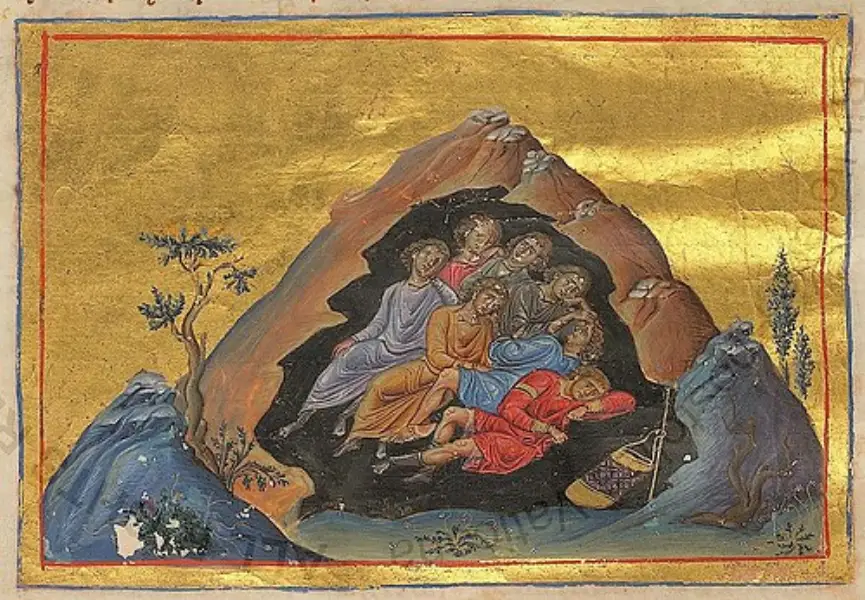
The Seven Sleepers of Ephesus are the young men of a late-antique legend honoured as saints by the Catholic, Eastern Orthodox and Oriental Orthodox Churches and remembered in Islam as the Aṣḥāb al-Kahf, the Companions of the Cave of the Qur'an's eighteenth sura. In the tale, seven youths accused of Christianity under the emperor Decius around the year 250 handed their possessions to the poor, withdrew to a mountain cave outside Ephesus to pray, and fell asleep; the emperor had the cave mouth sealed. Decius died in 251 and the empire turned Christian. When a landowner — usually placed under Theodosius II, about 447, though the Golden Legend sets the waking in 478 — broke open the cave to use it as a cattle pen, the sleepers woke believing a single day had passed, and one of their number went down to Ephesus for food, astonishing the city by trying to spend coins from a reign two centuries old. Questioned by the bishop, they told their story, praised God, and died. The legend spread through Syriac, Greek and Latin in over two hundred manuscripts, and bones identified as their relics reached Marseille in the era of the Crusades.
The Complete Life
The Legend
The Seven Sleepers of Ephesus are the young men of a late-antique legend honored as saints by the Catholic, Eastern Orthodox and Oriental Orthodox churches, and remembered in Islam as the Aṣḥāb al-Kahf, the Companions of the Cave of the Qur'an's eighteenth sura. In the tale, seven youths of Ephesus, accused of Christianity under the emperor Decius around the year 250, handed their possessions to the poor, withdrew to a mountain cave outside the city to pray, and fell asleep; the emperor had the cave mouth sealed. Decius died in 251, and the empire turned Christian. When a landowner — usually placed under Theodosius II about 447, though the Golden Legend sets the waking in 478 — broke open the cave to use it as a cattle pen, the sleepers woke believing a single day had passed. One of their number went down to Ephesus for food and astonished the city by trying to spend coins from a reign two centuries old. Questioned by the bishop, they told their story, praised God, and died.
§ Introduction
Spread and Cult
The legend appeared in several Syriac sources before the time of Gregory of Tours (538-594), and Jacob of Serugh (c. 450-521) wrote a verse homily on the sleepers; the pilgrim account De situ terrae sanctae (518-531) already records a church of the sleepers at Ephesus. Gregory's Glory of the Martyrs popularized the story in the West, and Jacobus de Voragine's Golden Legend (1259-1266) fixed the best-known Western version. The story spread through Syriac, Greek and Latin in over two hundred manuscripts, and entered the Qur'an as Sura 18, which tells of the youths of the cave and their dog — the most widely transmitted form of the legend on earth. Bones identified as relics of the sleepers were carried to the Abbey of Saint Victor at Marseille during the Crusades.
§ Origins and propagation
Legacy
The sleepers' cult is pre-congregation, venerated since at least the fifth century, with feasts on 27 July in the Roman calendar, 4 August and 22 October in the East. Their historicity is unhistorical — the tale is a religious romance of the delay of God's justice — and its value lies elsewhere: as a story of the resurrection, of the persecuted who sleep through their persecutors' empire, and as a rare story shared by the Qur'an and the martyrologies. Excavations near Ephesus in 1926-1928 uncovered hundreds of fifth- and sixth-century graves around the grotto, with inscriptions invoking the sleepers — the archaeological trace of a cult that was real even if its heroes were not.
§ Introduction
Timeline
- 250
During the persecutions of Decius, seven young men accused of Christianity give their goods to the poor and hide in a mountain cave, which the emperor orders sealed.
§ Christian story
- 251
Decius dies, and in the following years Christianity goes from persecuted faith to religion of the Roman Empire.
§ Christian story
- 401
The story appears in several Syriac sources; the earliest manuscript copy, MS Saint-Petersburg No. 4, dates to the fifth century.
§ Origins and propagation
- 447
A landowner opens the sealed cave, usually dated to the reign of Theodosius II; the sleepers wake, one buys food in Ephesus with old coins, and they die after telling the bishop their story.
§ Christian story
- 450
Jacob of Serugh (c. 450-521) writes a verse homily on the sleepers, relying on an earlier Greek source now lost.
§ Origins and propagation
- 478
The medieval Golden Legend assigns the awakening a precise date: the year 478, within the reign of Theodosius.
§ Dissemination in the West: story and relics
- 518
A Holy Land pilgrim's guide composed between 518 and 531 already mentions an Ephesus church honoring the sleepers.
§ Origins and propagation
- 594
By the end of his life (538-594), Gregory of Tours has popularized the story in the West through his late sixth-century Glory of the Martyrs.
§ Dissemination in the West: story and relics
- 801
The ninth-century Irish martyrology Félire Óengusso lists their commemoration under 7 August.
§ Origins and propagation
- 1259
Jacobus de Voragine's Golden Legend (1259-1266) fixes the best-known Western version
§ Origins and propagation
- 1926
Excavation of the grotto near Ephesus (1926-1928) uncovers hundreds of fifth- and sixth-century graves with inscriptions to the Seven Sleepers
§ Caves of the Seven Sleepers
The Record
- Symbols
- Cave·Sleeping youths (often with the dog of the Qur'anic version, Qitmir)
- Canonization
- Pre-congregation (ancient cult, venerated since at least the 5th century)
Bibliography
Show 12 sources
- 1 2 3 Fortescue, Adrian (1909). "Seven Sleepers of Ephesus" . In Herbermann, Charles (ed.). Catholic Encyclopedia . Vol. 5. New York: Robert Appleton Company.
- ↑ "Chapter 18" . Κοράνιον [ The Koran ] . Translated by Pentakis, Gerasimos I. (reprint ed.). Athens: Printing House of the Establishments of A. [Anestis] Konstantinidis (Τυπογραφείον των καταστημάτων Α. Κωνσταντινίδου). 1886. p. 210 . Retr
- 1 2 3 Archer, George (October 2016). "The Hellhound of the Qur'an: A Dog at the Gate of the Underworld". Journal of Qur'anic Studies . 18 (3). Edinburgh : Edinburgh University Press on behalf of the Centre for Islamic Studies at the School
- 1 2 3 4 5 6 7 8 9 "Cave of Ashabe Kahf (The Cave of the Seven Sleepers)" . Madain Project . Archived from the original on November 2, 2020 . Retrieved November 2, 2020 .
- 1 2 "Ορθόδοξος Συναξαριστής :: Άγιοι Επτά Παίδες εν Εφέσω" . www.saint.gr . Retrieved March 23, 2025 .
- 1 2 "The Seven Sleepers of Ephesus." In The Catholic Encyclopedia, Vol. 5. New York: Robert Appleton Company, 1909. Retrieved from https://www.newadvent.org/cathen/05496a.htm
- 1 2 3 4 5 6 7 8 Witold Witakowski, "Sleepers of Ephesus, Legend of the" , in Gorgias Encyclopedic Dictionary of the Syriac Heritage: Electronic Edition , edited by Sebastian P. Brock , Aaron M. Butts, George A. Kiraz and Lucas Van Rompay (G
- ↑ Pieter W. van der Horst (February 2011). Pious Long-Sleepers in Greek, Jewish, and Christian Antiquity (PDF) . The Thirteenth International Orion Symposium: Tradition, Transmission, and Transformation: From Second Temple Literature throug
- 1 2 3 4 Baring-Gould, S. (1876). "Curious myths of the Middle Ages" . London: Rivingtons – via Internet Archive.
- 1 2 3 4 5 Bartłomiej Grysa, "The Legend of the Seven Sleepers of Ephesus in Syriac and Arab Sources: A Comparative Study" , Orientalia Christiana Cracoviensia 2 (2010): 45–59.
- ↑ Liuzza, R. M. (2016). "The Future is a Foreign Country: The Legend of the Seven Sleepers and the Anglo–Saxon Sense of the Past". In Kears, Carl; Paz, James (eds.). Medieval Science Fiction . King's College London , Centre for Late Antique
- ↑ Peeters, P.; Société de Bollandistes (1910). Bibliotheca hagiographica orientalis . Robarts – University of Toronto. Bruxellis, apud editores [Beyrouth (Syrie) Imprimerie catholique]. pp. 1012– 1022.
Profile text adapted from the Wikipedia article, licensed CC BY-SA 4.0.
Pray with this saint every day
Save The Seven Sleepers of Ephesus to your favorites, read the full profile, and get feast-day reminders in the Saints app.
Get the Saints AppFree on the App Store for iPhone and iPad