
died c. 740·Feast July 31 (Orthodox Church); August 2 (Church of England)
St. Sidwell
Virgin Martyr and Patroness of Exeter
Overview
Sidwell, also called Sidwella and known in Latin as Sativola, was a virgin saint of the English county of Devon, honoured as the patroness of the city of Exeter. The legend places her among the Saxon Christians of the eighth century, the daughter of a wealthy landowner whose death left her exposed to a jealous stepmother. Her habit of leaving the city walls to bring food to labourers in the fields made her known to the countryside around Exeter, and it was on one of these journeys of charity that tradition says she met her death, beheaded by reapers her stepmother had hired to kill her. Where her head fell, a spring of water was said to have burst from the ground, and that well became a place of pilgrimage for centuries. Her cult flourished at Exeter from the earliest Saxon centuries, and by the year 1000 her shrine was already drawing pilgrims. She is remembered as the sister of Juthwara of Sherborne, and her story shares its pattern with other Cornish and Devonian virgin martyrs. Her feast is kept on 31 July in the Orthodox Church and 2 August in the Church of England, and her name is borne by one of the principal streets of Exeter.
The Complete Life
Daughter of Benna
The legend of Sidwell places her in the eighth century among the Saxon Christians of Exeter. Her father was Benna, a wealthy landowner of the district, and on his death the young woman passed into the care of a stepmother whose heart was set against her from the first. The tales say the older woman was consumed by jealousy of her stepdaughter's beauty and virtue, and by greed for the inheritance she controlled; from that poisonous combination came the plot that would end her life. Sidwell herself appears in the story as a devout virgin who did not withdraw from the world but served it. She often left the city, passing out through the walls to carry food to the villagers labouring in the fields beyond, so that the working countryside around Exeter came to know her face and her kindness. Medieval readers would have recognised the pattern at once: the innocent daughter exposed to a hostile household, like the saints Juthwara of Sherborne, her supposed sister, and Urith, whose stories run along the same lines of family treachery and miraculous witness. In Sidwell's case the domestic cruelty of the legend is anchored to a real landscape of fields, wells and city gates.
§ Legend
A Life of Quiet Service
Sidwell's holiness, as the tradition tells it, was exercised not in a cloister but on the roads outside Exeter's gates. She was a Saxon Christian of the city, unmarried and consecrated to God in the manner of the virgin saints of the West Country, and her particular work was the corporal mercy of feeding the poor. The villagers who worked the fields beyond the walls could not easily come into the city, and so she went out to them, bringing food in her own hands. This habitual charity is what the legend places on the day of her death: she was on one of these rounds of mercy, beyond the city walls, when the reapers found her. Later devotion fixed the instruments and signs of her witness with memorable precision. The Catalogus Sanctorum Pausantium in Anglia tells how two reapers, hired hands engaged by her stepmother, beheaded her with a harvest scythe, the tool that became her emblem in art. The cruelty of the deed was answered, in the tale, by three signs: water springing up where her head came to rest, a shaft of light shining over the site for three nights, and a well that would draw pilgrims for a thousand years.
§ Legend
Martyrdom Beyond the Walls
The tradition dates Sidwell's death to about 740 and sets it outside the east side of Exeter, in the fields where she had so often gone to feed the workers. The reapers her stepmother had hired did their work with a scythe, and the virgin fell in the place of her charity. The legend does not leave her there: her apparition was said to walk abroad with the severed head in her hands, setting it back where it belonged at the place of her burial, an image common to the decapitated virgin martyrs of the Celtic and Saxon West and shared with her sister Juthwara and with Urith of Chittlehampton. Her body was laid to rest at the place known as St Sidwells, just beyond the gate, and the spring that had broken from the ground where her head fell became the Well of St Sidwell, at what is now the junction of Well Street with York Road. The waters themselves were older than her cult, having been tapped since Roman times and piped by wooden aqueducts to supply the city's citadel; her martyrdom consecrated them, and the well at her tomb became the sign by which later generations found her.
§ Legend
An Ancient Cult at Exeter
Sidwell was never subject to a formal process of canonization; she belongs to the saints of the undivided early English church whose recognition rests on popular devotion. The cultus at Exeter has been active from Anglo-Saxon times, and by the year 1000 pilgrims were visiting her shrine in numbers worth recording. The traffic continued into the later middle ages: both John Leland and William Worcester mention the activity of pilgrims at her shrine, evidence that her cult was a living part of the city's religious life into the fifteenth century. Her feast is assigned differently by different calendars: to 31 July, to 1 August, or to 2 August, a cluster of dates belonging to the Lammas season that her attributes preserve; the Orthodox Church keeps 31 July and the Church of England 2 August. She is venerated today in the Roman Catholic Church, the Orthodox Church and the Anglican Communion, a threefold remembrance fitting for a saint whose martyrdom long predates the divisions of the sixteenth century. The survival of her cult through the Reformation, and the rebuilding of her church after the bombing of the Second World War, mark her as one of those local saints whom a city refuses to surrender.
§ Veneration
The Saint in the City
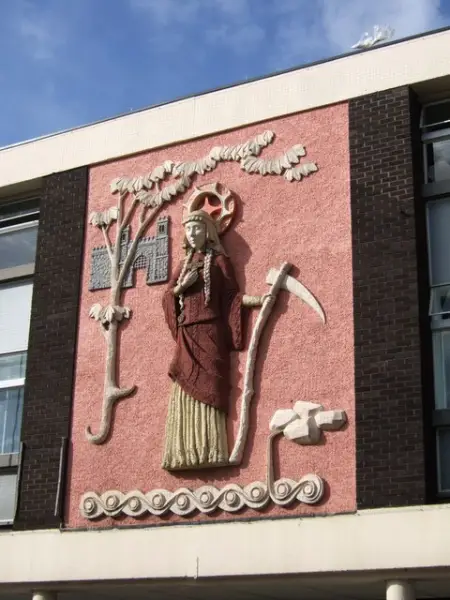
Sidwell's presence in Exeter is written into its streets and buildings. St Sidwells, formerly a village outside the east gate and now part of the city, bears her name, and one of Exeter's main streets is Sidwell Street. The Church of St Sidwell, standing just outside the site of the east gate, survives today, though substantially reconstructed after a German bomb fell upon it in the early hours of 4 May 1942, leaving the tower standing but so damaged that it had to be pulled down; a replacement church now occupies the site. The scythe and the well accompany her figure in art. She appears in stained glass in Exeter Cathedral, in the chapel of All Souls College in Oxford, and in the parish church of Ashton in Devon, and her image appears on no fewer than seven painted rood screens across the county. A statue of her stands in the Sacred Heart Church in South Street, and the fibreglass relief by the Bideford artist Fred Irving, created in 1969 on a shopping arcade in Sidwell Street, carries her image into the ordinary commerce of the city. Her cult also crossed the Tamar: a church at Laneast in Cornwall is dedicated to her, and there, too, a holy well keeps her memory.
§ Iconography
Timeline
- 740
Beheaded, according to the traditional dating, by corn reapers hired by her stepmother outside the walls of Exeter
§ Legend
- 1000
Pilgrims are recorded visiting her shrine at Exeter by this date, attesting an already established cultus
§ Veneration
- 4 May 1942
A German bomb falls directly on the church of St Sidwell outside Exeter's east gate, leaving the tower so badly damaged it must be pulled down
§ Veneration
- 1969
Bideford artist Fred Irving creates the fibreglass relief of the saint on a shopping arcade in Sidwell Street, Exeter
§ Iconography
The Record
- Major works
- The Well of St Sidwell at Exeter, a centre of pilgrimage in Anglo-Saxon and Norman England
- Patron of
- Exeter, of which she is patroness saint
- Symbols
- Scythe·Holy Well·Lammas
- Canonization
- Pre-congregation; cultus active at Exeter from Anglo-Saxon times
Prayer
Bibliography
Show 7 sources
- "Sidwella", St. Sidwells Heritage Hub.
- "Saint Sidwell", The Saints of Great Britain and Ireland.
- Orme, Nicholas. "Sidwell (Sativola)", The Saints of Cornwall, OUP Oxford, 2000, p. 234. ISBN 9780191542893.
- Monks of Ramsgate. "Sidwell". Book of Saints, 1921. CatholicSaints.Info, 1 August 2016.
- "St Sidwell martyred outside city walls", Telling Our Stories, Devon Development Education.
- "St Sidwell's Church, Sidwell Street", Exeter Memories, 13 September 2009.
- Förster, Max. "Die heilige Sativola oder Sidwell." Anglia 62 (1938): 33–80.
Profile text adapted from the Wikipedia article, licensed CC BY-SA 4.0.
Pray with this saint every day
Save St. Sidwell to your favorites, read the full profile, and get feast-day reminders in the Saints app.
Get the Saints AppFree on the App Store for iPhone and iPad