
possibly martyred c. 311·Feast July 30
St. Silvan
Martyr Venerated in Dubrovnik
Overview
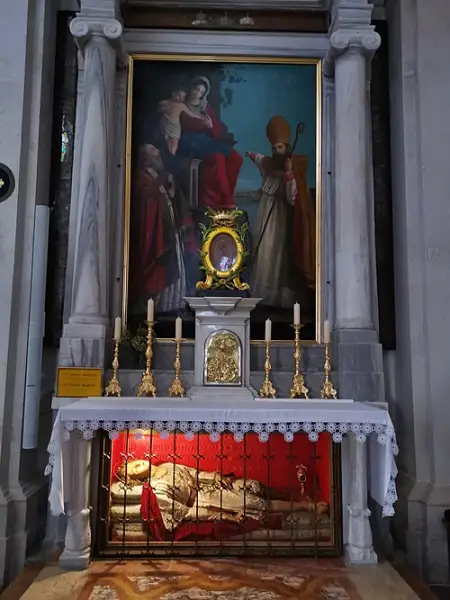
Saint Silvan was a Christian martyr, possibly of the fourth century, whose relics rest in the Church of St Blaise in Dubrovnik, where they have been enshrined since the middle of the nineteenth century. Of the man himself very little is known. He is commemorated on 30 July. The wax figure that encloses his relics shows a young man whose garment carries a cross worked in embroidery at the breast, indicating that he was a priest, and perhaps a cleric of still higher rank. A visible wound on the neck of the figure points to beheading as the manner of his death. Many saints of this name were honoured in the early church, and it remains uncertain which of them lies at Dubrovnik; the most common identification is with Saint Silvanus, Bishop of Emesa in Phoenicia, who was put to death around 311. Other bearers of the name died by other means, at ages that do not fit the figure, or are believed to lie elsewhere. Whatever the truth of his identity, the martyr at Dubrovnik has been honoured there for more than a century and a half, presented to pilgrims in one of the most striking relic ensembles on the Dalmatian coast.
The Complete Life
A Martyr of the Early Church
Silvan belongs to the martyrs of the church's first great age of persecution, honoured from the beginning without any formal process of canonization. He is commemorated liturgically on 30 July, the date by which his memory is kept at Dubrovnik. The church honours a considerable number of saints of this name, and the tradition itself acknowledges the difficulty: several were put to death in different ways, some thrown from cliffs, others dying natural deaths at ages that cannot fit the young man shown in the Dubrovnik effigy, and still others are believed to be buried in other places altogether. The identification most often given is that the relics belong to Saint Silvanus, Bishop of Emesa in Phoenicia, who suffered around the year 311, in the last great persecution before Constantine. A gruesome wound on the neck of the figure is read as evidence of the manner of his death, and the embroidered cross on his garment marks him as a priest or possibly a higher-ranking cleric, consistent with a bishop. Certainty is not to be had, and the devotion of the church does not depend on it: the martyr is honoured as one of those who sealed their faith with blood in the age of the persecutors.
§ Identification
The Relics at Dubrovnik
The visible legacy of St Silvan is enshrined in the Church of St Blaise, the patronal church of Dubrovnik, where his relics have rested since the middle of the nineteenth century. According to the account of the nineteenth-century traveller William Frederick Wingfield, the skeleton of St Silvanus was given to the city of Dubrovnik by Pope Pius IX together with a wax figure. The figure is remarkable among the relic ensembles of Catholic Europe: it clothes its subject in vestments marked at the breast with a cross in needlework, while at the neck a wound is visible that tells the story of his death to every visitor. Within the church of Dubrovnik's patron, the martyr lies among the treasures of a republic that guarded its relics as it guarded its liberty. For pilgrims to the Dalmatian coast he is one of the memorable sights of the city, a saint whose face can be seen though his history cannot be fully told. The little that is written about him has been preserved chiefly by travellers' accounts, and his commemoration on 30 July keeps his name alive in the calendar where his biography cannot.
§ Description
Timeline
- 311
By the most common identification, Silvanus, Bishop of Emesa, is martyred around this date, apparently by a wound to the neck
§ Identification
- 1859
William Frederick Wingfield publishes his travel account recording that the skeleton of St Silvanus, with a wax figure, was given to Dubrovnik by Pope Pius IX
§ Description
The Record
- Symbols
- Wax effigy of a young cleric with an embroidered cross·Wound on the neck, sign of martyrdom
- Canonization
- Pre-congregation; ancient martyr cult, with relics enshrined at Dubrovnik
Prayer
Bibliography
Show 2 sources
- "Značenje imena Silvan". www.znacenje-imena.com. Značenje-Imena.com.
- Wingfield, William Frederick (1859). A Tour in Dalmatia, Albania and Montenegro: With an Historical Sketch of the Republic of Ragusa from the Earliest Times Down to Its Final Fall. R. Bentley. p. 106. Retrieved 19 February 2024.
Profile text adapted from the Wikipedia article, licensed CC BY-SA 4.0.
Pray with this saint every day
Save St. Silvan to your favorites, read the full profile, and get feast-day reminders in the Saints app.
Get the Saints AppFree on the App Store for iPhone and iPad