
c. 515 – c. 592·Feast November 3
St. Silvia
Mother of Gregory the Great
Overview
Silvia, or Sylvia, was the mother of Pope Gregory the Great and a Roman matron honoured as a saint in her own right. Born around 515, either in Sicily or at Rome, she belonged to a distinguished family and married Gordianus, a Roman regionarius of the gens Anicia. The couple lived in a house on the Clivus Scauri and raised two sons, the elder being Gregory, the future pope, and the second whose name has not survived. Her piety was celebrated, and the schooling she secured for her sons was of the best; the greatness of Gregory owes more to that household than the meagre records allow us to measure. Widowed around 573, she withdrew from the world to a cell by the gate of the basilica of Saint Paul, while still supplying her son's monastic house with vegetables from her own garden. The Romans honoured her as the very type of the Christian widow, and her veneration is of early date. She died around 592, and Pope Clement VIII entered her name in the Roman Martyrology at 3 November. Expectant mothers pray to her for a safe delivery, and her sister-in-laws Trasilla and Emiliana are venerated with her as saints.
The Complete Life
A Matron of the Anicii
Silvia was born around 515, and even her native place is divided between the traditions: some sources give Sicily, others Rome. What the records agree upon is her standing. She belonged to a distinguished family, and her marriage joined her to the highest aristocracy of the city, for her husband Gordianus was a Roman regionarius of the gens Anicia, the great house that had produced emperors, consuls and bishops of the aging Roman world. The family home stood on the Clivus Scauri, on the slope of the Aventine, in the Rome of the last decades of the sixth century, a city passing from ancient to medieval life under the shadow of wars and of the bishops who increasingly governed it. There Silvia bore two sons. The elder was Gregory, whose pontificate would give the Latin church its liturgy, its missions and many of its moral teaching; the younger is a shadow, remembered only in the statement that he existed and that his name did not survive through the ages. Around her, piety ran in the family: her sisters-in-law Trasilla and Emiliana are venerated as saints, and a third, Gordiana, and her husband Gordianus himself were honoured in the same devotion.
§ Life
Wife and Mother
Silvia's first vocation was marriage and motherhood, and she fulfilled it in a manner the sources single out for praise. Her piety drew the admiring notice of all who knew the household, and the education she arranged for her sons was an achievement in a Rome battered by the Gothic War, in which schools, books and teachers had become rarities. From her Gregory received the formation that would make him first a magistrate of the city, then a monk, and finally one of the most consequential popes in history; the moral seriousness and the administrative habit of the great pope had their first school at home. The family's Christian character was reinforced by the wider circle of the household, in which three sisters-in-law and the husband himself came to be honoured among the blessed. When Gregory, as pope, caused a mosaic likeness of his parents to be made for the monastery of Saint Andrew, and in doing so bore public witness to what he owed to them; the description of that portrait by Johannes Diaconus preserves the only image of Silvia that the middle ages possessed. Her motherhood was not a prelude to her sanctity but its first and largest field: the woman who taught the teacher of the English mission taught him by the ordinary faithfulness of a Roman Christian home.
§ Life
The Widow's Cell
Around 573 Gordianus died, and Silvia's life took the form by which the Romans remembered her. Instead of returning to her family or remaining mistress of the house on the Clivus Scauri, she withdrew to a place of religious dedication described in the sources by a Latin phrase, the cella nova beside the gate of blessed Paul, a modest dwelling by the gate of the basilica of Saint Paul-outside-the-Walls, where she devoted herself wholly to the service of God. The move made her a living figure of the Christian widow, the state the apostolic writings had long honoured as a rank of its own within the church, and the faithful of Rome treated her precisely as that type: a matron of the great world who had counted everything loss for the life of prayer. Yet her withdrawal was not a cutting of ties. She continued to provide her son Gregory's monastic house with vegetables from her own garden, a domestic charity that has charmed every generation that has read of it, and which preserves in a single detail the reality of her spirituality: fasting and prayer, charity to monks, work done with her own hands, and a mother's care that survived her change of state.
§ Life
Last Years and Death
The dates of Silvia's last years fall within the earliest and strangest months of her son's pontificate. Gregory was elected pope in 590, in a Rome devastated by flood and plague, and Silvia died around 592, while that pontificate was still young. She did not live to see the maturity of the work for which her son is remembered, the conversion of the English, the reform of the liturgy, the administration that made the Roman see a power in the West; she had seen instead the monk she raised dragged from his cloister to the altar, as he himself lamented. In death she was near him still: her house on the Aventine remained in the family's religious orbit, and her memory was kept where she had lived. Gregory honoured his parents with a mosaic portrait executed at the monastery of Saint Andrew, where he himself had founded a community, and the minutely detailed description of it by Johannes Diaconus is the devotion of a son fixed in glass and stone. Through that image, and through the chapel and oratory that later arose in her honour on the Coelian, the last years of the widow were woven permanently into the sacred topography of Rome.
§ Life
Veneration
The veneration of Silvia is of early date, arising among the Romans who had known her and who honoured her as the very model of a Christian widow. Her cult was never submitted to the modern processes of canonization; she belongs to the saints recognised by the continuous devotion of the church. In the ordinary form of her commemoration her name was formally inserted under 3 November in the Roman Martyrology by Pope Clement VIII, whose pontificate ran from 1592 to 1605, an act that fixed her feast in the liturgical books of the Roman church. She is venerated in both the Roman Catholic Church and the Eastern Orthodox Church, which share her memory across the divide of the east and west. Among her people her intercession found a particular sphere: expectant mothers call upon her when delivery draws near, a fitting patronage for the mother of a great son and for a saint honoured in her motherhood as much as in her widowhood. The family sanctity that surrounded her was itself part of the devotion, for her sisters-in-law Trasilla and Emiliana are venerated as saints, and with Gordiana and her husband Gordianus they form a household in which holiness became a family inheritance.
§ Veneration
Chapels and Memory in Rome
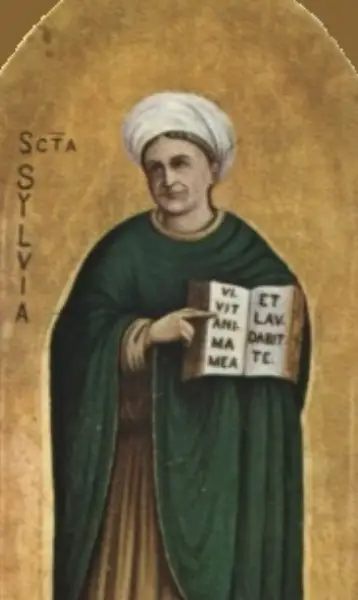
Silvia's memory is fixed in the stones of Rome. The house in which she had built a chapel, on the Aventine, became in 645 the dwelling of monks of Mar Saba in Palestine, who took up residence there and consecrated the house to the cult of Saint Sabas, so that the walls she had hallowed passed directly into the monastic history of the city. On the Coelian hill, in the church of San Gregorio Magno al Celio, raised on the site of her son's own monastery, there stands a chapel dedicated to Santa Silvia, alongside the oratory that bears her name, and there the mother is honoured within the complex that memorialises the son. Her feast on 3 November keeps her in the calendar of the universal church, while her patronage of pregnant women carries her into the most intimate hopes of Christian families. Art has remembered her with a curious fidelity to her son's testimony: altar painters have given her blue eyes, one tradition insists, correcting the dark eyes of conventional figures, because the mosaic described by Johannes Diaconus preserved the true colours of Gregory's mother. Few mothers of the great have been so honoured by the church they quietly formed.
§ Veneration
Timeline
- 515
Born, according to the traditional dating, in Rome or possibly Sicily
§ Saint Silvia
- 573
Left a widow by the death of her husband Gordianus, she withdraws to a religious life in a cell by the gate of Saint Paul's
§ Life
- 592
Dies at Rome, in or shortly before the first pontificate year of her son Gregory the Great
§ Saint Silvia
- 645
Monks from the monastery of Mar Saba in Palestine settle in her former house on the Aventine and devote it to the celebration of Saint Sabas
§ Veneration
- 1592
Pope Clement VIII, whose pontificate ran from 1592 to 1605, enters her name in the Roman Martyrology at 3 November
§ Veneration
The Record
- Major works
- Chapel built in her house on the Aventine
- Patron of
- Pregnant women, invoked for a safe delivery
- Canonization
- Pre-congregation; name inserted in the Roman Martyrology under 3 November by Pope Clement VIII
Prayer
Bibliography
Show 5 sources
- "03.11: Memoria di Santa Silvia Madre di s. Gregorio Magno (verso il 572 a Roma o tra il 590 e il 592)". www.ortodossia.it. Retrieved 2021-08-13.
- Pope Benedict XVI. Great Christian Thinkers, Fortress Press, 2011, p. 141. ISBN 9780800698515.
- Löffler, Klemens (1912). "St. Silvia". In Herbermann, Charles (ed.). Catholic Encyclopedia. Vol. 13. New York: Robert Appleton Company.
- Pettiti, Gianpiero. "Santa Silvia", Santi e Beati (in Italian).
- "Oratorio di Santa Silvia al Celio", Turismo Roma.
Profile text adapted from the Wikipedia article, licensed CC BY-SA 4.0.
Pray with this saint every day
Save St. Silvia to your favorites, read the full profile, and get feast-day reminders in the Saints app.
Get the Saints AppFree on the App Store for iPhone and iPad