
1814-1866·Feast March 7 (also venerated with the 103 Korean Martyrs on September 20)
St. Siméon-François Berneux
Bishop, Apostolic Vicar of Korea, and Martyr
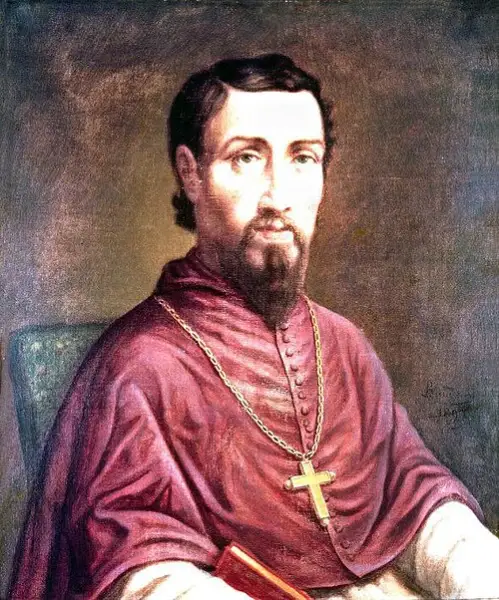
Overview
Siméon-François Berneux was born at Château-du-Loir in 1814, on 14 May, and at seventeen entered the seminary of the Paris Foreign Missions Society, completing his studies at Le Mans. Ordained on 20 May 1837, he taught theology at the Missions seminary before sailing from Le Havre in February 1840 on the long route to the Far East: Java, Manila, and Macau, and then Tonkin in January 1841, where he was promptly imprisoned and marched to Hue for trial. Convicted of proselytism in 1842 and sentenced to death, he saw the sentence suspended and walked free in March 1843; on the voyage home he obtained leave at Reunion to turn back, and was sent instead to Manchuria, reaching the Liaodong Peninsula in March 1844. In December 1854 he was consecrated bishop with the title of Capsus to govern Korea as its Apostolic Vicar, and in 1856 he slipped into that country by Chinese junk, landing near Seoul to live and work in hiding. The great purge of 1866 found him. Arrested and interrogated repeatedly under torture through February, he was condemned and beheaded at Saenamteo outside Seoul on 8 March 1866. His death helped trigger the French punitive expedition of that year, which only hardened Korea's isolation. His relics were carried to Berlin in 2001.
The Complete Life
Early Life
Château-du-Loir, in France, was Berneux's birthplace, and the date 14 May 1814 — the year of the Bourbon restoration, into that rural Catholic France which for generations stocked the Paris Foreign Missions. The Missions' seminary received him at seventeen in 1831, his studies being completed at Le Mans. Ordained on 20 May 1837, he was named in October 1838 to teach theology to the seminarians who would follow him east.
§ Biography
Conversion and Vocation
Berneux left the classroom for the mission field in 1840. Sailing from Le Havre on 12 February, he reached Anyer in Java on 31 May, spent the summer in Manila, and continued to Macau; in January 1841 he sailed for Tonkin. His first taste of missionary life was a prison. In Vietnam he was arrested and marched inland to Huế for trial, arriving on 28 May 1841; in 1842 the court found him guilty of proselytism and condemned him to die, a sentence indefinitely postponed. Released on 12 March 1843, he set out for France — and at the Isle of Bourbon (Réunion) received permission to turn back. Appointed to begin missions in Manchuria, he arrived on the Liaodong Peninsula on 15 March 1844, and worked there for a decade.
§ Biography
Mission and Ministry
Consecration to the episcopate came in December 1854 — titular bishop of Capsus, vicar apostolic of Korea — in succession to Jean-Joseph-Jean-Baptiste Ferréol, who had labored in Korea from 1845 until death ended his charge in 1853. Of all the society's fields Korea was the harshest: a sealed kingdom where the faith had grown up lay-led and outlawed, and where earlier vicars had already laid down their lives. From Shanghai in January 1856 Berneux sailed by Chinese junk, made Korean waters on 15 March, transferred on Good Friday to a boat belonging to local Christians, and was put ashore near Seoul. He and his party entered the city on foot and were led straight to the lodgings of Marie-Nicolas-Antoine Daveluy, the French priest already at work there. A residence established inside Seoul, Berneux spent the next decade as pastor of a church in hiding — governing thousands of secret Catholics, guiding the first Korean priests as they were ordained, and holding the clandestine connection to Europe open.
§ Biography
Trial and Final Years
The great purge of 1866 found him. Berneux was arrested and tried; through February he was interrogated repeatedly under torture, sentenced to death, and executed by decapitation at Saenamteo outside Seoul on 8 March 1866. Daveluy then took over as vicar apostolic, surviving only a few weeks before he too was executed on 30 March. The killing of Berneux and his fellow missionaries stirred the French to send their punitive expedition against Korea that year — an expedition that failed in its objects and only reinforced the kingdom's policy of isolation.
§ Biography
Canonization
Theologians approved his spiritual writings in May 1914, and the cause itself was formally inaugurated on 13 November 1918, with the style Servant of God. Paul VI beatified him on 6 October 1968; John Paul II, at Seoul on 6 May 1984, numbered him among the 103 Korean Martyrs at their canonization. His own feast is 7 March, the collective one 20 September.
§ Canonization
Legacy
What Berneux left behind was a church kept alive at its most fragile — the bishop who maintained a hidden Catholic people in communion with the wider Church across a hermetically sealed border. Berlin received his relics in 2001, and they rest at the Institut St. Philipp Neri in that city; Stefaan Lcleir's 2000 biography, the standard study, shows how live the European memory of the Korea mission has remained. In the calendar of the 103 he stands with Daveluy and the rest of the clergy of 1866, whose deaths closed the last and bloodiest of the Joseon persecutions.
§ Canonization
Timeline
- 14 May 1814
Born at Château-du-Loir in France
§ Biography
- 1831
Enters the Seminary of Foreign Missions in Paris at the age of seventeen
§ Biography
- 1833
Moves to the Seminary of Le Mans to complete his studies
§ Biography
- 20 May 1837
Ordained a priest
§ Biography
- Oct 1838
Appointed Professor of Theology at the Foreign Missions Seminary
§ Biography
- 12 Feb 1840
Departs Le Havre for Asia, reaching Anyer in Java on 31 May and continuing via Manila to Macau
§ Biography
- Jan 1841
Sails from Macau to Tonkin, where he is imprisoned and taken for trial
§ Biography
- 28 May 1841
Arrives at Huế to stand trial for his missionary work
§ Biography
- 1842
Found guilty of spreading the faith by a Vietnamese court, he is condemned to die, though the sentence is soon suspended
§ Biography
- 12 Mar 1843
Released from prison and sets sail for France, later obtaining permission to return to the missions
§ Biography
- 15 Mar 1844
Arrives on the Liaodong Peninsula to begin missions in Manchuria
§ Biography
- 27 Dec 1854
Consecrated bishop as titular bishop of Capsus and appointed Apostolic Vicar of Korea
§ Biography
- Jan 1856
Sails from Shanghai for Korea on a Chinese ship, reaching Korean waters on 15 March
§ Biography
- Feb 1866
Arrested and repeatedly interrogated under torture, then sentenced to death
§ Biography
- 8 Mar 1866
Executed by decapitation at Saenamteo outside Seoul
§ Biography
- 13 May 1914
Theologians approve his spiritual writings, advancing his cause
§ Canonization
- 13 Nov 1918
His cause is formally opened, granting him the title Servant of God
§ Canonization
- 6 Oct 1968
Beatified by Pope Paul VI
§ Canonization
- 6 May 1984
Canonized by Pope John Paul II among the Korean Martyrs
§ Canonization
- 2001
His relics are brought to Berlin, where they are held at the Institut St. Philipp Neri
§ Canonization
The Record
- Canonization
- Beatified by Pope Paul VI on 6 October 1968; canonized by Pope John Paul II on 6 May 1984
Prayer
Bibliography
Show 5 sources
- ↑ Pratt, Keith; Rutt, Richard (December 16, 2013). Korea: A Historical and Cultural Dictionary . Routledge. p. 35. ISBN 9781136794001 . Retrieved 17 August 2015 .
- ↑ "Bishop St. Siméon-François Berneux [ Catholic-Hierarchy ] " .
- ↑ Index ac status causarum beatificationis servorum dei et canonizationis beatorum (in Latin). Typis polyglottis vaticanis. January 1953. p. 80.
- ↑ "Saint Siméon-François Berneux" . CatholicSaints.Info . 7 March 2010 . Retrieved 18 August 2015 .
- ↑ "Roman Martyrology" (in Italian). The Vatican .
Profile text adapted from the Wikipedia article, licensed CC BY-SA 4.0.
Pray with this saint every day
Save St. Siméon-François Berneux to your favorites, read the full profile, and get feast-day reminders in the Saints app.
Get the Saints AppFree on the App Store for iPhone and iPad