
13th century·Feast May 16
St. Simon Stock
Carmelite Priest and Prior General
Overview
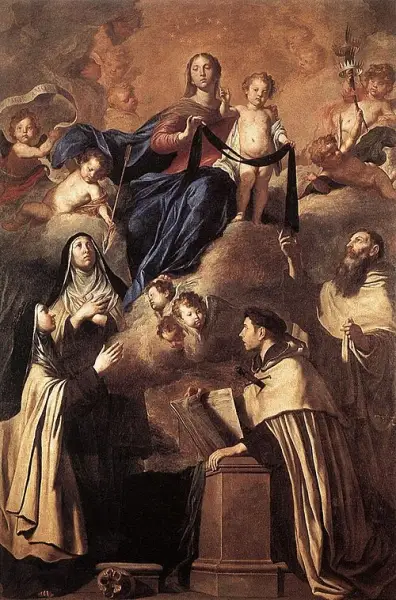
Simon Stock was an English Carmelite of the thirteenth century and an early prior general of the order. The Carmelites had begun as hermits on Mount Carmel in Palestine; when the Crusader kingdoms fell and Muslim rule returned, the brothers moved to Europe early in the 1200s and became mendicant friars, and it was in this transition that Simon's name appears — he was perhaps elected prior general at a London chapter in 1254. Hard facts about him are scarce: two fourteenth-century necrologies witness both to his reputation for holiness and to a pilgrimage he made to Jerusalem, and Aylesford in Kent, the site of the first Carmelite general chapter held outside the Holy Land in 1247, is believed to have been his home and where a priory still keeps his cranium as a relic. There is no medieval evidence for the popular legend that he lived as a hermit in a hollow tree. His fame rests on the Brown Scapular: tradition holds that on 16 July 1251 the Virgin Mary appeared to him holding the scapular and promised that whoever died clothed in it would not suffer the fires of hell. The earliest surviving account of that vision, however, dates only from the late fourteenth century, and a detailed 'letter of Peter Swanington' produced to defend the story in the seventeenth century is recognized as a fabrication. The devotion itself, which the Carmelites began extending to lay people in the sixteenth century, remains widespread and is recommended by the Church.
The Complete Life
Early Life
Simon Stock was an English Carmelite of the thirteenth century, and the honest first fact about him is that the record is thin. He is believed to have been born around 1165, possibly at Aylesford in Kent, though even that rests on later tradition rather than contemporary documents. What the evidence supports is this much: the Carmelite brothers — formally the Brothers of the Blessed Virgin — began as hermits on Mount Carmel in Palestine; when the Crusader kingdoms fell and Muslim rule returned, the brothers moved to Europe in the early thirteenth century and became mendicant friars; and into that transition, in England, fits the figure of Simon. Aylesford hosted the first Carmelite general chapter held outside the Holy Land in 1247, and Simon is believed to have lived there. The popular legend that he spent years as a hermit living in a hollow tree has no medieval evidence behind it, and the Carmelites themselves have long declined to defend it.
§ Life
Vocation
Simon's vocation, as far as it can be seen, was the vocation of a transitional moment in religious history. The Carmelites arrived in Europe as hermits — Palestinian solitaries with a rule from Albert of Jerusalem — and had to remake themselves, within a generation, as one of the mendicant orders of the towns, alongside the Franciscans and Dominicans whose success defined the age. Men like Simon were the ones who effected that transformation: accepting constitutions, adopting the mixed life of the friars, and holding the old contemplative identity inside the new structures. He was perhaps elected prior general of the order at a London chapter in 1254, and two fourteenth-century necrologies — the near-contemporary witnesses to his existence — attest both to his reputation for holiness and to a pilgrimage he made to Jerusalem, a telling detail for a Carmelite, whose order's heart remained the mountain it had left.
§ Life
Mission and Ministry
As prior general in the order's critical decades, Simon's ministry was government and consolidation: the securing of houses, chapters, and papal favor for a community of refugee hermits becoming a European order. He died at Bordeaux in France on 16 May 1265, in the course of the order's business. Aylesford in Kent keeps his memory most concretely: the priory there, of long Carmelite history, displays his cranium as a relic, and the place has become the English center of his cult. What the thirteenth century remembered of him — the holy prior, the Jerusalem pilgrim — was modest and credible; what the centuries after built upon it was something else again.
§ Introduction
The Brown Scapular
Simon's fame rests on the Brown Scapular. Tradition holds that on 16 July 1251 the Virgin Mary appeared to him at Cambridge, holding the scapular and promising that whoever died clothed in it would not suffer the fires of hell. The earliest surviving account of that vision, however, dates only from the late fourteenth century, more than a hundred years later, and the great Carmelite writers of the fourteenth century never once mention the scapular. The story belongs to a recognizable medieval genre — several orders told of Mary handing down a habit or pledging protection — and its historicity has been challenged since at least 1653, when Jean de Launoy raised the question at the University of Paris. The 'letter of Peter Swanington,' produced in the seventeenth century to defend the account with eyewitness detail, is recognized as a fabrication. The Carmelite order today venerates Simon while acknowledging the documentary weakness, and the Church has repeatedly recommended the scapular devotion itself without pronouncing on the vision.
§ Brown Scapular
Canonization
Simon was never canonized by the modern process; he belongs to the vast company of medieval saints whose cult grew from local and order devotion. The earliest surviving liturgical office in his honor was composed at Bordeaux in 1435; liturgies in his honor are first known in Ireland and England from 1458, and order-wide by 1564. His feast, an optional memorial, is kept on 16 May, and he is the patron of Bordeaux and of the English province of Discalced Carmelites — a saint whose cult is strongest precisely where the sources for him are weakest, a fact his own order states plainly.
§ Life
Legacy
Whatever the historian concludes about the vision, the Brown Scapular is one of the most widely diffused sacramentals in the Catholic world, and it all routes through Simon Stock's name. From the sixteenth century the Carmelites began giving the scapular to lay people who wished to be affiliated with the order, and it became the standard Marian devotion of the Catholic masses — a small cloth habit by which the laity share in a religious family's patronage. Aylesford, restored to the Carmelites in 1949, is a living shrine of the devotion. Simon's legacy is therefore a curious and instructive one: a barely documented prior general of the thirteenth century, whose name is known to millions because of a story his own order dates, cautiously, to a century after his death.
§ Introduction
Timeline
- 1165
Born in England, possibly at Aylesford, Kent, around this year.
§ Introduction
- 1247
Aylesford hosted the Carmelite Order's first general chapter held outside the Holy Land; Simon is believed to have lived there.
§ Life
- 16 Jul 1251
Traditional date of the vision in which the Virgin Mary gave him the Brown Scapular, first recorded over a century later.
§ Brown Scapular
- 1254
Perhaps elected Prior General of the Carmelite Order at a London chapter meeting.
§ Life
- 16 May 1265
Died at Bordeaux, France; his feast day is kept on 16 May.
§ Introduction
- 1435
The earliest surviving liturgical office in his honour was composed at Bordeaux.
§ Life
- 1458
His cult is first attested liturgically in Ireland and England in this year.
§ Life
- 1564
His liturgy began to be celebrated throughout the Carmelite Order.
§ Life
- 1653
Jean de Launoy of the University of Paris publicly challenged the historicity of the scapular vision.
§ Brown Scapular
- 2001
John Paul II hailed the scapular devotion as a treasure for the whole Church on its 750th anniversary.
§ Brown Scapular
In Their Own Words
Whoever dies clothed in this habit shall not suffer the fires of hell.
The Record
- Patron of
- English province of the Discalced Carmelites
- Symbols
- Brown Scapular of Our Lady of Mount Carmel
- Canonization
- Pre-congregation; the earliest liturgical office in his honour was composed at Bordeaux in 1435, and his cult spread through Ireland and England from 1458 and through the whole Carmelite Order from 1564
Prayer
Bibliography
Show 9 sources
- 1 2 3 Staring, A. (2003). "Simon Stock, St.". In Catholic University of America (ed.). New Catholic Encyclopedia . Vol. 13 (2nd ed.). Detroit, New York, San Diego, Washington, D.C.: Thompson/Gale; Catholic University of America. p. 134. ISB
- ↑ "The fifteenth century" . www.thefriars.org.uk . Retrieved 4 November 2024 .
- ↑ Hilgers, Joseph. "St. Simon Stock." The Catholic Encyclopedia. Vol. 13. New York: Robert Appleton Company, 1912. 28 Jun. 2013
- ↑ Bede Edwards, OCDS. "St. Simon Stock – The Scapular Vision & the Brown Scapular Devotion." Carmel Clarion Volume XXI, pp 17–22, July–August 2005, Discalced Carmelite Secular Order, Washington Province.
- ↑ Petrisko, Thomas. Inside Heaven and Hell , St. Andrews Press, 2000, ISBN 978-1-891903-23-6 page 105
- ↑ Andrew Jotischky; The Carmelites and Antiquity. Mendicants and their Pasts in the Middle Ages . Oxford: Oxford University Press, 2002.
- ↑ Kavanaugh, Kieran (16 May 2019). "Brown Scapular: A Silent Devotion" . DiscalcedCarmel . Archived from the original on 5 November 2024 . Retrieved 5 November 2024 .
- ↑ Pope John Paul II Message to the Carmelite Family March 25, 2001
- ↑ "Scapular of John Paul II. Even after assassination he did not allow to take if off" . John Paul II Vatican Foundation . 10 July 2019 . Retrieved 4 November 2024 .
Profile text adapted from the Wikipedia article, licensed CC BY-SA 4.0.
Pray with this saint every day
Save St. Simon Stock to your favorites, read the full profile, and get feast-day reminders in the Saints app.
Get the Saints AppFree on the App Store for iPhone and iPad