
c. 270 – 348·Feast December 12 (Eastern Christianity); December 14 (Western Christianity)
St. Spyridon
Wonderworker and Bishop of Trimythous
Overview
Spyridon of Trimythous, honoured in East and West alike as the Wonderworker, was a Cypriot shepherd who became one of the most beloved bishops of the fourth century. His birth, placed around 270, took place at the village of Assia, and his beginnings were humble and rural; from his youth he was known for piety, simplicity and generosity to the poor. Married and the father of a daughter, Irene, he lost his wife soon after their marriage and gave himself more fully to the service of the church, eventually being elected bishop of Trimythous near modern Famagusta. Unlike most prominent bishops of his age he kept the simplicity of his rural origins. Tradition counts him among the Fathers of the First Council of Nicaea in 325, where his plain confession of faith is said to have confuted a Greek philosopher defending Arianism and won the man to the Nicene creed. His life, told in a lost poem by his pupil Triphyllius and in seventh-century vitae, is filled with miracles: rain in drought, a river parted, a lamp refilled, an emperor healed, the dead raised. He died around 348 while at prayer, God having revealed to him the hour of his death. His incorrupt relics, carried to Constantinople in the 650s and to Corfu in 1453, rest today in the Saint Spyridon Church on that island, whose keeper and deliverer he is honoured to be.
The Complete Life
A Shepherd of Cyprus
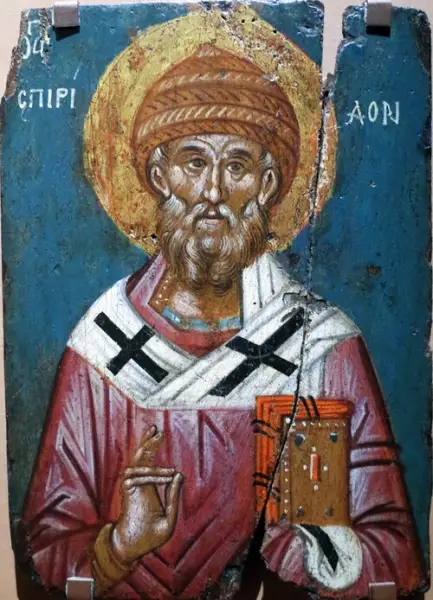
The Cypriot village of Assia saw the birth of Spyridon, dated by tradition to about 270, in the era of Roman rule. His background was rural and modest, and his first work was the care of sheep, the occupation that stayed with him in memory and in iconography long after he had taken his place among bishops. The accounts of his life agree that from an early age he was marked by piety, simplicity and generosity toward the poor, the three virtues that would define him through every change of state. He was, in this respect, the opposite of the conventional churchman of his era: the prominent bishops of the fourth century were usually products of the cities and the schools, trained in rhetoric and philosophy, while Spyridon brought to the episcopate the habits of the field and the village, unlettered but steeped in prayer. Later tradition never allowed this origin to be forgotten. In the pictures of him he wears the shepherd's hat as often as the omophorion, and the Christian memory of Cyprus kept him precisely as the holy countryman made shepherd of souls, the farmer-saint whose hands remembered the soil of Assia.
§ Life
Husband, Father, Widower, Cleric
Before he was a bishop, Spyridon was a married man. He took a wife and had a daughter, Irene, who would be bound to his story in one of the strangest of his miracles after her own death. Tradition tells that her death followed within a short time of the wedding, and this grief became the turning point of his life. Freed by widowhood from the first claim upon him, he devoted himself more fully to the religious life and to the service of the church, giving to God the years that might have been spent in raising a family. He entered the clergy and won recognition among the Christians of Cyprus for his devotion and pastoral care, so that his advancement came not from learning or patronage but from the trust of the people he served. The sequence of his life, shepherd, husband, father, widower, cleric, bishop, made him a saint of the ordinary Christian path, in which marriage and loss and service are stages of a single calling. The tradition has always drawn the moral: his accessibility to the poor and his patient common sense in office were the fruit of a life that had known work, marriage, grief and prayer in their natural order.
§ Life
Bishop of Trimythous and Father of Nicaea
In his later years the church of Trimythous chose Spyridon for its bishop; the town, ancient and venerable, stood not far from what is now Famagusta, and there he guided a local Christian community through the great turning point of the fourth century, the transformation of the church in the Roman Empire after Constantine. His fame, however, rests above all on his part in the doctrinal struggle of that age. Tradition counts him among the bishops gathered at the First Council of Nicaea in 325, the council summoned to answer the Arian denial of the full divinity of the Son. There, the story goes, he entered dispute with a Greek philosopher who defended the Arian cause and was far his superior in rhetorical skill and philosophical learning. The unlettered Cypriot answered not with syllogisms but with a simple explanation of the Christian faith, and the philosopher, overcome, accepted the decisions of the council and embraced Nicene Christianity. After returning to Cyprus he served as bishop of Trimythous until his death, and the literary tradition that carries his memory began at once: his pupil Triphyllius dedicated a poem to him, now lost, which inspired the two seventh-century vitae, one by Theodore of Paphos around 655 and another perhaps by Leontios of Neapolis, works later used by Symeon the Metaphrast, with Arabic and Georgian hagiographies as well.
§ Life
The Wonderworker
The spirituality of Spyridon was the simple, effective prayer of a man who believed that God hears the righteous, and the miracle stories gathered around him are variations on that single theme. Like the Prophet Elijah, whose company he is said to share, his prayers brought rain to Cyprus in seasons of drought. When a friend was falsely accused, imprisoned and condemned to death, Spyridon hurried to help him, found his way blocked by a flooded river, prayed, and crossed on the parted waters; the judge, told of the miracle, repented and freed the innocent man. When his lamp was one night nearly spent and its flame about to die, he prayed and the oil was replenished. His power reached the great as readily as the poor: he healed the emperor Constantius II when the man lay gravely ill and near death. He raised a dead child at a mother's pleading, and when the mother herself collapsed and died from the shock of joy, he prayed a second time and restored her too. The tradition reads all these deeds as the overflow of a life of unbroken prayer; it was while praying that he died, having been told by God the hour of his own death.
§ Miracles
Death and Burial
Spyridon served the church of Trimythous to the end of his life, and the tradition closes his story with the same quiet confidence that marks its beginning. God revealed to him the time of his death, and he prepared for it as a shepherd prepares the flock for the night, without alarm. He died around the year 348, at prayer, in Trimythous on Cyprus, the office he had held for the last portion of his long life. He was buried on the island, and the Christian communities of Cyprus honoured his memory at his grave through the generations that followed. From that Cypriot tomb his influence went out into the world, as devotion to him spread beyond the island through the Byzantine Empire and the whole Eastern Christian world, carried by the liturgy, by the vitae of the seventh century and by the continual telling of his miracles. But the grave itself was not to keep him: two centuries after his death, war would uproot his body and begin the long journey that carried the incorrupt shepherd of Trimythous from Cyprus to the imperial capital and finally to Corfu, where his people keep him still.
§ Life
Incorrupt and Confirmed
Spyridon was never canonized by any later process; he belongs to the saints recognised by the undivided church from the first generations of his cult. The decisive confirmation of his sanctity, in the eyes of the tradition, came from his relics. When the Arabs took Cyprus in the 650s, his body was disinterred and carried to Constantinople, and the body had suffered no decay, and within it lay a sprig of basil, the royal plant; the undecayed remains and the fragrant herb together were read as heaven's confirmation of his holiness, and the cult gained new force from them. He is venerated in the Eastern Orthodox Church, the Catholic Church and the Oriental Orthodox Churches, one of the few saints whose cult runs without interruption through every division of Christendom. The West honours him on 14 December and the East on 12 December, with an additional celebration on the Saturday before Great Lent, known as Cheesefare Saturday; in churches following the Julian calendar the December feast falls on 25 December of the civil calendar. Venice, recognising his role in the defence of Corfu, established an annual Litany of St. Spyridon on 11 August in commemoration of the island's deliverance.
§ Relics
Keeper of Corfu
Nowhere is Spyridon loved as he is on Corfu, of which he is the patron and is styled the Keeper of the City in memory of the wonder by which he drove the plague from the island; the faithful show visitors the scratch that the departing plague is said to have cut into a fortification stone of the old citadel in its fury at being driven out. His protection was invoked again in 1716, when a Turkish army and fleet under Sultan Ahmed III besieged the town for twenty-two days before abandoning the assault, and among the rumours that spread panic in the Turkish camp ran the report of soldiers who had beheld a monk bearing a flaming torch against them, a figure taken for the saint himself. The victory was attributed to his intervention together with the command of Count Schulenburg, and Venice celebrated it with Vivaldi's oratorio Juditha triumphans. He is patron also of Piraeus, celebrated there every 12 December, of potters, craftsmen, healers and farmers, and of the Tolstoy family, whose founder Andrei chose him in the fifteenth century and whose gold reliquary cross, given by Grand Prince Vasily II, survives in the family. His relics are carried in procession every Palm Sunday and on great occasions, with all the philharmonics of Corfu taking part, and his icon, known from the sixteenth century onward, shows the shepherd-bishop with his Gospel book, his basil and his shepherd's hat.
§ Corfu
Timeline
- 270
Born in the village of Assia on Cyprus, traditionally around this date, into a modest rural family
§ Life
- 325
Attends the First Council of Nicaea and is said to confound a Greek philosopher defending Arianism with a simple confession of faith
§ Life
- 340
At a council in Alexandria, the city's pagan idols collapse through the bishops' prayers when Spyridon arrives, the last idol falling at his coming
§ Miracles
- 348
Dies at Trimythous, Cyprus, traditionally around this date, while at prayer, having been warned in advance of the time of his death
§ Life
- 650
When the Arabs take Cyprus in the 650s, his body is disinterred and carried to Constantinople, where it is found incorrupt with a sprig of basil
§ Relics
- 1453
At the Ottoman capture of Constantinople, his relics are carried to Corfu by the Corfiote monk Kalohairetis and enshrined in the Saint Spyridon Church
§ Relics
- 19 Jul 1716
A Turkish army of 33,000 men lays siege to Corfu town; after twenty-two days and reported apparitions of the saint with a lit torch, the siege is raised
§ Corfu
- 1986
The relic of his right arm, long kept in Rome at Santa Maria in Vallicella, is brought back to Corfu
§ Relics
The Record
- Patron of
- Potters and craftsmen·Healers and farmers·Corfu, as Keeper of the City·Piraeus·Cyprus·The Tolstoy family
- Symbols
- Gospel Book·Potsherd·Sprig of basil·Shepherd's hat·Nugget of gold·Snake·Jewelry·Goat·Golden sword·Torch
- Canonization
- Pre-congregation; venerated in the Eastern Orthodox, Catholic and Oriental Orthodox Churches
Prayer
Bibliography
Show 9 sources
- "St. Spyridon of Tremithus". OrthoChristian.Com. Retrieved 2024-07-24.
- "Saint Spyridon the Wonderworker, Bishop of Tremithus". www.oca.org. Retrieved 2024-07-24.
- "The Life of Saint Spyridon the Wonderworker". St Elisabeth Convent. Retrieved 2026-07-08.
- "St. Spyridon". The Station of the Cross. 14 December 2025. Retrieved 9 July 2026.
- Kazhdan, Alexander; Ševčenko, Nancy Patterson (1991). "Spyridon". In Kazhdan, Alexander (ed.). The Oxford Dictionary of Byzantium. Oxford and New York: Oxford University Press. p. 1940. ISBN 0-19-504652-8.
- "The Life and Miracles of Saint Spyridon the Wonderworker (Part II)". Orthodox Christian Ethos. 13 December 2023. Retrieved 9 July 2026.
- "Agios Spyridon". Destination Piraeus. Retrieved 9 July 2026.
- "Saint Spyridon". En Romiosini. Retrieved 7 July 2026.
- "Patron Saint". Saint Spyridon Greek Orthodox Cathedral. Retrieved 9 July 2026.
Profile text adapted from the Wikipedia article, licensed CC BY-SA 4.0.
Pray with this saint every day
Save St. Spyridon to your favorites, read the full profile, and get feast-day reminders in the Saints app.
Get the Saints AppFree on the App Store for iPhone and iPad