
1550-1568·Feast August 15 (anniversary of death); November 13 (General Roman Calendar 1670-1969)
St. Stanislaus Kostka
Jesuit Novice, Patron of Youth and Novices
Overview
Stanisław Kostka, born on 28 October 1550 at Rostkowo in Masovia, was a Polish novice of the Society of Jesus who died in Rome on 15 August 1568, a month before his eighteenth birthday. The second of seven children of a senator of the Kingdom of Poland, castellan of Zakroczym, and of Małgorzata Kryska, aunt of the future chancellor Feliks Kryski, he was sent in 1564 with his elder brother Paweł to the Jesuit college at Vienna, where his amiability and fervour made him conspicuous and where he joined the Congregation of St. Barbara and Our Lady. In a serious illness he alleged that St. Barbara brought two angels to give him the Eucharist; the tutor John Bilinski testified that the boy was not delirious. Exasperated by his piety, Paweł mistreated him, and after another beating Stanislaus warned that his brother's roughness would drive him away for good. In October 1567, disguised as a mendicant, he fled Vienna on foot for Augsburg, where St. Peter Canisius tested his vocation at Dillingen; he reached Rome on 25 October 1567 and was received into the novitiate of St. Andrew by St. Francis Borgia. His ten months as a novice, in the testimony of his master Fr. Giulio Fazio, were those of a model of religious perfection, notwithstanding a delicate constitution that spared himself no penance. Taken ill on the feast of St. Lawrence, he wrote to the Virgin begging to die on her Assumption, and on the morning of 15 August 1568 he died, having foretold his death days before. He was beatified in 1605, canonized in 1726, and is the patron of youth and novices.
The Complete Life
Early Life
Stanislaus Kostka was born at Rostkowo, in Przasnysz County of Masovia, on 28 October 1550, into the high nobility of Poland. His father was a senator of the kingdom and castellan of Zakroczym; his mother Małgorzata, of the Kryski family of Drobni, was sister and niece of voivodes and aunt of Feliks Kryski, the celebrated chancellor of Poland. He was the second of seven children, of whom his elder brother Paweł, whose treatment of him would become part of his story, survived to attend his beatification in 1605. His childhood was the normal one of a nobleman's son in Masovia, formed by the piety of the household and by tutors; his family's plan was the career usual for his class, and in the summer of 1564 he and Paweł set out with their tutor John Bilinski for Vienna, to attend the Jesuit college that had opened there four years before. He was then thirteen. The Jesuits of Vienna found him conspicuous in his class over three years of schooling, not only for amiability and cheerfulness of expression, but for a religious fervour that was growing rather than settling, and Paweł later swore under oath that his brother's absorption in the things of God went so far that he often lost consciousness — most often in the Jesuit Fathers' church.
Vocation
Stanislaus' vocation declared itself in the midst of opposition. For six months he had carried the thought of the Society of Jesus before he found the courage to mention it to the superiors; in Vienna they were reluctant to admit him, dreading the storm his father — a senator of great influence — might unleash on a Society that was only just settling a tempest stirred up by earlier admissions. A serious illness during the Vienna years had deepened the resolve; in it, as he later told a fellow Jesuit at Rome, St. Barbara brought two angels to give him Holy Communion, and his tutor Bilinski, though he saw nothing himself, was certain that the violence of his sickness had not driven Stanislaus out of his mind. The final break came through Paweł's mistreatment. After one beating too many, Stanislaus turned on his brother with the words that his rough treatment would end in his going away never to return, leaving Paul to explain his leaving to their father and mother. The superiors having suggested Augsburg, where Peter Canisius was provincial, he set out in October 1567, exchanging the dress of a gentleman for that of a mendicant, and walked the four hundred miles without equipment, guide, or resources. Pursued by his brother, who was delayed by exhausted horses and broken carriage wheels, he gained a day and kept it, spent a month at Dillingen being tested by Canisius in the boarding-school, and arrived in Rome on 25 October 1567, where Francis Borgia, the general, received him into the novitiate of St. Andrew after several days of rest.
Spirituality
The spirituality of Stanislaus was that of a soul in a hurry, and its two poles were the Eucharist and Our Lady. The testimony of the process, which drew on his master of novices, Giulio Fazio, and on his companions, portrays a novice who served as model and mirror of religious perfection, one who — despite a very delicate constitution — denied himself not the smallest penance, applying cold compresses to a chest burning with fever. His devotion to the Blessed Sacrament, prepared for by the alleged vision of St. Barbara, was the centre of his day; his devotion to the Virgin, formed in the Congregation of St. Barbara and Our Lady at Vienna, was the centre of his heart. The letter composed in his last illness — begging Our Lady to summon him to heaven to keep with her the glorious feast of her Assumption — is the plainest window into his inner life, and its apparent answer, on the very feast he named, fixed his memory forever. Fazio summed him up as a model of obedience and cheerfulness rather than of austerity alone; the later tradition that emphasized extraordinary penances has been corrected by the acts of the process, which show a healthy, joyful, entirely surrendered boy. His spirituality is thus the consecrated ardour of the very young, and it is precisely this that the church has set before its youth.
Final Years
Stanislaus' ten months in the novitiate at St. Andrew's were his whole religious life. On the evening of the feast of St. Lawrence, 10 August 1568, he fell ill with a high fever, and he understood plainly that his final hour was at hand. He wrote his letter to the Blessed Virgin, begging her to summon him to heaven to keep with her the glorious feast of her Assumption; the trust that had won him so many favours before was rewarded once more, for towards four o'clock on the morning of 15 August 1568 he passed away — his own death having been foretold by him a few days earlier. He was seventeen years of age. The community buried him with the tenderness novices give their own, and the report of his death, and of its manner, spread quickly; Bilinski, his old tutor, was still alive to testify, and Paweł, the brother who had beaten him, lived to see him beatified in 1605 by Pope Paul V, an act of providence the biographers have never failed to note. He was canonized by Benedict XIII in 1726, and his feast, kept on 13 November in the general calendar for three centuries, now marks the day of his death, the Assumption itself, on which he had asked to die.
Legacy
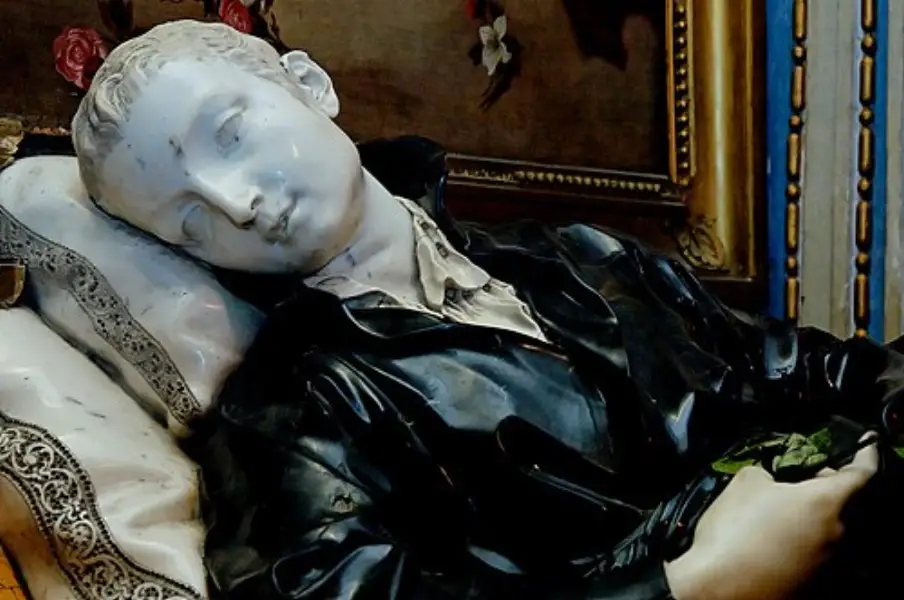
Stanislaus Kostka is one of the great patrons of the young. Canonized in 1726, he became at once the model for Jesuit novices and for Catholic students, and his iconography, the young novice in prayer, spread across the world, and especially across Poland, which counts him among its principal patrons. His cult has a special association with the church's colleges and with youth movements of every kind; parishes, schools, and churches named for him are numbered in every country the Jesuits served. Historically he is a document of the early Society of Jesus as much as of his own sanctity: the Vienna college, Canisius and Dillingen, Borgia and the Roman novitiate all appear in his story, and his flight from Vienna in a beggar's dress is a reminder that even the greatest families could not always be told when God called. The Jesuit novitiate in Rome, and the house where he died, kept his memory from the first, and his cause moved with unusual speed for a non-martyr. He died a novice, having made no vows but his baptismal ones kept whole, and the church honours in him the perfection of beginnings, the sanctity of a life that was almost entirely promise, fulfilled at once.
Timeline
- 28 Oct 1550
Born at Rostkowo, Przasnysz County, Poland, the second of seven children of a Polish senator.
§ Introduction
- 25 Jul 1564
Arrived at Vienna with his brother Paweł and tutor to attend the Jesuit college opened four years earlier.
§ School life
- 1567
Fled Vienna in mendicant's dress, walking over four hundred miles to Dillingen, where Peter Canisius tested his vocation.
§ Entry into the Society of Jesus
- 25 Oct 1567
Arrived exhausted in Rome; admitted days later to the novitiate of Saint Andrew by General Francis Borgia.
§ Entry into the Society of Jesus
- 10 Aug 1568
Fell ill with a high fever on the Feast of Saint Lawrence and wrote a letter to the Blessed Virgin.
§ Death
- 15 Aug 1568
Died in Rome towards four in the morning on the Feast of the Assumption, having foretold his death.
§ Death
- 8 Oct 1605
Beatified by Pope Paul V in Saint Peter's Basilica; his brother Paweł attended the ceremony.
§ Veneration
- 31 Dec 1726
Canonised by Pope Benedict XIII in Saint Peter's Basilica.
§ Introduction
The Record
- Major works
- Letters written from Vienna and Rome, preserved in the acts of his cause
- Patron of
- Youth and students·Novices·Poland (one of its principal patrons)·Broken bones (traditional)
- Symbols
- Jesuit novice's cassock·The Infant Jesus (visionary tradition of the novitiate)·Palm of a young saint
- Canonization
- Beatified in 1605 by Pope Paul V; canonized in 1726 by Pope Benedict XIII
Prayer
Profile text adapted from the Wikipedia article, licensed CC BY-SA 4.0.
Pray with this saint every day
Save St. Stanislaus Kostka to your favorites, read the full profile, and get feast-day reminders in the Saints app.
Get the Saints AppFree on the App Store for iPhone and iPad