
c. AD 5 – c. 34·Feast December 26 (Western Christianity); December 27 (Eastern Christianity)
St. Stephen
Protomartyr, Deacon and Archdeacon of Jerusalem
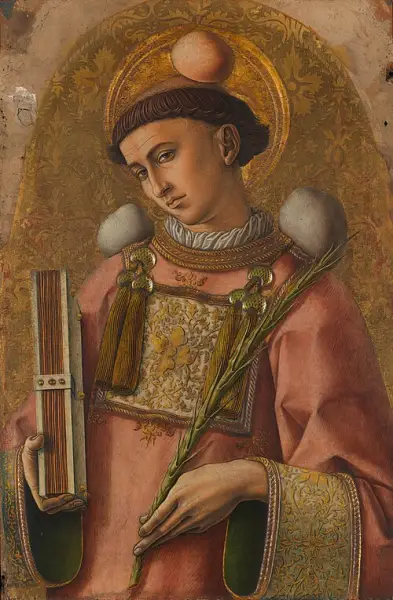
Overview
Stephen, whose Greek name means wreath or crown, is honoured as the protomartyr, the first disciple to die for faith in Jesus Christ. The Acts of the Apostles, the only source for his life, introduces him as one of the Seven deacons chosen by the apostles to oversee the daily sharing of food with the widows of Greek speech in the Jerusalem community, and Orthodox tradition calls him their archdeacon. A Hellenistic Jew, full of faith and of the Holy Spirit, he performed wonders and signs among the people and taught with a power that defeated his opponents in debate. Dragged before the Sanhedrin on charges of blasphemy, he delivered the longest recorded speech in Acts, a retelling of the history of Israel that argued the Temple could not contain God and that his hearers were repeating their ancestors' resistance to the Spirit. Cast out of the city and stoned, he died praying for his killers, while a young Pharisee named Saul, the future apostle Paul, looked after the cloaks of the executioners and consented to his death. Devout men buried him with loud mourning. The recovery of his relics at Beit Jimal in 415 fixed the Western feast on 26 December, the day after Christmas, and his cult spread through every church of East and West.
The Complete Life
A Hellenist of Jerusalem
Almost nothing is recorded of Stephen before his appearance in the sixth chapter of Acts, and the few inferences that can be drawn are drawn carefully. His name, Stephanos, is Koine Greek and means wreath or crown, and it has been assumed from this that he belonged to the Hellenistic Jews of Jerusalem, Greek-speaking members of the diaspora who had settled in the holy city. Since another of the Seven, Nicholas of Antioch, is expressly described as a convert to Judaism before his conversion to Christianity, the usual conclusion is that Stephen came into the world a Jew, though of his family, trade and upbringing the book says nothing. He emerges into history as a man already full of faith and of the Holy Spirit, chosen with six companions for a work of administration in the infant church at Jerusalem. Orthodox belief adds that he was the eldest of the Seven and therefore bears the title archdeacon. He would have died in his late twenties or early thirties by the traditional reckoning of his years, a young man, beardless in the imagination of the artists who from the earliest centuries painted him with a tonsure and the vestments of a deacon.
§ Background
Chosen to Serve at Table
Stephen's vocation began in a quarrel about fairness. In the Jerusalem community a grievance had arisen among the Hellenistic Jews, who complained that their widows were being slighted in the daily distribution of food in favour of the widows of Hebrew Christians. The apostles, unwilling to abandon prayer and the ministry of the word for the service of tables, instructed the community to choose seven men of good reputation, full of the Spirit and of wisdom, to take charge of the charitable distribution. Stephen stood first among those chosen, and the office they received was the diaconate in its founding form: the organised care of the poor as an essential work of the church and not an afterthought. Yet the book describes him at once in larger terms, a man working wonders and signs among the people, so that the waiter at tables was also a wonderworker and a teacher. Pope Leo XIV has drawn the lesson that service to the destitute and the shedding of blood for Christ belong together in him: the first martyr of the church came from the seven men set aside for the poor, and his charity and his sacrifice form one testimony.
§ Background
Wonders, Signs and Debate
Stephen's mission was exercised in the synagogues of Jerusalem, especially the congregations of the Hellenists, the libertines and the men of Cyrene, Alexandria, Cilicia and Asia. There he taught and performed his wonders and signs, and there his message ran into opposition. Members of these synagogues challenged his teaching, and Stephen defeated them in debate, so completely that fury at the humiliation drove them to desperate measures. They suborned false witnesses to allege that he had preached blasphemy against Moses and against God, and they dragged him before the Sanhedrin, the supreme court of Jewish elders, accusing him of speaking against the Second Temple and the Torah. The charges were grave, but the account shows the accused wholly without disquiet, wearing a countenance as of an angel. Pope Benedict XVI observed in 2012 that Stephen's answer was not an attack on the law of Moses but an argument from the Jewish scriptures themselves, showing that the law was not subverted by Jesus but fulfilled in him. His mission thus ended where it had been conducted, in the public argument over what Israel's own Scriptures promised, carried on by a deacon of the young church with the freedom of the prophets.
§ Background
The Speech to the Sanhedrin
The substance of Stephen's spirituality is preserved in the long speech that fills almost the whole of the seventh chapter of Acts, the longest of the discourses the book records. He began with the God of glory appearing to Abraham in Mesopotamia, and built from the patriarchs to Moses: God called from the burning bush, delivered Israel from Egypt, and was nonetheless forsaken by the people he had freed. Two great themes thus emerge, that God does not dwell confined within any building made by hands, and that Israel's history is a long record of resistance to the divine initiative. When he applies the second theme to his hearers, calling them a stiff-necked people who, like their ancestors, always resist the Holy Spirit, the courtroom erupts. Scholars have noticed that his retelling of the biblical stories diverges in places from the texts themselves, as when he places Jacob's tomb at Shechem, and have explained the differences as condensation, error, borrowed tradition or deliberate theological point. They have also noticed, with the theologian Friedrich Justus Knecht, how closely his death mirrors the death of his Lord: condemned for professing the divinity of Jesus, executed outside the city, commending his spirit to God and praying forgiveness for his executioners, Stephen followed the Master in the very shape of his dying.
§ Speech to Sanhedrin
The Stoning
Castigated by the prisoner they had come to judge, the members of the court could restrain their anger no longer. Stephen looked up and cried out that he saw the heavens opened and the Son of Man standing at the right hand of God, placing the recently risen Jesus beside the throne of God himself, and at that claim the crowd seized him. The first stone-throwers stripped off their outer garments and piled them at the feet of a youth called Saul, the future apostle Paul, a Pharisee and Roman citizen whom the book records as approving the killing. Under the stones, Stephen prayed twice: that the Lord Jesus would receive his spirit, and that the sin of his killers would not be laid to their charge. Then he sank to his knees and, in the book's gentle phrase, fell asleep. Devout men carried his body to burial and made great lamentation over him, though Acts does not say where the grave was dug. The persecution that broke out that day scattered the Jerusalem church, and the disciples, except the apostles, fled through the regions of Judaea and Samaria, many reaching Antioch, so that the martyrdom that seemed to end Stephen's work became, in the providence the historian reads into it, the beginning of the church's journey to the ends of the earth.
§ The stoning of Stephen
The Finding of the Relics
Stephen was venerated as a saint from the moment of his death, without any process, as the first of the long line of Christian martyrs. The turning point of his cult came in 415, when a priest named Lucian, purporting to be guided by a dream and by the appearance of Gamaliel, revealed the location of the remains at Beit Jimal; with them were found the relics of Nicodemus, of Gamaliel and of Gamaliel's son Abibas. On 26 December of that year the relics of the protomartyr were carried in procession to the Church of Hagia Sion, and that date became the feast of Saint Stephen, kept in the West the day after Christmas. In 428 the relics, with those found in his tomb, were translated from Jerusalem to Constantinople and placed in a church prepared for them, an event commemorated on 2 August, and in 439 the empress Aelia Eudocia built a church north of the Damascus Gate to receive them afresh. Pope Pelagius II later translated relics to Rome during the building of San Lorenzo fuori le Mura, interring them beside Lawrence, whose tomb, the Golden Legend says, moved aside to make room. The feasts of the finding and the translations, on 3 August and 15 September in older use, show how richly the calendars remembered him.
§ Tomb and relics of Stephen
The Feast of Stephen
No saint of the first generation is honoured so widely or so domestically as Stephen. In the West his feast on 26 December is a public holiday across much of Europe, from Austria and Germany to Italy, Poland and Scandinavia, the very feast of Stephen named in the carol of Good King Wenceslas; the Church of England keeps it as a Festival, and the Armenian churches keep Saint Stephen's Day on 25 December itself. In the East his feast falls on 27 December, the Third Day of the Nativity, and he is commemorated again on 4 January in the Synaxis of the Seventy. His cult is written into the map of Christendom: the Stephansdom of Vienna, founded in 1147, the round church of Santo Stefano Rotondo in Rome, San Lorenzo fuori le Mura where he lies beside Lawrence, the basilica of Saint-Étienne in Jerusalem, and the gate of the old city that bears his name. In England his name clings to St Stephen's Chapel at Westminster, the first home of the House of Commons, and to Wren's St Stephen's Walbrook. He is patron of deacons and altar servers, of the Guild of St. Stephen, of masons and casket makers, of horses and of those who suffer headaches, of the Acoma Pueblo and of cities from Kigali to Owensboro; the Imperial Regalia of the Holy Roman Empire preserve St. Stephen's Purse, said to hold soil soaked with his blood, and Augustine of Hippo recorded the miracles that flowed from his relics in Africa.
§ Saint Stephen's Day
Timeline
- 5
Born around this date, presumably into a Greek-speaking Hellenistic Jewish family
§ Saint Stephen the Protomartyr
- 34
Condemned for blasphemy by the Sanhedrin, he is taken outside the city and stoned to death, praying for his killers as he dies
§ The stoning of Stephen
- 26 Dec 415
After a priest named Lucian dreams of the location, the protomartyr's relics are recovered at Beit Jimal and taken in procession to the Church of Hagia Sion
§ Tomb and relics of Stephen
- 2 Aug 428
His relics, with those of Nicodemus, Gamaliel and Abibas, are translated from Jerusalem to Constantinople and placed in a church prepared for them
§ Eastern Christianity
- 439
The empress Aelia Eudocia translates his relics to a new church she has built north of the Damascus Gate in his honour
§ Tomb and relics of Stephen
- 1147
The cathedral of St. Stephen, later the Stephansdom, is founded in Vienna, becoming the seat of the archbishop and the symbol of Austria
§ Commemorative places
- 1542
Francis Xavier builds a church in honour of St. Stephen at Kombuthurai in India
§ Commemorative places
In Their Own Words
Behold, I see the heavens opened, and the Son of Man standing on the right hand of God.
Which of the prophets have not your fathers persecuted? and they have slain them which showed before of the coming of the Just One; of whom ye have been now the betrayers and murderers: who have received the law by the disposition of the angels, and have not kept it.
The Record
- Major works
- The speech to the Sanhedrin, the longest discourse recorded in the Acts of the Apostles
- Patron of
- Altar servers·Deacons·Bricklayers and masons·Casket makers·Against headaches·Horses·Acoma Pueblo·Serbia·Kigali, Rwanda·Dodoma, Tanzania·Passau, Germany·Owensboro, Kentucky·Prato and Cetona, Italy·Kessel, Belgium·Ligao·Republic of Srpska
- Symbols
- Stones·Dalmatic·Censer·Miniature church·Gospel Book·Martyr's palm·Orarion in Eastern iconography
- Canonization
- Pre-congregation; venerated as the first martyr of Christianity in all churches that honour saints
Prayer
Bibliography
Show 9 sources
- "Saint Stephen the Martyr". CatholicSaints.info. Retrieved 21 February 2025.
- Souvay, Charles. "Saint Stephen". Catholic Encyclopedia, 1912. New Advent. Retrieved 3 April 2013.
- Williams, David J. (1989). Acts (Understanding the Bible Commentary Series). Baker Books. ISBN 978-0-8010-4805-0.
- Brandon, S. G. F. (1967). Jesus and the Zealots: A Study of the Political Factor in Primitive Christianity. Charles Scribner's Sons. p. 158. ISBN 978-0-684-31010-7.
- Knecht, Friedrich Justus (1910). "LXXXVIII. Election and Ordination of Deacons. – Stephen the First Martyr". A Practical Commentary on Holy Scripture. B. Herder Book Company.
- Cotton, Hannah M.; Di Segni, Leah; Eck, Werner, et al., eds. (2012). Jerusalem, Part 2: 705–1120. Corpus Inscriptionum Iudeae/Palaestinae. Vol. 1. De Gruyter. p. 275. ISBN 978-3-11-025188-3.
- Koivisto, Rex A. (1987). "Stephen's Speech: A Theology of Errors?" Grace Theological College.
- Oxford Dictionary of Saints, ed. David Hugh Farmer, corr. ed. (Oxford: Clarendon Press, 1979), p. 361. ISBN 0198691203.
- Pope Leo XIV, Dilexi te, paragraph 37, published on 4 October 2025.
Profile text adapted from the Wikipedia article, licensed CC BY-SA 4.0.
Pray with this saint every day
Save St. Stephen to your favorites, read the full profile, and get feast-day reminders in the Saints app.
Get the Saints AppFree on the App Store for iPhone and iPad