
c. 705 – 779·Feast December 17
St. Sturm
Founder and First Abbot of Fulda
Overview
Sturm, remembered also as Sturmius or Sturmi, was a monk of the Anglo-Saxon mission period and the disciple most closely bound to Boniface's reform of the German church. Born around 705 at Lorch in the March of Styria and probably a kinsman of the Agilolfing dukes of Bavaria, he was entrusted as a boy to Boniface and educated at the Benedictine house of Fritzlar under Abbot Wigbert. After missionary labour in Hesse and Westphalia he founded, at Boniface's direction, the monastery of Fulda on the river of the same name in 744, becoming its first abbot in 747. A journey to Monte Cassino secured the young community's Benedictine character and, through Pope Zachary, its exemption from episcopal control. His greatest triumph was receiving the body of Boniface, killed in Frisia in 754, for burial at Fulda — an honour that made the abbey one of the great pilgrimage centres of the German lands. Exiled to Jumièges in 763 through the hostility of Archbishop Lullus of Mainz, he was restored within two years and later obtained royal protection from Charlemagne, together with a missionary field in Saxony. He died at Fulda on 17 December 779.
The Complete Life
A Boy Given to the Mission
Sturm was born about the year 705 at Lorch, a settlement in the March of Styria within the Bavarian world of the early eighth century. His family belonged to the highest nobility of the region, since he was most likely a relative of the Agilolfing dukes who ruled Bavaria. His parents gave the boy over to the care of Boniface, the great reforming bishop then reorganizing the church across Bavaria and Austria and establishing the dioceses of Salzburg, Regensburg and Würzburg. Entrusting a son to such a man marked the family out as committed to the new Christian order taking shape along the Danube and its tributaries. Under Boniface's arrangement the child was placed for his education in the Benedictine monastery of Fritzlar, where Abbot Wigbert directed his formation. Fritzlar stood among the earliest monastic foundations supporting the mission east of the Rhine, and there the boy absorbed the Rule, the liturgy and the missionary spirit that would define his adult life. By the time he left the cloister he was a monk formed in the strict Benedictine tradition and prepared for work on the frontier of the faith.
§ Life
Missionary and Hermit
Sturm's first field of labour lay in northern Hesse, a region only half won for the Gospel. There, in 736, he established a monastic settlement at a place recorded as Haerulfisfeld, the later Hersfeld, planting a community in ground where the faith was still fragile. In 740 he was ordained to the priesthood at Fritzlar, the house of his education, binding his ministry formally to the church Boniface was building. Boniface next sent him to Westphalia, where he spent three years as a missionary among peoples still attached to their old worship, an assignment that schooled him in hardship and in preaching to the unbaptized. When that term ended he withdrew to Hersfeld and embraced the solitary life of a hermit. The retreat did not last. Raiding Saxons crossed the frontier and drove him from his unprotected cell, an expulsion that proved providential, for it left the monk available when his master needed a founder. His early career had already shown the pattern that would govern the rest of it: establish, preach, withdraw to prayer, and begin again wherever the church required him.
§ Life
The Founding of Fulda
In 744 Boniface instructed Sturm to establish a monastery in the district of Eichloha, territory that Carloman, Mayor of the Frankish palace, had granted to the mission. Sturm chose the ruins of a sixth-century Merovingian royal camp, destroyed half a century earlier by Saxon raiders, standing at a ford on the Fulda river. There he raised the new abbey, and Boniface named him its first abbot. Around 748 he set out with two companions for Monte Cassino, the cradle of Benedictine monasticism, and for a year the three visited the abbeys of Italy studying how monks lived under the Rule, so that the observance might be transplanted faithfully to Fulda. Before returning he obtained an audience with Pope Zachary, who placed the monastery directly under Roman jurisdiction rather than under the local bishop — a privilege that later brought him into serious conflict with Lullus, archbishop of Mainz. His decisive triumph came in 754, when Boniface was killed near Dokkum in Frisia and Sturm carried his point against the bishops of Mainz and Utrecht, and so the martyr's body came to Fulda for burial. The grave drew Anglo-Saxons and other peoples in pilgrimage, filling the abbey with prestige and a stream of gifts.
§ Life
The Benedictine Heart
The spiritual shape of Sturm's life was Benedictine to its core. Formed at Fritzlar under the Rule, he judged no distance too great for its faithful observance: his journey to Monte Cassino was itself an act of devotion, undertaken so that Fulda might practice monastic life exactly as the patriarch of Western monks had handed it down, and he spent a year among the abbeys of Italy learning it before bringing the observance home. His conviction that a monastery should stand under God alone, governed by its abbot and answerable to the Apostolic See rather than to ambitious diocesans, cost him decades of strife with the bishops of Mainz and Würzburg, yet he would not surrender the exemption. Humility came to him late, and through humiliation. During his exile he lived among the common people of Germany, far from the abbatial dignity he had known, and the experience changed him. When rehabilitation came, his whole manner had grown humbler, and the common folk, who had watched the transformation, came to call him the Quaint Saint. The nickname preserved what his contemporaries noticed most in him: power refined by suffering into kindness.
§ Life
Royal Protection and the Saxon Frontier
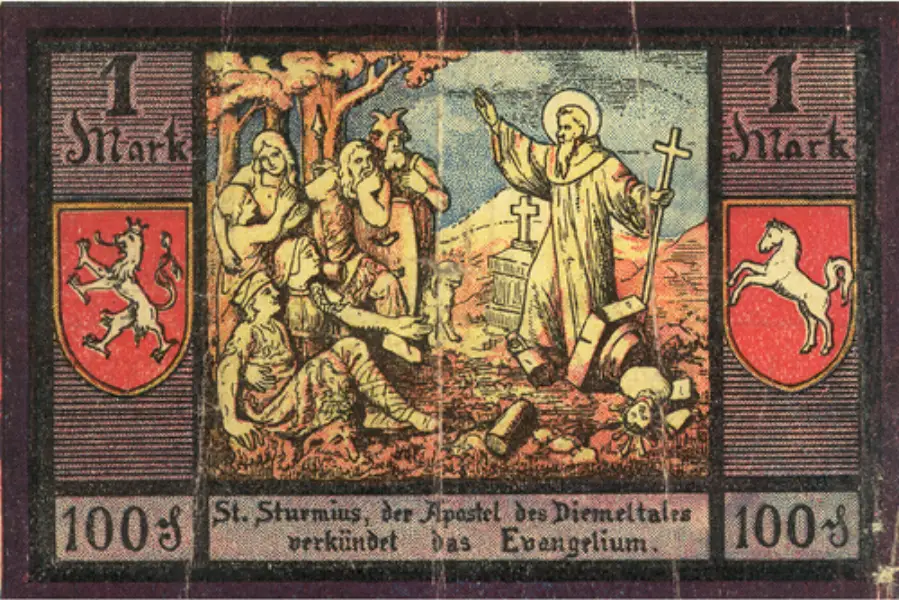
The last decade of Sturm's abbacy joined royal favour to renewed frontier danger. In 774 Charlemagne granted the Abbey of Fulda royal protection, and in that same year Fulda received a missionary territory in heathen Saxony, becoming a bridgehead in the Frankish political effort to seize the Saxons' lands and impose Christianity on them. Sturm pushed the work forward and founded the abbey of St. Boniface at Hamelin. It proved precarious. Once Charlemagne departed to fight the Moors in Spain, revolt broke out among the Saxons and the monks were driven out, undoing what had been begun. Sturm, now an old man, did not withdraw from the struggle. In 779 he accompanied Charlemagne on campaign into Saxony itself, sharing the hardships of the field beside the king whose protection the abbey required. The effort broke his health. He fell ill and, after returning to Fulda, died there on 17 December 779. The monks buried him in the cathedral church of the abbey he had founded thirty-five years earlier on an abandoned military ruin beside the river. His long tenure in the office had made Fulda the model and the master of German monasticism.
§ Life
A Saint of the Undivided Church
Sturm's sanctity was acknowledged long before the machinery of formal canonization existed in the West. He was counted a saint before the East–West Schism of 1054, and for that reason the Orthodox Church continues to honour him alongside the Catholic communion. The papacy of the later centuries did not automatically confirm every saint of the undivided church, and some pre-Schism cults were reviewed; Sturm's was among those that received formal confirmation, when Pope Innocent II canonized him in 1139. By then Fulda had been the burial place of Boniface and a chief school of the German church for nearly four centuries, and the memory of its first abbot was inseparable from its standing. His life had been written early in the Vita Sturmi by Eigil, the fourth abbot of Fulda, who died in 822, was a relative of Sturm, and had lived as a monk at Fulda for more than twenty years under his government. That biography, drawn from the testimony of a disciple, remains the foundation of everything known about him, and no early German abbot is documented by so near a witness.
§ Veneration
Fulda and the Fountain
Fulda itself is Sturm's greatest monument. The monastery he founded at the ford grew into the chief abbey of the German lands, the burial church of Boniface, a school renowned across Europe, and a pilgrimage centre whose stream of gifts and donations endowed one of medieval Christianity's greatest houses. Every generation of German monks felt the influence of an observance that was the direct descendant of the Rule he had carried back from Monte Cassino, and the missionary assignment in Saxony, however entangled with Frankish conquest, opened the eastern lands to monastic evangelization. His memory remained fixed in the city that grew around the abbey. At Fulda, before the old town hall, the fountain called Saint Sturm's Fountain still stands, its figures showing Benedict, Boniface and Sturm together — the lawgiver of monasticism, the apostle who commissioned the founder, and the founder himself, ranked side by side above the water. The image states his historical position concisely: he stood in the succession of Boniface's disciples, transmitted the Benedictine institute to Germany, and made of an abandoned ruin the spiritual capital from which the faith was carried onward into Saxony.
§ Veneration
Timeline
- 705
Born at Lorch in the March of Styria, most likely into the kin of the Agilolfing dukes of Bavaria
§ Life
- 736
Established a monastic settlement at Haerulfisfeld, the later Hersfeld, while labouring as a missionary in northern Hesse
§ Life
- 740
Ordained a priest at Fritzlar, the monastery of his education
§ Life
- 744
Sent by Boniface to found a monastery in the district of Eichloha, at a ford on the Fulda river
§ Life
- 747
Began his tenure as first abbot of the new abbey of Fulda
§ Life
- 748
Set out with two monks for Monte Cassino, spending a year among the Benedictine abbeys of Italy
§ Life
- 754
Carried his case against the bishops of Mainz and Utrecht, and brought the slain Boniface's body to Fulda for burial
§ Life
- 763
Banished by Pippin the Younger at the urging of Lull and sent to Jumièges in Normandy
§ Life
- 774
Obtained royal protection from Charlemagne and a missionary assignment for Fulda in heathen Saxony
§ Life
- 17 Dec 779
Accompanied Charlemagne into Saxony, then fell ill and died at Fulda on 17 December
§ Life
- 1139
Formally canonized by Pope Innocent II
§ Veneration
The Record
- Major works
- Abbey of Fulda·Monastic settlement at Hersfeld·Abbey of St. Boniface at Hamelin
- Symbols
- Shown with Benedict and Boniface on Saint Sturm's Fountain at Fulda
- Canonization
- Canonized by Pope Innocent II in 1139; honoured as a saint before the East–West Schism of 1054
Prayer
Bibliography
Show 6 sources
- "The Monastery of Fulda". The Catholic World, A Monthly Magazine of General Literature and Science (1878). 28 (165): 301-309.
- Löffler, Klemens. "St. Wigbert." The Catholic Encyclopedia Vol. 15. New York: Robert Appleton Company, 1912.
- Staley, Tony. "Sometimes a name just sticks", The Compass, December 14, 2001.
- "Saint Sturm", Nominis.
- Friedrich Wilhelm Bautz (1975). "Eigil (Egil), 4. Abt von Fulda". In Biographisch-Bibliographisches Kirchenlexikon (BBKL) (in German). Vol. 1. Hamm: Bautz. col. 1479. ISBN 3-88309-013-1.
- Nicolaus Heutger (1996). "Sturmius". In Bautz, Traugott (ed.). Biographisch-Bibliographisches Kirchenlexikon (BBKL) (in German). Vol. 11. Herzberg: Bautz. cols. 149–150. ISBN 3-88309-064-6.
Profile text adapted from the Wikipedia article, licensed CC BY-SA 4.0.
Pray with this saint every day
Save St. Sturm to your favorites, read the full profile, and get feast-day reminders in the Saints app.
Get the Saints AppFree on the App Store for iPhone and iPad