
died c. 412·Feast August 12
St. Taurinus
First Bishop of Évreux and Martyr
Overview
Taurinus of Évreux, also known as Taurin, died about the year 412 and receives veneration as a saint from Catholics and Eastern Orthodox Christians alike. His legend makes him the first bishop of Évreux, an evangelist of the region who died a martyr. The story of his life is preserved in a tenth-century manuscript based on a ninth-century text written by a monk named Deodatus, who mingled factual information with the marvels conventional in the passiones of his day; the garbled chronology makes the date of his episcopacy impossible to fix, though scholars usually place it early in the fourth century or in the middle of the fifth. The legend gives him a Roman birth, a Christian mother named Eustycia, baptism at the hands of Pope Clement I and the godfather Denis the Areopagite. As bishop, from about 385, he is said to have expelled a shape-shifting demon from the temple of Diana, converted the temple into a church of the Virgin, raised the dead Euphrasia and Marinus to life, and won thousands to baptism before suffering martyrdom about 412. His relics were divided among Évreux, Lezoux, Gigny and Chartres, and he is patron of the diocese.
The Complete Life
A Roman Childhood of Legend
The life of Taurinus comes down chiefly through a legendary account written by the monk Deodatus, preserved in a tenth-century manuscript based on a ninth-century text. In that narrative the father was the heathen Tarquinius, the mother the devout Christian Eustycia, and the birthplace Rome. Before the birth an angel came to Eustycia with news that the boy she carried was marked for a great destiny. Pope Clement I baptized the child, and his godfather was Denis the Areopagite, the convert of Athens counted among the first disciples of the Apostle Paul — a figure whom the legend misidentifies with Denis, first bishop of Paris. Modern scholarship explains the conflation: about the ninth century Abbot Hilduin of Saint-Denis was determined to show that the Areopagite and the Parisian bishop were one man, and the story of Taurinus's baptism served that purpose by assuring a line of apostolic succession leading from Paul straight to the bishops of Évreux. Whatever the value of the details, the legend's intent is clear: it rooted a Norman see in the soil of the apostolic age and claimed for its founder the most venerable Christian pedigree imaginable.
§ Legend
Bishop of a Troubled Chronology
Setting a date to Taurinus's episcopate is impossible, for the legendary life garbles its chronology, mixing factual information with the wonderful stories expected of a passio. Scholars have usually placed his tenure at the beginning of the fourth century or in the middle of the fifth, and the traditional reckoning makes him a bishop around the year 385. What the tradition is unanimous about is his office: the legend presents him as the first bishop of Évreux, the ancient Mediolanum Aulercorum of the Gallic province of Lugdunensis. A first bishop in that age means a missionary organizer, a man who gathered a Christian community where paganism still governed civic life, ordained its clergy and fixed the pattern of the see that would endure long after him. The passio shows him exercising exactly that authority: confronting the cults of the city, cleansing their temples and converting their priests. Though the written life is late and heavily embroidered, the memory it preserves of a founding bishop who evangelized the region and sealed his work with martyrdom has been continuous in the church of Normandy from an early date.
§ Legend
The Demon of Évreux
The central drama of the legend is Taurinus's combat with a demon that haunted Évreux and took three shapes in turn: a lion, a bear and a buffalo. Interpreters have read the metamorphoses either as figures of the deadly sins or as emblems of the religions the saint displaced — the official Roman religion in the lion, the worship of Diana in the bear, and the local agrarian religions in the buffalo. Orderic Vitalis records in his Ecclesiastical History that Taurinus drove the demon out of the local temple of Diana, and that when he ordered it to break the idols with its own hands it obeyed, though it was not cast at once into the pit: it was condemned to remain in the place it had ruled, watching the people it had tormented saved. The local people knew it as Gobelinus and said it haunted Évreux still, showing itself in different forms yet injuring no one. The bishop then transformed the pagan temple into a church dedicated to the Virgin Mary. The goddess had two priests, Cambise and Zara, who tried to bar his entrance, but were immobilized when he made the sign of the cross, and asked to be made Christian. His wonders continued. He raised Euphrasia, a girl who had died in a fire, leaving no trace of burning on her, and the miracle won a hundred and twenty converts. He also revived Marinus, son of the local prefect, who had died from a fall into a hole; after a short prayer the young man stood alive, and at once he, his entourage and twelve hundred others sought baptism.
§ Legend
Martyrdom and Succession
The legend gives Taurinus the crown of martyrdom: having evangelized the region of Évreux and broken its idols, he died a martyr's death, placed by tradition about the year 412 in the city where he had ruled as bishop. His work did not lapse with him. Pope Damasus I sent Maximus of Evreux to continue his predecessor's labours, an apostolic attention to a small Gallic see that shows how highly the mission there was regarded. The devotion of the church of Évreux to its first bishop never faltered. A monastery dedicated to him stood in the city by the sixth century; his relics were divided, carried, hidden and enshrined through the upheavals of the Norman age; and the abbey of Saint-Taurin remained the centre of his cult into the modern era. Whether the details of the passio are history or edifying fiction, the church of Normandy has never doubted the substance of the tradition: a founder-bishop who gave the see its faith and, by the legend's testimony, his blood. No other first bishop of the Norman lands is remembered with so long and so well documented a cult.
§ Legend
Relics, Abbays and the Chasse
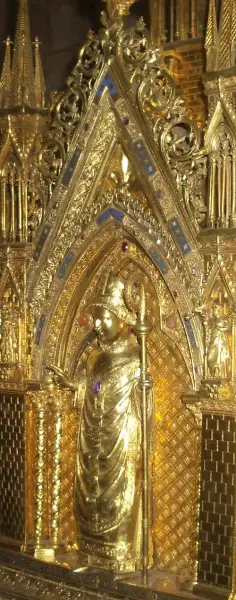
The afterlife of the cult is unusually well documented. A monastery dedicated to Taurinus existed at Évreux from the sixth century, and in the tenth century Richard I of Normandy saw to its restoration. Bishop Landulphus, credited with discovering the relics of the saint in answer to fervent prayer, built a basilica in his honour. The relics were then scattered by war and contested by claimants. In 892 Bishop Sebarius transferred some of them to Lezoux in the Puy-de-Dôme, and part of that group later reached the Abbey of Cluny. During the ninth-century Norman invasions the remaining relics were carried to Gigny in the Jura, where their presence is attested as of the twelfth century. Others had been deposited in the church of Pézy, then carried on to Chartres Cathedral in 1024. Meanwhile the abbey of Saint-Taurin at Évreux passed in 1035 under Fécamp's jurisdiction, that house also putting forward a claim to the body; the monks of Saint-Taurin maintained that they owned a part of the relics. In 1247 Abbot Gislebert de Saint-Martin had a splendid reliquary — the chasse that still bears the saint's image — made to house what remained. Taurinus is patron saint of the Diocese of Évreux, honoured there on 12 August with the crozier of a bishop as his emblem.
§ Veneration
Timeline
- 385
Received the episcopate around this year, which the legend makes the first at Évreux
§ Legend
- 412
Suffered martyrdom at Évreux, the ancient Mediolanum Aulercorum, according to the traditional date of his death
§ Saint Taurinus
- 892
Bishop Sebarius transferred some of the saint's relics to Lezoux in the Puy-de-Dôme
§ Veneration
- 1024
Relics kept at the church of Pézy were transferred to Chartres Cathedral
§ Veneration
- 1035
Fécamp Abbey received jurisdiction over Saint-Taurin, while putting forward its own claim to the body
§ Veneration
- 1247
Abbot Gislebert of Saint-Martin had a reliquary made at Saint-Taurin for the surviving relics
§ Veneration
The Record
- Major works
- Church of the Virgin at Évreux, converted from the pagan temple
- Patron of
- Diocese of Évreux
- Symbols
- Bishop's crozier
- Canonization
- Pre-congregation; ancient cultus centred on the abbey of Saint-Taurin at Évreux
Prayer
Bibliography
Show 5 sources
- Herrick, Samantha Kahn. Imagining the sacred past: hagiography and power in early Normandy. Cambridge, Harvard University Press, 2007. p. 51 et seq. ISBN 9780674024434.
- Goyau, Georges. "Evreux." The Catholic Encyclopedia Vol. 5. New York: Robert Appleton Company, 1909.
- Orderic Vitalis. "Book 5, Chapter 7". The Ecclesiastical History of England and Normandy. Translated by Thomas Forester. p. 136.
- Monks of Ramsgate. "Taurinus". Book of Saints, 1921. CatholicSaints.Info. 10 August 2016.
- "Abbatial Church of Saint-Taurin", Normandy Tourism.
Profile text adapted from the Wikipedia article, licensed CC BY-SA 4.0.
Pray with this saint every day
Save St. Taurinus to your favorites, read the full profile, and get feast-day reminders in the Saints app.
Get the Saints AppFree on the App Store for iPhone and iPad