
late 5th century – 6th century·Feast September 14
St. Tecwyn
Sixth-Century Founder and Patron of Llandecwyn
Overview
Tecwyn, sometimes transliterated Tegwyn — with the feminine form Tegwen — and sometimes anglicised as Teckwyn, was a sixth-century Welsh saint, the patron and founder of Llandecwyn in the county of Gwynedd. Early in the Age of the Saints he reached Wales and founded the church of Llandecwyn, the settlement that still keeps his name. He is believed to have been brother to a family of founding saints: Tanwg of Llandanwg, Twrog of Maentwrog, Tegai of Llandegai and Baglan of Llanfaglan and Baglan. Enwogion Cymru records him as a son of Ithel Hael of Lydaw in Brittany, reaching Britain in Saint Cadfan's company during the days of Vortigern, whose answer to the withering of belief in the island was to summon learned churchmen from Gaul to restore Christianity. In speech the newcomers' Breton differed little from the Welsh of that day, which eased their settlement. Tecwyn belonged to the college of Bardsey, founded as a monastery in 516. His memory lives at Llandecwyn and in the pilgrimage route, Saint Tecwyn's Way, that begins at a window depicting him in the church of Llanfihangel-y-traethau. His feast day is 14 September.
The Complete Life
From Brittany to Bardsey
Tecwyn belonged to the first generation of the Age of the Saints, the movement that carried monastic Christianity across the Irish Sea world in the late fifth and sixth centuries. According to the biographical dictionary Enwogion Cymru, he was the son of Ithel Hael of Lydaw, the Breton land that bred so many of the church's missionaries, and he came to Britain in the company of Saint Cadfan, in the days when Vortigern, troubled by the withering of belief in the island, sent for learned churchmen from Gaul to renew the faith there. At that date the newcomers' Breton speech differed little from the Welsh of the day, and the settlers passed easily into the religious life of their new country. Tecwyn joined the college of Bardsey, the island monastery founded in 516 that became the goal of pilgrims and the school of saints. His own permanent work lay on the mainland of Gwynedd, where he founded the church of Llandecwyn, the place that still carries his name, and served as its patron and first pastor, the father of its Christian life from the first stone onward.
§ Saint Tecwyn
A Brotherhood of Founders
The mission of Tecwyn was a family enterprise of the Breton diaspora. He is believed to have been brother to a remarkable group of founding saints: Tanwg of Llandanwg, Twrog of Maentwrog, Tegai of Llandegai and Baglan of Llanfaglan and Baglan — five kinsmen scattering from one household to plant churches along the coast and valleys of Gwynedd. Their father Ithel Hael had sent his sons with Cadfan's company in the time of Vortigern, when the British ruler sought learned churchmen from Gaul to restore a faith grown weak in the island. Working from the island college of Bardsey, these brothers of Llandecwyn gave the district its sacred geography, each dedication marking a centre of prayer and instruction in territory where no Christian institution had stood before. Tecwyn's own foundation anchored the faith of his corner of Gwynedd and bound it to the monastic learning of Bardsey. The work of such men was quietly decisive: they built small, taught in the speech of the people, and left a network of churches that endured when kingdoms had passed away. In such company solitude was never the rule, for the faith advanced along the roads the brothers opened together.
§ Saint Tecwyn
Llandecwyn and the Pilgrim Way
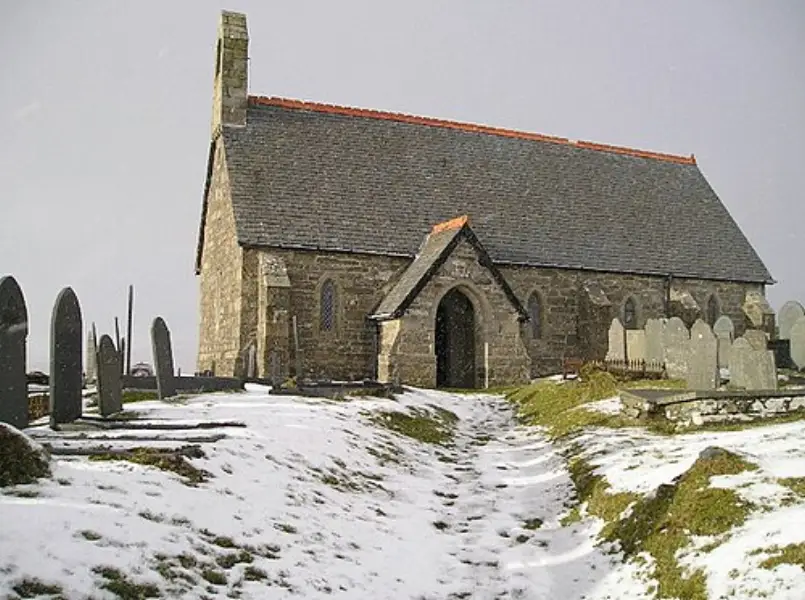
Llandecwyn remembers its founder in name, church and landscape. The parish on the Gwynedd coast keeps the dedication of the church Tecwyn established, and his feast is observed on 14 September. A few miles to the southwest, the church of Llanfihangel-y-traethau has a window depicting the saint, and that image marks the starting point of Saint Tecwyn's Way, a pilgrimage route running between the two churches that lets modern walkers trace the saint's country on foot. His name has travelled in variant forms: it appears sometimes as Tegwyn, with the feminine form Tegwen, and has been anglicised as Teckwyn, small signs of how widely the saint was known across the Welsh-speaking world. His cult belongs to the pre-congregation age, before formal canonization, when the holiness of a founder was attested by the very existence of the church that grew from his work. For the people of Gwynedd he remains among the brotherhood of Breton-born saints who gave the county its oldest Christian foundations, and the pilgrim way that bears his name keeps his memory moving from one holy place to another.
§ Saint Tecwyn
The Record
- Major works
- Church of Llandecwyn, Gwynedd
- Patron of
- Llandecwyn, Gwynedd
- Canonization
- Pre-congregation; cultus of the Welsh Age of the Saints
Prayer
Bibliography
Show 3 sources
- The Roman and British Martyrology. O'Neill & Duggan. 1846. Retrieved 8 October 2022.
- Williams, Robert (1852). Enwogion Cymru: A Biographical Dictionary of Eminent Welshmen, from the Earliest Times to the Present, and Including Every Name Connected with the Ancient History of Wales. Llandovery.
- "The Arrival of St Tecwyn - image from Stained Glass in Wales". stainedglass.llgc.org.uk. Retrieved 19 August 2020.
Profile text adapted from the Wikipedia article, licensed CC BY-SA 4.0.
Pray with this saint every day
Save St. Tecwyn to your favorites, read the full profile, and get feast-day reminders in the Saints app.
Get the Saints AppFree on the App Store for iPhone and iPad