
6th century·Feast Unknown
St. Tegai
Sixth-Century Founder and Patron of Llandygai
Overview
Tegai, sometimes spelt Tygai, was a saint of the early sixth century remembered as the patron and founder of Llandygai in Gwynedd, Wales. According to Enwogion Cymru he was among the sons of Ithel Hael of Brittany, and he came to Wales with his brother Tecwyn, the founder of Llandecwyn, in the company of Saint Cadfan. On arriving in Britain he joined the college of Bardsey Island, the monastery that stood at the centre of Welsh monasticism, and from that formation he went out to plant the church of Llandygai, which still bears his name. Medieval Welsh tradition, recorded in Achau y Saint, calls him Tegai Glasog of Maelan. Nothing further is recorded of his life: no acts, no miracles, no death scene survive, and even his feast day is not known. He belongs to the brotherhood of Breton-born founders who, in the generation of Cadfan, gave the coastlands and valleys of northwest Wales their oldest Christian foundations.
The Complete Life
A Son of Ithel Hael
Tegai appears in the records of the Welsh Age of the Saints as the founder and patron of Llandygai, the church in the Ogwen country of Gwynedd that still bears his name. Writing in the nineteenth century, the biographical dictionary Enwogion Cymru describes him as a saint of the early part of the sixth century and records that he was a son of Ithel Hael, a lord of Brittany. Together with his brother Tecwyn, founder of Llandecwyn, he crossed from Brittany to Wales in the company of Saint Cadfan, leader of that company of Breton churchmen who came to renew the faith of Britain. On arriving he joined the college of Bardsey Island, the monastery founded in 516 that stood at the heart of Welsh monasticism, training saints and serving as a place of pilgrimage for the holiest of the age. From that formation he went out to his own foundation in the north, planting the church of Llandygai and giving his name to the parish that grew around it. Bardsey gave the Breton brothers their formation, and each of them carried it coastward or inland in his turn.
§ Saint Tegai
The Breton Renewal of Wales
The mission of Tegai was shared with a whole family of founders. His brothers included, by the same tradition, not only Tecwyn of Llandecwyn but Tanwg of Llandanwg, Twrog of Maentwrog and Baglan of Llanfaglan, saints whose churches trace a chain of Breton foundations along the coast and mountains of northwest Wales. The company in which Tegai travelled had been summoned, in the telling of Enwogion Cymru, by Vortigern, who procured wise men and divines from Gaul to renovate Christianity in the island, in consequence of the decay and failure that had befallen the faith in Christ. Whether or not that motive is historical, it reflects the memory of a deliberate renewal of British Christianity from the Breton shore, carried by men who spoke a tongue nearly identical to Welsh. Tegai's share of that renewal was the valley country of Gwynedd and the church of Llandygai, a Christian centre where none had stood before, connected through Bardsey to the wider monastic world of the Irish Sea. Such coverage was no accident. Kinsfolk labouring in concert could shelter one another's foundations and keep a single discipline across many houses.
§ Saint Tegai
The Church Beneath the Mountains
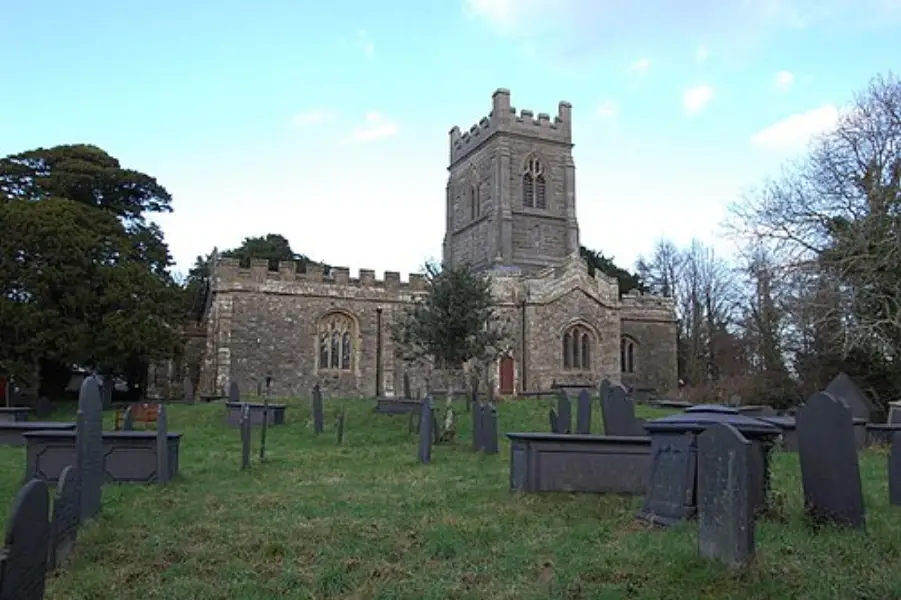
Llandygai remains the monument of Tegai: the parish and its church, recorded in the diocese of Bangor within the deanery of Ogwen, keep his dedication after some fourteen centuries. Medieval Welsh tradition recorded in Achau y Saint preserves another name for him, calling him Tegai Glasog of Maelan, a hint that more than one strand of legend attached to the founder. The date of his feast has not survived, a loss felt more keenly because the annual feast was the chief act of an early cult; his name likewise varies in the sources, where the spelling Tygai also appears. He belongs to that company of sixth-century saints — sons of one Breton house, companions of Cadfan, children of Bardsey — who fixed the Christian map of Gwynedd. Their dedications outlasted kingdoms and conquests alike, and the quiet church beneath the mountains still answers to the name of the man the genealogies remember as a son of Ithel Hael, patron of Llandygai. That endurance is itself the strongest testimony to his cult, for a dedication survives only where a community continues to pray. The valley remembers him still.
§ Saint Tegai
The Record
- Major works
- Church of Llandygai, Gwynedd
- Patron of
- Llandygai, Gwynedd
- Canonization
- Pre-congregation; cultus of the Welsh Age of the Saints
Prayer
Bibliography
Show 2 sources
- "The Diocese of Bangor, Deanery of Ogwen, St Tegai, Llandygai". Archived from the original on 7 June 2011. Retrieved 10 June 2009.
- Williams, Robert (1852). Enwogion Cymru: A Biographical Dictionary of Eminent Welshmen, from the Earliest Times to the Present, and Including Every Name Connected with the Ancient History of Wales. W. Rees.
Profile text adapted from the Wikipedia article, licensed CC BY-SA 4.0.
Pray with this saint every day
Save St. Tegai to your favorites, read the full profile, and get feast-day reminders in the Saints app.
Get the Saints AppFree on the App Store for iPhone and iPad