
c. 500 – 560·Feast February 9
St. Teilo
Bishop of Llandaff and Founder of Llandeilo Fawr
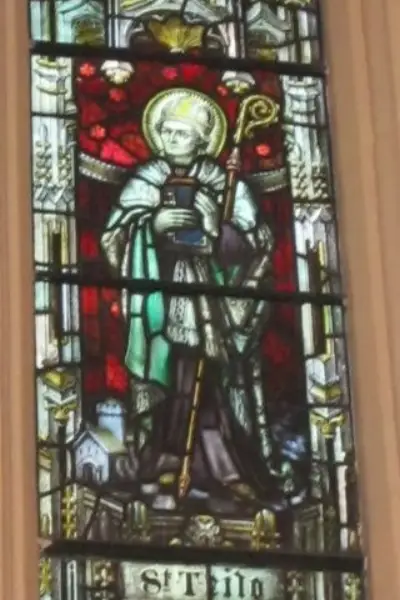
Overview
Teilo, also known as Eliud, was a monk, bishop and founder of churches in the British church, born about the year 500 at Penalun, the modern Penally near Tenby in Pembrokeshire, and died on 9 February, probably in 560, at Llandeilo Fawr. Tradition calls him cousin, friend and disciple of Saint David; he ruled as bishop of Llandaff and built the first church where Llandaff Cathedral now stands, his tomb lying there; he also founded Llandeilo Fawr and Penally Abbey. Educated in the schools of Dubricius and Paulinus of Wales, he helped David establish his abbey at Mynyw and succeeded Dubricius as bishop. Driven out by the yellow plague of the 540s, he left Wales in 549 for Dol in Brittany, where he joined Samson, received the confession of King Geraint and, legend says, tamed the dragon of Budic II. After some seven years he returned to Wales and died at Llandeilo Fawr. Three churches claimed his relics, and his body was said to have become three identical bodies. He is patron saint of Cardiff, honoured on 9 February in Wales, and more than twenty-five churches and schools in Wales, Brittany, Cornwall and Devon bear his name.
The Complete Life
Born at Penally
Teilo was born about the year 500 at Penalun, the modern Penally near Tenby in Pembrokeshire, in the southwest of Wales. Old Welsh speakers may have called him Eliau or Eilliau, while Latin writers rendered his name Teliarus or Teliavus, and the Bretons Telo or Teliau. Ensich ap Hydwn is usually named as his father; Anowed is reckoned his brother, and two saints, Ismael and Euddogwy, his nephews. Certain modern genealogies style him grandson of Ceredig son of Cunedda, and so kin to the royal house of Gwynedd, the dynasty that also counted Saint David among its members; but that connection to a northern dynasty is doubtful, resting on the Iolo Manuscripts, a collection now recognized as the forgeries of Edward Williams. More secure is the circle into which he was born: a Christian British aristocracy that gave its sons to the church in the generations after the Roman withdrawal, when monastic schools rather than cities formed the leaders of the Welsh. Out of Pembrokeshire, a heartland of the early Welsh church and a nursery of its monasteries, came one of that church's greatest bishops.
§ Biography
In the Schools of the Saints
Teilo's education was entrusted to two institutions, each directed by a saint. The first was the school of Dubricius, or Dyfrig, the renowned church leader and educator of southern Wales, whose pupils carried his influence across the whole region. The second was the school of Paulinus of Wales at a place called Wincdi-Lantquendi, generally thought to be Whitland, and there Teilo met and became the close companion of the student who would overshadow them all: David, called Dewi in Welsh, the future patron saint of Wales. The friendship formed in Paulinus's school lasted their lives, and tradition ranks Teilo as cousin, friend and disciple of David. Like many founder-bishops of the age, the companions appear to have had experience in battle, a reminder that leadership of the British church in the sixth century demanded the qualities of a chieftain as much as of a clerk. Armed with that double formation — the learning of Dubricius, the discipline of Paulinus, the friendship of David — Teilo was ready for the work of founding and ruling that filled his manhood. In an age when schools were few, such training marked a man out for rule.
§ Biography
Mynyw, Llandaff and the Flight to Dol
With his companions Aeddan and Ysfael, Teilo travelled to Mynyw, where David founded his abbey, later famous as St Davids. The site was held by an Irish pirate named Bwya; the saints drove him out, slaughtered his cattle and burned his stronghold down, clearing the ground for one of the great monasteries of western Christendom. Teilo's own succession came in the east: when Dubricius withdrew to a hermit's cell on Bardsey Island, Teilo succeeded him as Bishop of Llandaff. He founded the first church in Llandaff, on the site of the future cathedral where his tomb now lies, headed a monastic school, and became bishop over Glywysing and Gwent. In the 540s the yellow plague, probably the Justinian plague, struck Britain, and in 549 Teilo left with a small band of monks for Dol in Brittany. Travelling through Dumnonia they received the confession of King Geraint and joined Samson of Dol; the fruit groves the two saints planted still bear the names of Teilo and Samson. Budic II of Brittany, legend says, asked Teilo to subdue a belligerent winged dragon, which the saint tamed and bound to a rock in the sea. He remained in Brittany seven years and seven months.
§ Biography
Death and the Three Bodies
Returning from Brittany, Teilo settled at Llandeilo Fawr, the monastery that bore his name, and there he died on 9 February, probably around the year 560, though the exact year is unknown. Wales held him in exceptional honour by then, and at his death his body was said miraculously to have become three identical bodies — a legend that almost certainly preserves the fact that three great churches claimed his relics: Llandaff Cathedral, Llandeilo Fawr and Penally Abbey, the house at his birthplace. At Llandaff his tomb occupies a place to the right of the altar, and his skull rests in the south chapel within a reliquary. That reliquary passed into the keeping of the Mathew family, who held it from 1480 until 1658, after Sir David Mathew had restored the saint's shrine in the cathedral, which had been desecrated by Bristol pirates; it had been gifted by Bishop Marshall. Many miracles were witnessed, it is said, both while he was alive and later at his tomb. His relics spread further still, venerated at Landeleau and Plogonnec in Finistère and at Saint-Thélo in the Côtes-du-Nord, a distribution that maps the Breton half of his fame.
§ Biography
Feast Days of Three Lands
Teilo's canonization belongs to the age before formal processes, and the exact date is not known; he is simply acknowledged as one whose extraordinary labours served the church in Wales and Cornwall, and whose name was honoured likewise in Armorica. The Roman Martyrology of 2004 enters him on 9 February as Teliávus, recognising him as bishop and abbot of the monastery at Llandaf in Wales, an official confirmation of a cult fifteen centuries old. Both the Catholic Church and the Eastern Orthodox Church number him among their saints. His festival is observed at different times in different places: in Wales and at Saint-Thélo his day is 9 February; Dol keeps 29 November; the Breton churches elsewhere keep 25 November. After the calendar change of 1752 his fair at Llandeilo was held not on the 9th but eleven days afterward, on the 20th or the next Sunday, a folk-memory of the old reckoning. In art he is shown mounted on a stag, as many Breton churches depict him, the image that recalls the tamer of the winged dragon and the master of all wild things.
§ Roman Martyrology
The Map of His Name
At least twenty-five churches and schools in Wales, Brittany, Cornwall and Devon are dedicated to Teilo. Among them are the churches at Llandeloy and Llantilio Pertholey, the Catholic church in Whitchurch, Cardiff, and St Teilo's Church in Wales High School in the same city. Brittany keeps him in its very map: three villages, Landeleau, Landêliau and Saint-Thélo, are named after him, each one a Land-Teilo, the place of Teilo. In Cardiff he holds the first place among heavenly patrons, for he is the patron saint of the city. A spring outside Llandaff Cathedral, known as Saint Teilo's Well, keeps the memory of his presence at the church he founded. His name enters also the Roman Martyrology and the medieval lists of the Bishops of St Davids, where the catalogues place him in David's own succession. Few saints of the sixth century can show a geography so wide: from Pembrokeshire to Brittany, his dedications trace the sea-routes of the Celtic church and the devotion of the peoples who sailed them. Where his name was planted, a church took root and stayed.
§ Legacy
Timeline
- 500
Born at Penalun, the modern Penally in Pembrokeshire, according to the traditional dating
§ Biography
- 549
Left Wales with a small band of monks for Dol in Brittany, fleeing the yellow plague
§ Biography
- 556
Having spent seven years and seven months in Brittany, must have departed around this year by that reckoning
§ Biography
- 9 Feb 560
Died at Llandeilo Fawr on 9 February, probably around this year, mourned as among the most honoured men of Wales
§ Biography
- 1480
Sir David Mathew restored the saint's shrine at Llandaff Cathedral, and the skull reliquary passed to the Mathew family
§ Biography
- 1658
The possession of the saint's skull reliquary by the Mathew family, held since 1480, came to an end
§ Biography
- 1752
Calendar reform moved the observance of his fair at Llandeilo from the 9th of February to the 20th or the Sunday following
§ Festival
- 2004
Entered in that year's Roman Martyrology on 9 February as Teliávus, bishop and abbot of Llandaf
§ Roman Martyrology
The Record
- Major works
- First church at Llandaff·Llandeilo Fawr·Penally Abbey
- Patron of
- Cardiff
- Symbols
- Riding a stag
- Canonization
- Pre-congregation; exact date unknown; listed in the Roman Martyrology (2004) under 9 February as Teliávus
Prayer
Bibliography
Show 6 sources
- Wainewright, John. "St. Teilo" in The Catholic Encyclopedia, Vol. XIV. Robert Appleton Co. (New York), 1912.
- Rees, W. J. (trans.) Liber Landavensis, pp. 351 & 370 ff. Welsh MSS. Society (Llandovery), 1840.
- Baring-Gould, Sabine & al. The Lives of the British Saints: The Saints of Wales and Cornwall and Such Irish Saints as Have Dedications in Britain, Vol. I, pp. 64 ff. Chas. Clark (London), 1908.
- Martyrologium Romanum, 2004, Vatican Press (Typis Vaticanis), page 142.
- Samuel Lewis (1845). A topographical dictionary of Wales. S. Lewis and Co. p. 497.
- Brian Daniel Starr (2008). The Life of Saint Brychan: King of Brycheiniog and Family. Brian Daniel Starr. p. 41. ISBN 978-1-4392-0361-3.
Profile text adapted from the Wikipedia article, licensed CC BY-SA 4.0.
Pray with this saint every day
Save St. Teilo to your favorites, read the full profile, and get feast-day reminders in the Saints app.
Get the Saints AppFree on the App Store for iPhone and iPad