
died 1 January 404·Feast January 1
St. Telemachus
The Monk Whose Death Ended the Gladiatorial Games
Overview
Telemachus, remembered in some calendars as Almachus or Almachius, was an Eastern monk whose death in the arena became one of the most consequential martyrdoms of late antiquity. According to the church historian Theodoret, he traveled from his native Asia Minor to Rome, entered an amphitheatre, and tried to halt a gladiatorial combat. The enraged crowd stoned him to death, but his sacrifice is said to have moved the Christian emperor Honorius to outlaw the games. Holweck's biographical dictionary dates the episode to 391, while the better-attested tradition gives 1 January 404. The story survives through Theodoret's Ecclesiastical History and its abridgement by Cassiodorus, and later writers such as John Foxe retold it with varying details. Though popular imagination places the scene in the Colosseum, Theodoret says only that it happened in the stadium. Commemorated on 1 January by Catholics, Orthodox, and Anglicans, Telemachus is honored as a hermit and martyr whose lone intervention is credited with abolishing a brutal Roman spectacle.
The Complete Life
A Stranger from the East
Asia Minor, the peninsula where the apostolic missions had planted some of the earliest Christian communities, gave the Church one of its most quietly decisive witnesses. Telemachus was born there while the Eastern Roman Empire still governed the lands around the Aegean, and almost nothing is recorded of his family or youth. What the sources preserve is the shape of his adult life: he embraced the ascetic discipline of the monk, renouncing property and comfort in order to devote himself wholly to prayer and penance. Eastern monasticism was then in its vigorous adolescence, drawing countless men and women into deserts and cities alike to pursue holiness at whatever cost. From that world of fasts, vigils, and unceasing intercession Telemachus eventually set out for the old capital on the Tiber. Why he made the journey the ancient writers do not say; later generations have imagined pilgrimage, restlessness, or an unmistakable inward command. What is certain is that he arrived in Rome as a stranger from the East, an ascetic amid crowds entertained by blood, and that on the first day of January in the year 404, by the common reckoning, his long road reached its appointed end.
§ Saint Telemachus
An Ascetic in the City of Spectacles
Telemachus belonged to the company of ascetics who had come to Rome from the East, men whose manner of life marked them out among the pleasures of the capital. His vocation was not to a bishop's throne or a monastery's leadership but to the hidden discipline of penance, and it carried him, by a providence he could not have scripted, into the heart of Rome's most durable entertainment. The games had survived the empire's conversion to Christianity, and gladiators still fought before cheering thousands even as the emperors professed the faith of Christ. Into that contradiction walked a solitary monk. He cannot have mistaken the arena for a church. Everything formed by his ascetic training, the daily dying to self, the readiness to suffer, the conviction that mercy outranks spectacle, fitted him for the act he was about to perform. Theodoret of Cyrrhus, the Syrian bishop who preserved the story, presents him without ornament: a monk who did what conscience demanded when conscience spoke. Later retellings supply speeches and dramatic gestures, but the earliest account is starker and stronger. A man of prayer stepped between killers and their victims, and paid for it with his life.
§ Sources
Into the Stadium
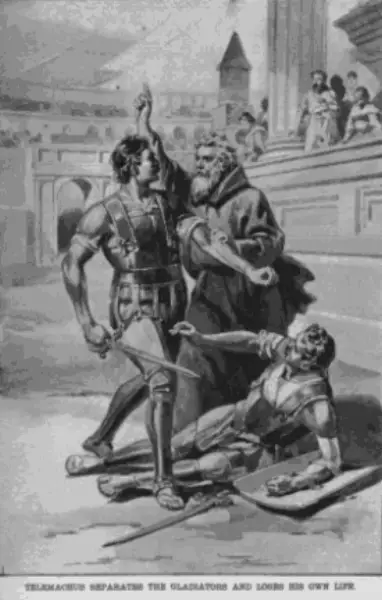
The act for which Telemachus is remembered took place, in Theodoret's words, in the stadium. Although later tradition often locates the martyrdom in the Colosseum, the historian names no such building; he says only that the monk entered the place where gladiators fought and tried to stop the combat. Standing in full view of the assembly, he pleaded for an end to the slaughter. The spectators, furious at the interruption of their sport, turned on him and stoned him. Some accounts add that he was first cut down by a gladiator's blade, and Foxe's version holds that the sight of his death changed the temper of the crowd; another strand of tradition has him denounce idolatry and the sacrifices offered to the gods before the city prefect ordered the gladiators to kill him. The outlines remain constant across the variants: a lone ascetic, an arena, an appeal for mercy, and a mob's lethal anger. Whatever the precise sequence, his death came while the games were in progress and because he dared to halt them. In an age that honored confessors for resisting persecution, Telemachus won his crown by resisting the cruelty of a crowd no one else had dared to face.
§ Sources
Stoned on the First of January
Telemachus died on 1 January 404, though the scholar Frederick George Holweck assigned the event to 391, and both dates continue to appear in reference works. The cause of death was execution by stoning, inflicted by the spectators whose entertainment he had interrupted. The fate of his body is not recorded, no shrine claims his remains, and the place of his burial is unknown. What he left instead was an impression strong enough to reach the imperial court. Honorius, the Christian emperor who ruled the West, learned of the monk's death and was, in the account that has come down through Theodoret, deeply moved by it. The martyrdom of an unarmed easterner, killed for begging that men should not kill one another for sport, became the occasion for a decision no earlier ruler had taken. The emperor went on to prohibit gladiatorial combat, an act that historians have long connected with the witness of the slain monk. Telemachus did not live to see the fruit of his sacrifice; he died among enemies in the January cold, and the empire he had shamed changed its laws soon after.
§ Saint Telemachus
A Martyr of the Undivided Church
Telemachus belongs to the long company of saints who were never canonized by formal process. His cause rests on antiquity and cult rather than on papal decree: he was honored as a martyr from the period when the Church counted such witnesses among her own, long before the graded stages of Servant of God, Venerable, Blessed, and Saint were defined. He is venerated in the Catholic Church, in the Orthodox Church, where Western Rite martyrologies list him, and in the Anglican Communion, with a common feast on 1 January. The foundation of his cult is literary rather than liturgical. Theodoret's Ecclesiastical History preserved the story in the fifth century, and Cassiodorus carried it into the Middle Ages through his tripartite epitome of the church histories. No dossier of miracles attaches to his name, and in art he is marked by no emblem beyond the scene of his death, remembered as The Martyrdom of Saint Telemachus. His sanctity rests on a single act, performed before a stadium of enemies and ratified, in the judgment of later centuries, by the emperor's abolition of the games his blood had ended.
§ Saint Telemachus
The Games Are Ended
Few martyrdoms can claim a social consequence as concrete as Telemachus's. Theodoret reports that Honorius, impressed by the monk's death, issued a historic prohibition of gladiatorial fights, and the story has made the little-known ascetic an enduring symbol of nonviolent resistance to institutionalized cruelty. His tale traveled widely. Cassiodorus abridged Theodoret's account for Latin readers; John Foxe retold it in his Book of Martyrs, adding that a gladiator first stabbed the saint but that his blood turned the hearts of the people; and another tradition has him preach against the worship of idols before the prefect condemns him. The details vary, but the kernel, a monk, an arena, and the end of the games, proved durable enough to be retold for century after century. He is counted among the martyrs of the Catholic Church and remembered each New Year's Day, the date of his witness. For modern readers his story has become an argument: that one unarmed man, standing against a cruelty everyone else had learned to enjoy, can accomplish what edicts and armies cannot, and that the price of such a victory is sometimes everything he has.
§ Sources
Timeline
- 391
An alternative dating recorded by the hagiographer Frederick George Holweck places the martyrdom in this year.
§ Saint Telemachus
- 1 Jan 404
Died by stoning in a Roman amphitheatre after stepping in to stop a gladiatorial combat.
§ Saint Telemachus
In Their Own Words
turned the hearts of the people
The Record
- Canonization
- Pre-congregation martyr; venerated by Catholics, Orthodox, and Anglicans
Prayer
Bibliography
Show 6 sources
- Theodoret. Honorius the Emperor, and the Monk Telemachus. Ecclesiastical History, Vol. 26. London, UK: Samuel Bagster and Sons, 1843, pp. 326–327.
- Holweck, Frederick George (1924). A Biographical Dictionary of the Saints. St. Louis, MO: B. Herder Book Co., p. 51.
- Jones, Terry. "Telemachus". Patron Saints Index. Archived from the original on 6 July 2008.
- Fox, John, ed. William Byron Forbush. "The Last Roman Triumph". Fox's Book of Martyrs.
- Burns, Paul (1995). Butler's Lives of the Saints: New Full Edition. Collegeville, MN: The Liturgical Press. ISBN 0-8146-2377-8.
- Baker-Smith, Dominic (2006). "Affectivity and Irenicism". Erasmus of Rotterdam Society Yearbook. 26 (1): 29–42. doi:10.1163/187492706X00051.
Profile text adapted from the Wikipedia article, licensed CC BY-SA 4.0.
Pray with this saint every day
Save St. Telemachus to your favorites, read the full profile, and get feast-day reminders in the Saints app.
Get the Saints AppFree on the App Store for iPhone and iPad