
1515-1582·Feast October 15
St. Teresa of Ávila
Carmelite Nun, Mystic, Doctor of the Church
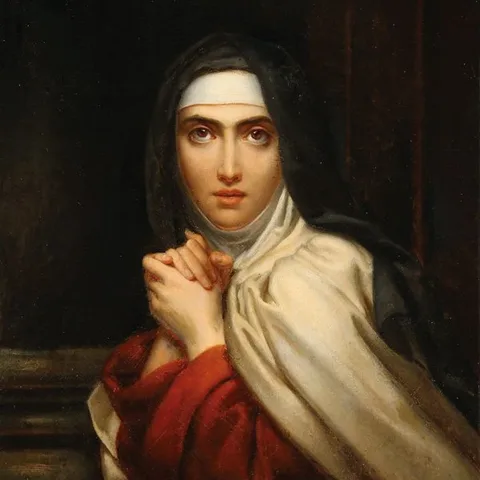
Overview
Teresa Sanchez de Cepeda Davila y Ahumada, born on 28 March 1515 at Avila into a converso merchant's family, lost her mother at fourteen, once plotted as a child to run off and be martyred by the Moors, and in 1534 entered the Carmelite Convent of the Incarnation against her father's hopes. Grave illness and the reading of Augustine's Confessions deepened her interior life; from 1559 came visions she was at first afraid to trust, among them the transverberation in which a seraph's golden lance of fire pierced her heart — the scene Bernini later carved. Finding the Incarnation's enclosure lax and its parlours crowded with visitors, she resolved on a house of strict poverty, and in 1562 founded St Joseph's at Avila over the town's protests. A patent from the Carmelite General in 1567 set her travelling the roads of Spain for two decades, founding reformed convents from Medina del Campo to Granada and enlisting John of the Cross and Fray Anthony of Jesus for the friars' first house at Duruelo in 1568. Persecution and the Piacenza chapter of 1576 slowed the work; relief from Gregory XIII and Philip II in 1579 freed it, and it became the separate Discalced Carmelite order. She died at Alba de Tormes in 1582 during the Gregorian calendar change.
The Complete Life
Early Life
At Ávila — or possibly at Gotarrendura — on 28 March 1515 was born Teresa Sánchez de Cepeda Dávila y Ahumada, of converso stock: her grandfather Juan Sánchez de Toledo, a forced convert, had been sentenced by the Inquisition for a relapse into Judaism before re-entering Catholic society, and her father Alonso — his son by a first marriage — was a rich dealer in wool who bought his way into the hidalguía. Teresa's mother Beatriz de Ahumada, his second wife, reared the girl in earnest Christianity and died when she was fourteen, leaving her to grieve and to take Our Lady as a mother in place of the one she had lost. The child's cast of mind showed early: with her brother Rodrigo she slipped out of the town at seven, intending the land of the Moors and martyrdom, and an uncle intercepted them barely beyond the walls. Knightly romances and books of fashion and gardens filled out her reading, until her father packed her off to the Augustinian sisters' school in Ávila.
§ Early life
Conversion and Vocation
A vocation she resisted at first, and accepted only after time spent with an uncle and other relations; in 1534, aged twenty and against her father's wishes, she went into the Carmelite Convent of the Incarnation at Ávila — a house of easy observance by the reputation of the day, raised on ground that had served the city's Jews for burial. Reading and suffering alike deepened her interior life. Osuna's Third Spiritual Alphabet taught her the prayer of recollection; Peter of Alcantara's treatise added the ascetical tradition around it. Mortification pursued past prudence laid her in bed for the better part of a year, near death, her recovery ascribed to St Joseph's intercession. A Spanish Confessions of St Augustine, coming to her about then, quieted her scruples — a saint so great yet once a sinner, she noted, was consolation. Then began the experiences that made her: on St Peter's day 1559 she was assured that Christ stood present before her, true body though unseen, and such visitations ran on for above two years. The most celebrated of them, the transverberation, sent a seraph's golden lance of fire again and again through her heart — agony and sweetness at once, and she would not have had it cease; it is the subject of Bernini's Roman masterpiece.
§ Religious life
Mission and Ministry
Teresa's reforming work began from what she saw around her. At the Incarnation, among some hundred and fifty nuns, enclosure had become so lax as to lose its purpose, and the endless parade of well-born visitors filled the house with frivolous conversation that made contemplative life nearly impossible. Advised by the Franciscan Peter of Alcantara and backed by her friend Doña Guiomar of Ulloa, she resolved on a house of strict poverty, and in 1562 founded the reformed convent of St Joseph's at Ávila. The project at first scandalized the town, and the little house stood in peril of suppression; the bishop's support and the evident order of the community turned animosity into approval. In 1567 a patent from the Carmelite general set her on the road: for two decades she traveled Spain founding reformed convents from Medina del Campo to Granada, and in 1568 she enlisted the young friar John of the Cross and Fray Anthony of Jesus for the first house of the reform among men at Duruelo. The cost was real: suspicion of her visions, resistance from the unreformed order, and the decree of the general chapter at Piacenza in 1576 that halted new foundations — years of persecution relieved only in 1579, when Gregory XIII and Philip II opened the way to a separate Discalced province, confirmed by papal decree in 1580. She died at Alba de Tormes on the night of 4/15 October 1582, in the very days of the Gregorian calendar change.
§ Religious life
Spirituality and Teaching
Her teaching lives in the handful of books obedience compelled from her, and they have never gone out of use. The Life — the autobiography she wrote partly in defense of her ecstasies — grades the soul's ascent: meditation and mental prayer first, then the prayer of quiet, then union that absorbs, then ecstasy itself. For her sisters she wrote the Way of Perfection on prayer and the counsels, with a housekeeper's eye on the practical. The Interior Castle, greatest of them, maps the soul as a castle of crystal with seven mansions ranged toward the innermost chamber where God dwells, and prayer as the journey of the soul inward to Him — geography drawn by one who protested she had no head for abstraction and so wrote only what she knew. Of the favors themselves she wrote without illusion: levitations embarrassed her, and she instructed the sisters to hold her down when they came. Clinicians and historians have since studied the detailed record she kept of her own states, and temporal lobe epilepsy among other diagnoses has been proposed. What her own tradition received was not a case history but Castilian prose of genius carrying the highest mystical theology, always tested against obedience, humility, and plain sense.
§ Introduction
Canonization
Teresa was canonized by Pope Gregory XV on 22 March 1622, forty years after her death — in the same ceremony that canonized Ignatius Loyola, Philip Neri, and Isidore the Farmer. In 27 September 1970 Pope Paul VI proclaimed her the first woman Doctor of the Church, a recognition of teaching authority the Church had until then conferred only on men; her feast is kept on 15 October.
§ Introduction
Legacy
Teresa is one of the small company of saints who changed the shape of an order and the language of a spirituality. The Discalced Carmelites she founded with John of the Cross remain one of the Church's great contemplative families, and her books are the classics from which Christian meditation in the West still learns — the Interior Castle's journey inward and the Way's instructions on prayer read far outside Carmel. With Catherine of Siena, she is patroness of Europe, and she stands at the head of the line of women doctors: Thérèse of Lisieux, Hildegard of Bingen, and the rest follow her through the door Paul VI opened in 1970. The converso granddaughter of a condemned relapse became, in Spain's golden age, the nation's most enduring religious writer.
§ External links
Timeline
- 28 Mar 1515
Born Teresa Sánchez de Cepeda Dávila y Ahumada at Ávila
§ Early life
- 1534
Enters the Carmelite Convent of the Incarnation at Ávila, aged twenty, against her father's wishes
§ Early life
- 1559
On St Peter's Day becomes convinced that Christ has presented himself to her in bodily form
§ Religious life
- 1562
The reformed convent she founded at Ávila is established and named St Joseph's, living in strict poverty
§ Monastic reformer
- Mar 1563
Having moved into the new convent house, she receives papal sanction for her principles of absolute poverty
§ Monastic reformer
- 1567
Receives a patent from the Carmelite General, Rubeo de Ravenna, to found further houses of the reform
§ Extended travels
- Nov 1568
The first monastery of Discalced Carmelite brothers is founded at Duruelo with John of the Cross
§ Monastic reformer
- 1576
Opponents within the unreformed Carmelite order begin harassing Teresa, her companions and her houses
§ Opposition to reforms
- 1577
Writes The Interior Castle, her masterpiece on the soul as a castle with seven mansions
§ Interior Castle
- 1579
The inquisition cases against her, Gracián and others are dropped
§ Opposition to reforms
- 1580
A formal papal decree adopts the split of the Discalced reform from the old Carmelite order
§ Opposition to reforms
- 4 Oct 1582
Dies at Alba de Tormes during the night that Spain switches from the Julian to the Gregorian calendar
§ Last days
- 25 Nov 1585
Her body is exhumed to be moved to Ávila and is found incorrupt
§ Holy relics
- 1586
The Duke of Alba de Tormes brings her body back, and Sixtus V orders it to remain there on pain of excommunication
§ Holy relics
- 1622
Canonized by Pope Gregory XV forty years after her death
§ Canonization
- 21 Jul 1627
Pope Urban VIII affirms her election as patron saint of Spain in a papal brief
§ Canonization
- 27 Sep 1970
Pope Paul VI proclaims her the first female Doctor of the Church, along with Catherine of Siena
§ Canonization
In Their Own Words
Let nothing disturb you. Let nothing make you afraid. All things are passing. God alone never changes. Patience gains all things. If you have God you will want for nothing. God alone suffices.
My Lord, it is time to move on... O my Lord and my Spouse, the hour that I have longed for has come.
It is love alone that gives value to all things.
Accustom yourself continually to make many acts of love, for they enkindle and melt the soul.
Be gentle to all and stern with yourself.
The Record
- Major works
- The Book of Her Life (autobiography)·The Way of Perfection·The Interior Castle·The Foundations (Libro de las Fundaciones)·Poems, including 'Nada te turbe'
- Patron of
- Headache sufferers (traditional)·Spain, co-patroness (Castile, from 1627)·People in need of grace
- Symbols
- Discalced Carmelite habit·Heart pierced by an arrow or lance (the transverberation)·Book and pen (writer)·Dove or the Holy Spirit
- Canonization
- Canonized 1622 by Pope Gregory XV; declared Doctor of the Church on 27 September 1970 by Pope Paul VI, the first woman so honored (with Catherine of Siena)
Prayer
Bibliography
Show 10 sources
- 1 2 At some hour of the night between 4 October and 15 October 1582, the night of the transition in Spain from the Julian to the Gregorian calendar .
- ↑ Pronounced / ˈ ɑː v ɪ l ə /
- ↑ Spanish pronunciation: [ teˈɾesa ˈsantʃeθ de θeˈpeða ˈdaβila i a.uˈmaða ]
- ↑ Teresa wrote that it must be a cherub ( Deben ser los que llaman cherubines ), but Fr. Domingo Báñez wrote in the margin that it seemed more like a seraph ( mas parece de los que se llaman seraphis ), an identification that most editors h
- ↑ For the creation of the work and an analysis of its transgression of religious decorum, see Franco Mormando's article, "Did Bernini's 'Ecstasy of St. Teresa' Cross a 17th-century Line of Decorum?," Word and Image, 39:4, 2023: 351–83 doi :
- ↑ Rowe 2011 , p. 47 refers to the Castilian Cortes as the "Castilian parliament"
- ↑ Learn more about what was modified in the modern update of The Interior Castle .
- ↑ See: The Autobiography Chs. 10–22
- ↑ Catholic Dictionary: Prayer of simplicity : "Meditation replaced by a purer, more intimate prayer consisting in a simple regard or loving thought on God, or on one of his attributes, or on some mystery of the Christian faith. Reasoning is
- ↑ Mental prayer, "oración mental", is not contemplative prayer. [ 64 ] [ 65 ] [ 66 ]
Profile text adapted from the Wikipedia article, licensed CC BY-SA 4.0.
Pray with this saint every day
Save St. Teresa of Ávila to your favorites, read the full profile, and get feast-day reminders in the Saints app.
Get the Saints AppFree on the App Store for iPhone and iPad