
281-319·Feast February 8
St. Theodore Stratelates
Martyr and Warrior Saint ('the General')
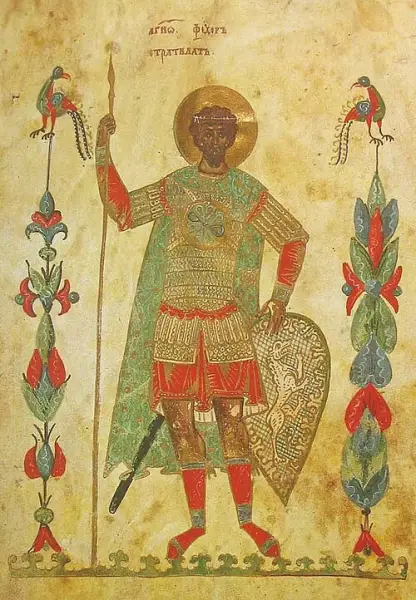
Overview
Theodore, called the Stratelates or General, and also Theodore of Heraclea, was a Greek warrior saint said to have been born at Euchaita in Asia Minor around 281. The legend credits him with killing, sword in hand, a giant serpent that had long terrorized the countryside outside his native town. For such bravery he was made military commander at Heraclea Pontica just as the emperor Licinius, in the years 307 to 324, launched his fierce assault on the Christians. Theodore invited the emperor to his city, promising a sacrifice to the pagan gods, and asked that every gold and silver image of the gods in Heraclea be collected at his house; he then shattered the lot and handed the pieces to the poor. Arrested for the deception, he was tortured and crucified, and the soldiers who came in the morning found him alive and unharmed; unwilling to slip away from a martyr's end, he gave himself up to Licinius and was beheaded on 8 February 319, a Saturday, at the third hour. His servant Varos, himself honored as a saint, witnessed and recorded the passion. Ancient and modern scholars alike doubt he was ever distinct from Theodore of Amasea the Recruit: Delehaye in 1909 held that the second Theodore was never historically established, and Walter in 2003 judged the Stratelates 'surely a fiction'. Before St Mark's relics came to Venice in 828, Theodore was that city's patron.
The Complete Life
Early Life
Theodore, surnamed the Stratelates, the General, is said to have been born at Euchaita in Asia Minor around 281, of Greek family, in the generation before the Diocletianic persecution. The legends that preserve him belong to the same great family of hagiography as the other warrior saints of the late empire, and, unusually among them, his tradition openly acknowledges its own doubleness: the stories of the military martyr Theodore of Amasea, Theodore the Recruit, and of Theodore the General diverged so far that later ages concluded they must be two men, and the earliest text distinguishing them dates only from the ninth century. Many scholars hold that there was in origin one Theodore, and that Stratelates is a second cult grown from the first; the shrine of the recruit was at Euchaita, and the general's separate shrine at Euchaneia, twenty-six kilometers away, a topography that itself suggests the division of one cult between two places.
§ Introduction
Mission and Ministry
The legend of Theodore Stratelates gives him the career of a soldier whose bravery made him commander of Heraclea Pontica on the Black Sea under the emperor Licinius. In the stories he is remembered for the killing of a giant serpent that terrorized the countryside around Euchaita, a deed the tradition places before his command and treats as the mark of his strength. As stratelates he is said to have used his office to protect the Christians of his province during the persecution Licinius inaugurated, and his conversions among the army are given as the reason for the emperor's concern with him, the same logic that governs the passion of Andrew Stratelates.
§ Life
Trial and Final Years
In the narrative of his passion Theodore invited Licinius to Heraclea, promising to offer sacrifice to the pagan gods, and asked that every gold and silver image of the gods in the city be assembled at his house. Having collected them, he smashed them to pieces and distributed the metal to the poor, a contempt of the gods enacted at the emperor's own expense. Arrested and tortured, he was, in the tradition, condemned and put to death at Heraclea Pontica, giving his life around 319, near the end of the persecutions. The memory of his death, and of his contempt for the idols, fixed his place among the great martyrs of the Byzantine calendar.
§ Life
Canonization
Theodore Stratelates is a pre-congregation saint, his cult established in the Byzantine church before formal canonization existed, and received in the Catholic, Oriental Orthodox, and Eastern Orthodox traditions alike. His feast, 8 February, is kept beside the feasts of Theodore the Recruit, whose memory the church also honors, and the Byzantine tradition celebrated the two Theodores with distinct offices while admitting their histories were entangled. The question of one Theodore or two was discussed by the Bollandists and by modern scholars, and the church's practice has been to keep the cults as the tradition delivered them.
§ Introduction
Legacy
Theodore Stratelates is the patron of soldiers, and in modern Russia his patronage was extended, remarkably, to the Federal Bailiffs Service, an illustration of the afterlife of the warrior saints in secular institutions. In Byzantine and Slavic art he appears as a mounted warrior or armed commander, distinguished in older depictions from the Recruit by the double-pointed beard; the dragon or serpent belongs to the composite Theodore iconography shared with Saint George. His cult, like that of his double, descends from the army chaplaincies of the late empire, and the historical question attached to his name has itself become part of his legacy, the standing case study of how the church's memory multiplies its martyrs.
§ Introduction
Timeline
- 281
Born at Euchaita in Asia Minor, of Greek origin
§ Life
- 8 Feb 319
After smashing the pagan statues of Heraclea and being crucified, he surrenders to Licinius and is beheaded on a Saturday morning
§ Life
- 828
Serves as patron saint of Venice until the relics of St. Mark are brought to the city
§ The two Theodores
- 900
Artisans of the Preslav Literary School produce a ceramic icon of the saint, among the very few such icons surviving
§ Commemoration
- 1909
Delehaye writes that the existence of a second Theodore has not been historically established
§ The two Theodores
The Record
- Patron of
- Soldiers, especially officers (the military aristocracy's patron, by contrast with Theodore Tiron's common soldiers)·Venice (early patron, before St Mark)
- Symbols
- Sword and dragon or serpent·Warrior's armor·Beard with two points in older iconography, distinguishing him from the one-pointed Theodore Tiron
- Canonization
- Ancient cult, pre-congregation; venerated in the Eastern Orthodox, Catholic, and Oriental Orthodox Churches
Prayer
Bibliography
Show 12 sources
- 1 2 3 "Prince Theodore - CopticChurch.net" .
- ↑ "Великомученик Феодор Стратилат | Свято-Троицкий Стефано-Махрищский монастырь" . stefmon.ru . Retrieved 2022-08-03 .
- ↑ "St Theodore Stratelates" . The Walters Art Museum .
- ↑ Nicol, Donald M. (1992). Byzantium and Venice: A Study in Diplomatic and Cultural Relations . Cambridge University Press. p. 25. ISBN 978-0-521-42894-1 .
- 1 2 "Greatmartyr Theodore Stratelates 'the General'", Orthodox church in America
- ↑ "Bibliotheca hagiographica graeca" . Bruxellis, Société des Bollandistes. 1909.
- 1 2 Walter p. 59
- ↑ Walter pp. 59–64
- ↑ Grotowski p. 119
- ↑ See Walter pp. 60–61 & note 93 and fig. 57
- ↑ Walter p. 60
- ↑ Walter p. 58, showing that Delehaye was mistaken in regarding them the same place
Profile text adapted from the Wikipedia article, licensed CC BY-SA 4.0.
Pray with this saint every day
Save St. Theodore Stratelates to your favorites, read the full profile, and get feast-day reminders in the Saints app.
Get the Saints AppFree on the App Store for iPhone and iPad