
d. 306·Feast November 9 (Roman Catholic); February 17 and the first Saturday of Great Lent (Eastern Orthodox)
St. Theodore of Amasea (Theodore Tiron)
Martyr and Great Martyr
Overview
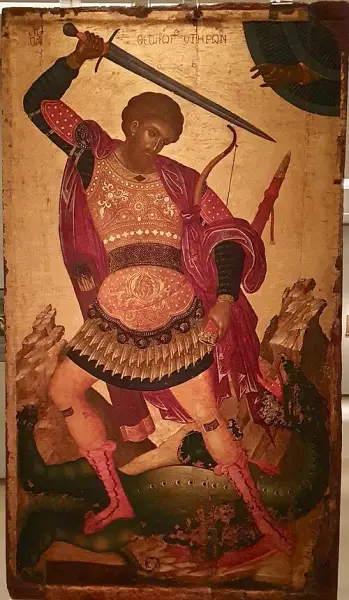
Theodore, whom tradition calls 'the Recruit' (Tiron), was a Greek soldier of the Roman army who died for his faith at Amasea in Pontus during the Great Persecution under Diocletian. His cohort had gone into winter quarters in Pontus when the order came that the men should offer pagan sacrifice. Theodore refused, and before the judges made an open confession of Christ's divinity. Because he was young, they held off sentencing him, giving him time to think it over. He used the time differently: he set fire to the local temple of the Magna Mater, Cybele. Rearrested and tortured, he was put to death by burning; the year is given as 306 by the later sources, though the Golden Legend says 287. Within a generation he was being honored as a martyr, and before 360 the empress Eusebia carried his relics to Euchaita. In Byzantine art he grew into a warrior saint on horseback, spearing a dragon — an image that predates the dragon of Saint George and later passed over to him — and in the Middle Ages he was often muddled with the parallel figure Theodore Stratelates of Heraclea. In Rome the faithful knew him simply as 'San Toto.'
The Complete Life
Early Life
Theodore, called the Tyro — the Recruit, the newly enlisted soldier — was born at Euchaita in Pontus, in the Roman Empire, modern Beyözü in Çorum Province, Turkey. He served as a soldier in the Roman army at a time when the armies of the eastern provinces were being pressed to demonstrate loyalty to the old gods, and the record of his life is entirely the record of his refusal.
§ Introduction
Trial and Witness
Ordered to sacrifice to the gods, Theodore refused, confessing the divinity of Jesus Christ. The judges, taking pity on his youth, did not execute him at once but delayed sentence to give him time to change his mind. Theodore answered the reprieve in the boldest way available to him: he burned the city's temple of Magna Mater, Cybele, the Great Mother whose cult the empire protected. He was rearrested and tortured, and was martyred by immolation, burned alive. The date is given as 287 in the Legenda Aurea, with later tradition, followed by Butler, giving 306, at Amasea; his death therefore falls either in the persecution of Diocletian's early years or its final and greatest phase. His relics were later carried to Euchaita, probably his birthplace, by the Christian empress Eusebia some time before her death in 360, and Euchaita became the centre of his cult.
§ Martyrdom
Canonization
Theodore belongs to the pre-congregation cult, venerated by the late fourth century, with liturgical commemoration continuous since. The Catholic Church keeps his feast on 9 November; the Eastern Orthodox Church on 17 February and on the first Saturday of Great Lent, where he is remembered with the koliva of boiled wheat associated with his memory. In Rome he was known to locals as San Toto.
§ Introduction
Legacy
Theodore stands as the earliest of the great soldier-saints and, within the Orthodox tradition, among the most frequently depicted. In painted images he appears as a soldier or, on occasion, in courtly attire, accompanied by the spear, the torch of his burning, the dragon, the pyre and the crown of thorns; he is invoked by soldiers, by Venice and Brindisi, against storms, and for the recovery of lost articles. The fresco of the Yılanlı Kilise in Cappadocia showing Theodore and George slaying the dragon side by side marks his place in the origin of the St. George and the Dragon legend — the dragon-slayer's iconography appears to have begun with Theodore, whom tradition also confused, or identified, with the similar soldier-martyr Theodore Stratelates of Heraclea. In the divine liturgy's first Saturday of Great Lent he guards the fast, a recruit still on duty.
§ Introduction
Timeline
- 306
Ordered at Amasea to offer pagan sacrifice, he refuses and confesses Christ's divinity; the judges defer sentence because of his youth
§ Martyrdom
- 306
He burns Amasea's temple of Magna Mater (Cybele), is rearrested, tortured, and condemned to death by fire
§ Martyrdom
- 17 Feb 306
Martyred by immolation at Amasea; later tradition follows Butler in dating this to 306, while the Legenda Aurea says 287
§ Introduction
- 360
Before her death in 360, the empress Eusebia carries his relics to Euchaita, which becomes the centre of his cult
§ Martyrdom
- 381
Gregory of Nyssa preaches an encomium in Theodore's honor at his sanctuary during the winter of 381
§ Veneration
- 397
Patriarch Nectarius of Constantinople preaches a sermon on Theodore before 397
§ Veneration
- 452
A church dedicated to Theodore exists in Constantinople
§ Veneration
- 530
A mosaic of Theodore is made at Rome's Church of Saints Cosmas and Damian
§ Veneration
- 600
The Vinica horseman image, if genuine, is the earliest picture of Theodore as an equestrian warrior holding a draco standard
§ Dragon slaying
- 828
Venice sets aside Theodore as its patron after the relics of Saint Mark are brought to the city
§ Venice
- 920
The Aghtamar fresco, of about 920, is the oldest secure image of Theodore killing a dragon
§ Dragon slaying
- 1000
In early-eleventh-century Cappadocia the dragon motif begins passing from Theodore to Saint George
§ Dragon slaying
- 1257
A Venetian admiral removes reputed relics of Theodore from Mesembria
§ Venice
- 1267
The relics taken from Mesembria reach Venice and are placed in the church of San Salvatore
§ Venice
- 1372
A statue of Theodore is set on the western column of the Piazzetta in Venice
§ Venice
- 1969
Following the Second Vatican Council's reform, the western church drops his liturgical celebration except in certain local calendars
§ Feast days
- 2000
Pope John Paul II makes the Roman church of San Teodoro available to Orthodox worship; services begin there in 2004
§ Veneration
The Record
- Patron of
- Soldiers·Venice·Brindisi·Against storms·Recovery of lost articles
- Symbols
- Dressed as a soldier, sometimes in court dress·Spear·Temple or torch (the burnt temple of Cybele)·Crocodile or dragon·Pyre·Crown of thorns
- Canonization
- Pre-congregation; venerated by the late 4th century
Bibliography
Show 3 sources
- ↑ The Latin epithet tyro ("recruit") preceded the Greek and was also variously hellenized as Týrōn ( Τύρων ), Tírōn ( Τίρων ), Tḕrōn ( Τήρων ), and Teírōn ( Τείρων ). [ 5 ]
- ↑ Butler had mentioned the likelihood that there was only one saint, probably a martyr and possibly a soldier, pointing out that the legends overlapped and could not be distinguished. [ 32 ] His 20th-century editor Thurston cited Delehaye .
- ↑ Walter shows that Delehaye was mistaken in thinking them the same place. [ 34 ]
Profile text adapted from the Wikipedia article, licensed CC BY-SA 4.0.
Pray with this saint every day
Save St. Theodore of Amasea (Theodore Tiron) to your favorites, read the full profile, and get feast-day reminders in the Saints app.
Get the Saints AppFree on the App Store for iPhone and iPad