
1829-1861·Feast February 2 (martyrdom); November 24 (DB row; with 117 Vietnamese martyrs)
St. Théophane Vénard
Priest of the Paris Foreign Missions, Martyr of Tonkin
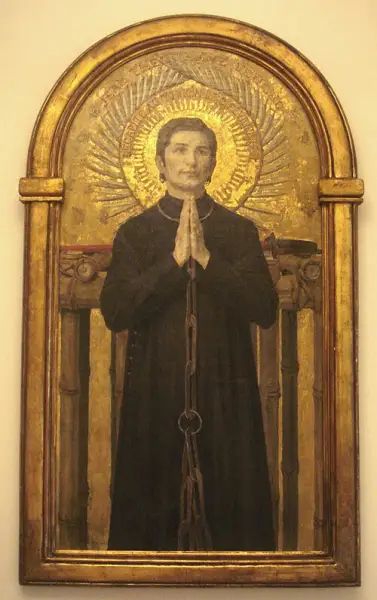
Overview
Jean-Théophane Vénard, born on 21 November 1829 in the village of Saint-Loup-sur-Thouet in the Poitiers diocese, was a French missionary priest of the Paris Foreign Missions Society, beheaded at Tonkin on 2 February 1861. One of six children of the village schoolmaster, he determined on the missions after reading as a boy of the martyrdom of Jean-Charles Cornay, studied at Doué-la-Fontaine, Montmorillon, and the major seminary at Poitiers, entered the Paris seminary of the Foreign Missions, and was ordained on 5 June 1852. Sailing from Antwerp that autumn and delayed by a gale into Plymouth, he passed through Singapore and fifteen months of Chinese studies in Hong Kong before being assigned to West Tonkin under Bishop Pierre-André Retord. There a new royal edict forced the missionaries into caves and forests, and Vénard exercised a largely nocturnal ministry in the mountains. Captured on 30 November 1860 and taken via Phủ Lý to Hanoi, he refused before the mandarin to apostatize or to tread on a crucifix, and was sentenced to beheading. He spent his last two months in a cage, writing to his family letters of such joy that they have never been out of print, until his execution on 2 February 1861. Beatified in 1909 and canonized in 1988, he is one of the most beloved of the Vietnam martyrs, a patron remembered for cheerfulness in chains.
The Complete Life
Early Life
Jean-Théophane Vénard first saw the light of day on 21 November 1829 in Saint-Loup-sur-Thouet, a village of the French countryside in the Poitiers diocese, born into the household of the village schoolmaster and his wife, one of six children in a family where faith and letters were the common air. His brother Eusèbe would later become curé of Assai, a village near Saint-Loup, and his sister Mélanie entered a religious community at Amiens, so the household gave the church more than one of its own. The decisive book of his childhood was an account of the martyrdom of Jean-Charles Cornay, another priest of the region killed in Tonkin in 1837, which the boy read and never forgot; the pattern of his life was set by a story. Taught the beginnings of Latin by the parish priest, he went in 1841 to the college of Doué-la-Fontaine, at eighteen to philosophy at the seminary of Montmorillon, and then to theology at the major seminary of Poitiers. He entered the seminary of the Paris Foreign Missions Society as a subdeacon and was ordained priest on 5 June 1852; on 19 September of that same year he left Paris for the Far East.
Vocation
Vénard's vocation was to the foreign missions at their most dangerous. The Paris Foreign Missions Society, to which he gave himself, was founded to supply Asia with priests, and its roll of martyrs was already long when he joined; the Tonkin to which he was sent had been watered by the blood of its members for decades, under the successive edicts of the Nguyễn emperors against the Christian religion. His journey out was itself an education in patience: a heavy gale drove the ship into Plymouth, where she lay delayed, and she finally put to sea on 10 October, reaching Singapore on New Year's Day 1853. Three weeks later he was sent to Hong Kong, where he remained fifteen months studying Chinese, the standard apprenticeship of the Society's men. A change of plans then assigned him not to China but to the mission of West Tonkin, the northern kingdom of Vietnam, under Bishop Pierre-André Retord. He arrived to find the church underground: a new royal edict had been issued against the Christians, and the bishops and priests were living in caves and dense woods, moving by night. The young priest's vocation was thus from the beginning a vocation to hunted ministry, and he accepted it with the cheerfulness that became his signature.
Mission
Vénard's ministry in West Tonkin lasted six years and was carried on in conditions of perpetual concealment. Based in the mountainous districts, he travelled mostly at night, celebrating the sacraments in hidden gatherings, training catechists, and sustaining the village communities that the edicts had scattered. The tradition of his mission preserves the image of a slight, lively man, devoted to his Christians and to the children he taught, writing home in the same playful affectionate style he had used since boyhood. The edict under which he lived and died was part of the renewed persecution of the emperor Tự Đức, whose court saw in Christianity a threat both ideological and political, in an age when French gunboats were appearing off the coast. On 30 November 1860 Vénard was seized and taken to Phủ Lý, and from that city on to the prefecture at Hanoi. Tried before a mandarin, he was required, in the standard formula, to apostatize and to trample on a crucifix; he refused both, and was sentenced to beheading. His mission thus ended where it had in a sense always pointed, and the refusal to tread on the cross became the summary of the whole Vietnamese martyrdom.
Spirituality
The spirituality of Théophane Vénard is contained in his prison letters, which his family preserved and which have been translated into many languages, praised by popes and read by generations of seminarians. Written from the cage in which he spent his last two months, they are astonishing for their tone: tender toward his family, humorous about his condition, and openly joyful in anticipation of his death, which he calls his crown and his wedding. To relatives' grief he answers with the theology of the martyrs stated as simple common sense, that a missionary's life is given in advance and that to die for Christ is the completion, not the frustration, of the work. He asked for the prayers of his family 'that I may be faithful', not that he might be delivered, and he made arrangements for his few possessions with the same lightness. At times during his captivity he was let out to hear the confessions of fellow prisoners and to take walks saying the rosary and singing hymns of thanksgiving, while the guards looked on in amazement. On the road to his execution he chanted psalms; to the executioner — a man who had designs on his clothes and wanted to know what he would give for a quicker death — he made the answer that is now his epitaph: 'The longer it goes on, the better it shall be.'
Final Years
Vénard was beheaded at Hanoi on 2 February 1861, the feast of the Presentation, after two months of captivity. The interval between sentence and execution was spent in the cage, from which the letters came; the tradition adds that the Christians were able to communicate with him and to support him, and that his bearing converted some of those who watched. After the beheading his head was exposed on a pole, according to the custom, and was secured by the Christians, who hid it; it is now venerated in Tonkin, while his body rests in the crypt of the motherhouse of the Paris Foreign Missions Society in Paris, to which it was eventually returned. The persecution that killed him was the same wave that produced the 117 martyrs of Vietnam canonized in 1988, of whom he is one of the small number of Europeans. His death, like his letters, circulated quickly in France, where the Society's annals made him known to the Catholic public within a generation, and the cause that would end in his canonization began with the introduction at Rome in 1879.
Legacy
The legacy of Théophane Vénard is chiefly literary and exemplary: he is the martyr as letter-writer, the man whose gaiety under sentence made the cost of discipleship attractive rather than merely terrible. His letters influenced a wide public, and among their readers was St. Thérèse of Lisieux, the young Carmelite of the next generation, who loved his story and called him her brother, keeping his portrait in her cell; the two saints, the joyful French missionary and the joyful French contemplative, have been paired by the church's devotion ever since. Beatified on 2 May 1909 by Pope Pius X together with thirty-three other martyrs of Tonkin, Cochin-China, and China, he was canonized by Pope John Paul II on 19 June 1988, in the same ceremony that raised the Vietnamese martyrs of many periods to the altar. The Roman Martyrology sums up his life in six years of clandestine ministry, hardship and suffering, a cage and a sentence under the emperor Tự Đức, and a peaceful walk to martyrdom. For the church in Vietnam, and for the whole church, he remains a patron of missionary joy.
Timeline
- 21 Nov 1829
Born at Saint-Loup-sur-Thouet in the Diocese of Poitiers, one of six children of the village schoolmaster.
§ Life
- 1841
Entered the college of Doué-la-Fontaine, fired by childhood reading of the martyrdom of Jean-Charles Cornay.
§ Life
- 5 Jun 1852
Ordained a priest on 5 June at the Paris Seminary for Foreign Missions, where he had entered as a sub-deacon.
§ Life
- 19 Sep 1852
Left Paris for the Far East, embarking from Antwerp; the gale-driven vessel paused at Plymouth before sailing on 10 October.
§ Life
- 1 Jan 1853
Arrived at Singapore on New Year's Day, then was sent to Hong Kong to study Chinese for fifteen months.
§ Life
- 30 Nov 1860
Captured and sent to Phủ Lý, then to the prefecture at Hanoi, where he refused to trample a crucifix.
§ Life
- 2 Feb 1861
Beheaded at Hanoi after imprisonment in a cage, chanting psalms on the way to execution.
§ Life
- 1879
His beatification cause was formally opened in Rome.
§ Veneration
- 2 May 1909
Declared Blessed by Pope Pius X in Rome, together with thirty-three other martyrs.
§ Veneration
- 19 Jun 1988
Canonised by Pope John Paul II in Vatican City along with nineteen other martyrs.
§ Veneration
In Their Own Words
The longer it lasts the better it will be.
The Record
- Major works
- Letters from prison to his family, classics of missionary spirituality, published after his death
- Patron of
- Vietnam missions·Prisoners for the faith·Those facing execution (by devotion)
- Symbols
- Missionary's cassock·The cage of his captivity·Palm of martyrdom·Beheading sword
- Canonization
- Beatified 2 May 1909 with 33 martyrs of Tonkin, Cochin-China, and China; canonized 19 June 1988 by Pope John Paul II with 19 other martyrs
Prayer
Profile text adapted from the Wikipedia article, licensed CC BY-SA 4.0.
Pray with this saint every day
Save St. Théophane Vénard to your favorites, read the full profile, and get feast-day reminders in the Saints app.
Get the Saints AppFree on the App Store for iPhone and iPad