
1873-1897·Feast October 1
St. Thérèse of Lisieux
Carmelite Virgin, Doctor of the Church
Overview
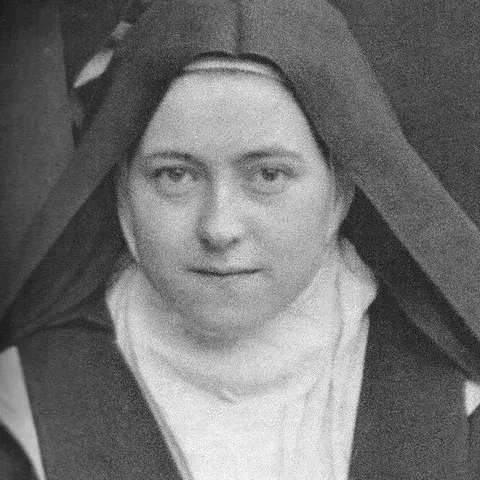
Marie-Francoise-Therese Martin was born at Alencon on 2 January 1873, last of the nine children of the watchmaker Louis Martin and the lacemaker Zelie Guerin, a couple later canonized together in 2015. Zelie's death when Therese was four and a half turned a lively child into a timid one; the family's move to Lisieux brought school unhappiness, nervous illness cured after she saw a statue of the Virgin smile at her in 1883, and, on Christmas Eve 1886, the sudden 'complete conversion' she described as God making her grow up in an instant. At fourteen she sought Carmel; refused for her age, she appealed directly to Pope Leo XIII during a Roman pilgrimage and entered the Carmel of Lisieux on 9 April 1888, fifteen years old. Nine hidden years followed — laundry, sacristy, care of difficult novices under her sister Pauline, now Mother Agnes — from which grew her 'little way': since great deeds were forbidden her, love would prove itself in small sacrifices and childlike trust. From 1895 she offered herself to merciful love and served as spiritual sister to the missionary priests Maurice Belliere and Adolphe Roulland, while tuberculosis advanced. Her three autobiographical manuscripts, published after her death as Story of a Soul, carried her name around the world. She died on 30 September 1897, aged twenty-four.
The Complete Life
Early Life
Marie-Françoise-Thérèse Martin was born at Alençon on 2 January 1873, the last of the nine children of the watchmaker Louis Martin and the lacemaker Zélie Guérin — a couple who would themselves be canonized together in 2015, the first spouses to be so honored. Four of the nine children died in infancy; the five surviving daughters all became nuns. Zélie's death of cancer when Thérèse was four and a half turned a lively, oversensitive child into a timid one; the family's move to Lisieux in November 1877 brought school unhappiness, then the nervous illness of 1882-83, cured — as she told it — after she saw a statue of the Virgin smile at her. On Christmas Eve 1886 came what she called her complete conversion: God, in an instant, made her grow up, and the timid girl became the young woman who could appeal to a pope.
§ Citations
Entry into Carmel
At fourteen Thérèse sought entrance to the Carmel of Lisieux, where three of her sisters already were; the bishop refused for her age, and her Roman pilgrimage of 1887 gave her the stage for her famous appeal: at the audience of 20 November she asked Pope Leo XIII for permission to enter, and he answered that what the superiors decided was God's will. Permission followed, and she entered Carmel as a postulant on 9 April 1888, fifteen years old — a child in an austere house of adults. Nine hidden years followed: the laundry, the sacristy, the refectory, and from 1893 the care of the novices under her sister Pauline, now Mother Agnes, who asked her to write the account of her childhood that became the first manuscript of Story of a Soul.
§ Citations
The Little Way
Out of those hidden years grew the 'little way', her teaching that has shaped Catholic spirituality more than any other of the modern era. Her reasoning was simple: since great deeds and martyrdom were forbidden her, love would prove itself in small things — small sacrifices, hidden acts of charity, childlike trust in God. In 1895 she made the Act of Oblation to Merciful Love, offering herself as a victim to God's love; the next years tested the offering with the dark night of aridity and doubt about heaven, which her later manuscripts describe with terrible honesty. In 1896, on the eve of Good Friday, her first haemoptysis revealed the tuberculosis that would kill her; and from her bed she served as spiritual sister to two missionary priests, Maurice Bellière and Adolphe Roulland, writing them the letters that join her contemplative vocation to the missions.
§ Merciful love
Final Illness
The last eighteen months were a physical and spiritual agony recorded almost day by day, for the prioress had ordered the youngest manuscript written and her sisters kept notes of her sayings. The tuberculosis advanced through hemorrhages, and her trial of faith continued: she told of being tempted to deny heaven and to believe only this life. She died on 30 September 1897, twenty-four years old, her last words being, according to the community's record, my God, I love you. She was buried in the Carmel's plot at Lisieux; the graces reported at her tomb began the movement that her manuscripts, circulated after her death, would carry around the world.
§ Introduction
Canonization
The cause moved with a speed the modern Church has not seen since: beatified on 29 April 1923, canonized by Pope Pius XI on 17 May 1925. In 1927 Pius XI named her, with Francis Xavier, co-patron of the missions — a cloistered nun patron of the missions, on the strength of her offering and her correspondence. A century after her death, in 1997, Pope John Paul II proclaimed her a Doctor of the Church through the apostolic letter Divini Amoris Scientia — the youngest doctor, and the third woman, after Teresa of Ávila and Catherine of Siena. Her feast is 1 October.
§ Other recognition
Legacy
Few saints in the Church's history have been as popular as Thérèse, and certainly none of the nineteenth century was more photographed. The basilica at Lisieux is among the most visited shrines in the world; her autobiography, Story of a Soul, has been translated into every major language and has never been out of print. Her little way democratized sanctity — the teaching that holiness is available in the ordinary, and that confidence in God matters more than achievement — and it has been taken up by every subsequent papacy. For Vietnam this corpus remembers her as co-patron of the missions with Francis Xavier, invoked in the church of the martyrs; her showers of roses, promised in her last months, remain the ordinary language of devotion to her.
§ Posthumous devotion
Timeline
- 2 Jan 1873
Born Marie Françoise-Thérèse Martin at Alençon, daughter of Louis Martin and Zélie Guérin
§ Birth and infancy
- 28 Aug 1877
Her mother Zélie dies of breast cancer at the age of forty-five
§ Family background
- Nov 1877
Louis Martin moves the family to Lisieux, to the house called Les Buissonnets near his wife's relatives
§ Early years
- Oct 1882
Her sister Pauline enters the Carmelite convent at Lisieux, deepening Therese's own desire for that life
§ Early years
- 13 May 1883
Recovered from a nervous illness, she reports that the statue of the Virgin in her room smiled at her
§ Illness
- 24 Dec 1886
Receives the grace she calls her 'complete conversion' on Christmas Eve
§ Complete conversion
- 20 Nov 1887
During the Roman pilgrimage she kneels before Pope Leo XIII and asks leave to enter Carmel at fifteen
§ Rome and entry to Carmel
- 9 Apr 1888
Becomes a postulant in the Carmel of Lisieux, joining two of her elder sisters
§ The Carmel of Lisieux
- 10 Jan 1889
Receives the habit and the religious name Therese of the Child Jesus
§ Postulancy
- 8 Sep 1890
Makes her religious profession at the age of seventeen and a half
§ Novitiate
- 29 Jul 1894
Her father Louis Martin dies
§ Life as a Carmelite
- 9 Jun 1895
Makes her Act of Oblation to Merciful Love during Mass on the feast of the Holy Trinity
§ Merciful love
- 1896
Suffers a first haemoptysis on the eve of Good Friday; tuberculosis is eventually diagnosed
§ Final years
- Jul 1897
Makes her final move to the monastery infirmary as her illness advances
§ Final years
- 19 Aug 1897
Receives her last communion
§ Final years
- 30 Sep 1897
Dies of tuberculosis at the Carmel of Lisieux, aged twenty-four; her last words are 'My God, I love you!'
§ Final years
- 4 Oct 1897
Buried in the Carmelite plot of the municipal cemetery at Lisieux
§ Posthumous devotion
- Sep 1910
Her grave is opened and her remains moved into a leaden coffin in another tomb
§ Posthumous devotion
- 10 Jun 1914
Pope Pius X signs the decree opening her process of canonization
§ Recognition
- 14 Aug 1921
Benedict XV promulgates the decree on her heroic virtues, declaring her venerable
§ Recognition
- 29 Apr 1923
Beatified by Pope Pius XI
§ Recognition
- 17 May 1925
Canonized by Pope Pius XI, only twenty-eight years after her death
§ Canonization
- 1927
Pope Pius XI names her co-patroness of the missions, with Saint Francis Xavier
§ Other recognition
- 1944
Pius XII names her joint patroness of France alongside Joan of Arc
§ Other recognition
- 19 Oct 1997
Pope John Paul II declares her a Doctor of the Church in the apostolic letter Divini Amoris Scientia
§ Other recognition
In Their Own Words
For me, prayer is a surge of the heart; it is a simple look turned toward heaven.
Since the age of three I have refused God nothing.
I assure you that God is much better than you believe.
My God, I love you!
The Record
- Major works
- Story of a Soul (autobiographical manuscripts A, B, C)·Letters, including the correspondence with Maurice Belliere and Adolphe Roulland·Plays on Joan of Arc (pious recreations, 1894-95)·Prayers and poems
- Patron of
- Missions (co-patroness with St. Francis Xavier, 1927)·France (co-patroness with St. Joan of Arc, 1944)·Aviators·Florists·The ill
- Symbols
- Roses·The Little Flower·Carmelite habit·The Holy Face of Jesus
- Canonization
- Beatified 29 April 1923; canonized 17 May 1925 by Pope Pius XI; declared Doctor of the Church on 19 October 1997 by Pope John Paul II (Divini Amoris Scientia)
Prayer
Bibliography
Show 12 sources
- ↑ French : Thérèse de Lisieux [ teʁɛz də lizjø ]
- ↑ Thérèse de l'Enfant Jésus et de la Sainte Face
- ↑ "Prière de la "petite Thérèse" de Lisieux" . site-catholique.fr . 11 September 2014.
- ↑ "Thérèse et la "petite voie" " . Le Monde.fr . 20 March 2005 – via Le Monde.
- ↑ McBrien, Richard P. (2001). The Pocket Guide to the Saints (1st paperback ed.). New York: HarperCollins . p. 672. ISBN 0-06065340-X . Retrieved 29 May 2013 .
- ↑ Flinn, Frank K. (2006). Encyclopedia of Catholicism . New York City: Infobase Publishing . p. 598. ISBN 0-8160-7565-4 . Retrieved May 29, 2013 .
- 1 2 The Autobiography of St. Thérèse of Lisieux: The Story of a Soul . Translated by Beevers, John. New York: Image Books . August 2001. pp. vii. ISBN 0-385-02903-9 .
- ↑ Descouvemont (1996) , p. 5.
- ↑ John Paul II (19 October 1997). "Angelus - Proclamation of St Therese of the Child Jesus and the Holy Face as a "Doctor of the Church" " . Holy See : Libreria Editrice Vaticana . Retrieved 13 October 2018 .
- 1 2 "The Life of Saint Thérèse of Lisieux" . Holy See: Libreria Editrice Vaticana . Retrieved 13 October 2018 .
- ↑ Calendarium Romanum (Libreria Editrice Vaticana, 1969), pp. 104, 141.
- ↑ Simar, Jean-Marie; Boubli, Nathalie (2013-12-07). "St. Therese's birthplace" . Sanctuaire d'Alençon (Shirne of Alençon) . Archived from the original on 2013-12-07 . Retrieved 2018-04-19 .
Profile text adapted from the Wikipedia article, licensed CC BY-SA 4.0.
Pray with this saint every day
Save St. Thérèse of Lisieux to your favorites, read the full profile, and get feast-day reminders in the Saints app.
Get the Saints AppFree on the App Store for iPhone and iPad