
c. 1225-1274·Feast January 28
St. Thomas Aquinas
Priest and Doctor of the Church
Overview
Tommaso d'Aquino, youngest son of the Lord of Roccasecca, was born around 1225 into a family that had marked him for the abbacy of Monte Cassino, where his schooling began at five. Aristotelian studies at Naples and Dominican preaching turned him instead to the friars at nineteen — a choice his family answered by kidnapping him and holding him nearly a year in the family castles, even, the canonization records say, hiring a prostitute to shake his resolve; he drove her off with a burning brand. Freed in 1244, he studied under Albertus Magnus at Paris and Cologne, where classmates who mistook his silence for slowness were told the dumb ox would one day bellow for the world to hear. Regent master at Paris by his early thirties, he taught, disputed, and dictated at an extraordinary rate, forging the synthesis of Aristotle and Christian doctrine called Thomism and writing the Summa contra Gentiles, disputed questions, commentaries on Scripture and Aristotle, and Eucharistic hymns still sung at liturgy. From 1272 he led a new studium at Naples. After a mystical experience at Mass on 6 December 1273 he stopped writing — all he had composed seemed like straw to him now — and on the way to the Council of Lyon he struck his head, fell ill, and died at Fossanova Abbey on 7 March 1274.
The Complete Life
Early Life
Tommaso d'Aquino was born around 1225 in the family castle at Roccasecca, near Aquino, in a corner of the Kingdom of Sicily that is now Lazio. He came from the powerful branch of the d'Aquino family: his father Landulf, Lord of Roccasecca, was a knight in the service of the Emperor Frederick II; his mother Theodora was of Norman stock, a countess of Teano. He was the youngest of nine children in a house of soldiers, and the family plan for a youngest son was the church — specifically the abbacy of Monte Cassino, the great Benedictine monastery then held by Thomas's uncle Sinibald. At five he was sent to the abbey for his first schooling. When war between Frederick II and Pope Gregory IX reached the monastery in 1239, his parents moved him to the studium generale at Naples, and the change proved decisive. There he studied under Peter of Ireland, met the newly translated Aristotle along with his Arab and Jewish commentators Averroes and Maimonides, and encountered John of St. Julian, a Dominican preacher — an order then barely thirty years old and held in no esteem by nobles.
§ Early life (1225–1244)
Conversion and Vocation
At nineteen Thomas resolved to join the Dominicans, and his family answered with force. The friars, expecting trouble, arranged to move him to Rome and on to Paris; his brothers, on his mother's instructions, seized him on the road as he stopped to drink at a spring and carried him to the family castle at Monte San Giovanni Campano. For nearly a year he was kept at Monte San Giovanni and Roccasecca while his family tried to make him renounce the friars' habit and take up the respectable Benedictine career. He spent the captivity tutoring his sisters and corresponding with the Dominicans. The episode that fixed itself in the tradition came when his brothers introduced a prostitute into his room to break his resolution: he drove her out with a burning brand, traced a cross on the wall with it, and — the canonization records say — fell into an ecstasy in which angels girded him with a cord of chastity, a belt he wore the rest of his life. In 1244 his mother, seeing that open surrender would humiliate the family more than escape, arranged for him to be let down by night through a window. He went to Naples, then to Rome, where the Master General of the order received him.
§ Early life (1225–1244)
Mission and Ministry
His working life was spent in the schools, and it was one of the most productive in the history of thought. Sent to Paris in 1245, he studied under Albertus Magnus and followed him to Cologne in 1248, where his silence led classmates to call him the dumb ox — Albertus replying that this ox's bellowing would one day be heard through the whole world. Back in Paris he lectured on Scripture, commented on Peter Lombard's Sentences, and in 1256 was made regent master in theology by the direct intervention of Pope Alexander IV, in the middle of the university's war over the mendicant orders, alongside his friend Bonaventure. His first regency produced the Disputed Questions on Truth. From 1259 he moved through the papal orbit — Orvieto, where he finished the Summa contra Gentiles, composed the Catena aurea, and wrote for Pope Urban IV the office for the new feast of Corpus Christi, whose hymns, Pange lingua with its Tantum ergo and Panis angelicus, are still sung; then Rome from 1265, teaching at Santa Sabina, where he began the Summa Theologiae. Recalled to Paris in 1268 against the Averroists, he wrote On the Unity of the Intellect against their reading of Aristotle. In 1272 his own province called him to found a studium at Naples, and he headed it until his death.
§ External links
Spirituality and Teaching
Thomas's teaching is the meeting of Aristotle with Christian doctrine, and its mark is order: every question set out, objections heard, distinctions drawn, and answered — a method as prayerful in intention as it is rigorous in execution. He held that grace does not abolish nature but perfects it, and built on that conviction the synthesis later called Thomism: the Five Ways to the knowledge of God, the treatise on natural law, the account of the virtues, the theology of the sacraments and above all of the Eucharist. His devotion ran to the same point as his intellect. The hymns he wrote for Corpus Christi became the liturgy's own words for the Blessed Sacrament. The mystical reports of his last years — tears before a crucifix, the reported answer 'Nothing but you, Lord' to the Christ who asked his reward, and finally the Mass of 6 December 1273 after which he put down his pen — belong to the tradition of a man for whom thinking about God and loving God were a single act.
§ External links
Trial and Final Years
At Naples he worked on the third part of the Summa and preached to the townspeople daily through Lent of 1273, on the Commandments, the Creed, and the Our Father — sermons the people received eagerly. On 6 December 1273, celebrating Mass, he underwent an experience of extraordinary length and depth; when his secretary Reginald of Piperno pressed him to resume dictation, he answered that he could not, because everything he had written seemed like straw. The Summa was left unfinished. In 1274 Gregory X summoned him to the Second Council of Lyon, where his work on the Greeks was to be presented. Riding along the Appian Way he struck his head on a fallen branch, and the illness that followed never fully left him. He stopped first at Monte Cassino, then at the Cistercian abbey of Fossanova, where the monks nursed him. At the last rites he prayed that everything he had written he submitted to the correction of the Roman Church, and he died on 7 March 1274 while the Song of Songs was being commented on for him. Later medicine has suggested a chronic subdural hematoma from the blow to his head.
§ Late career, cessation of writing, and death (1272–1274)
Canonization
His path to the altar ran through controversy. In 1277, three years after his death, Bishop Étienne Tempier of Paris condemned 219 propositions, some twenty of them recognizably Thomistic, and the condemnation damaged his name among the theologians for years. His order's persistence — and the sheer weight of the work — turned the judgment: when the devil's advocate at his process objected that no miracles had been proven, a cardinal is said to have replied that there were as many miracles as articles in the Summa. Pope John XXII canonized him on 18 July 1323 at Avignon, fifty years less a few months after his death. On 15 April 1567 Pius V named him a Doctor of the Church, ranking his feast with the four great Latin fathers; at the Council of Trent his Summa was placed on the altar beside the Bible and the Decretals. In 1369 his relics were translated to the Dominicans' church of the Jacobins at Toulouse; after an interval at Saint-Sernin from the Revolution era onward, they were restored to the Jacobins in 1974. His feast, long kept on 7 March, was moved to 28 January in the 1969 revision of the calendar.
§ External links
Legacy
No theologian has formed Catholic thought more thoroughly. Thomism became, from the sixteenth century and again after Leo XIII's 1879 encyclical Aeterni Patris commended Thomas's theology as the standard exposition of Catholic doctrine, the Church's working philosophy — the frame in which seminary teaching, canon law, and Catholic social thought were long carried on, and the direct ancestor of debates in ethics and natural law that continue today. His method — state the objections honestly, distinguish, answer — remains the model of Catholic theology as a rational discipline. Dante placed him in the Heaven of the Sun among the great exemplars of religious wisdom; the Angelicum in Rome, grown from the college founded on his school, bears his name. He is honored beyond the Catholic Church, with festivals in Anglican churches and respect among philosophers who share none of his premises, and his nickname Doctor Angelicus has survived seven centuries — the dumb ox who taught the world to think in order.
§ Citations
Timeline
- 1225
Born at the castle of Roccasecca, youngest of nine children
§ Introduction
- 1239
Enrolled at the studium generale of Naples; encounters Aristotle, Averroes, and Maimonides
§ Early life (1225–1244)
- 1244
Joins the Dominicans at nineteen; seized by his brothers and detained about a year; released, he meets the Master General in Rome
§ Early life (1225–1244)
- 1245
Studies at the University of Paris, likely meeting Albertus Magnus; follows him to Cologne in 1248
§ Paris, Cologne, Albert Magnus, and first Paris regency (1245–1259)
- 1256
Appointed regent master in theology at Paris by papal intervention
§ Introduction
- 1259
Leaves Paris in 1259; writes the Summa contra Gentiles and begins the Summa Theologiae by 1265
§ Introduction
- 1272
Founds and heads a studium generale at Naples, preaching daily in Lent 1273
§ Late career, cessation of writing, and death (1272–1274)
- 1273
Mystical experience at Mass on 6 December; ceases dictating, saying all seems like straw
§ Late career, cessation of writing, and death (1272–1274)
- 1274
Summoned to the Council of Lyon, falls ill on the road; dies at Fossanova Abbey, 7 March
§ Late career, cessation of writing, and death (1272–1274)
- 1323
Canonized by Pope John XXII, 18 July
§ Introduction
In Their Own Words
Reginald, I cannot, because all that I have written seems like straw to me.
Nothing but you, Lord.
Charity, by which God and neighbor are loved, is the most perfect friendship.
Reason in man is rather like God in the world.
Three things are necessary for man to be saved: knowledge of what is to be believed, knowledge of what is to be desired, and knowledge of what is to be done.
Truth is the ultimate end of the whole universe.
The Record
- Major works
- Summa Theologiae (unfinished)·Summa contra Gentiles·Disputed Questions on Truth·Scriptum super Sententiis (Commentary on the Sentences)·Commentaries on Aristotle·Commentaries on Scripture (Isaiah, Jeremiah, Lamentations, Pauline epistles)·Eucharistic hymns for the liturgy
- Patron of
- Students and seminarians (named the model teacher for those preparing for the priesthood)·Universities and Catholic schools·Theologians
- Symbols
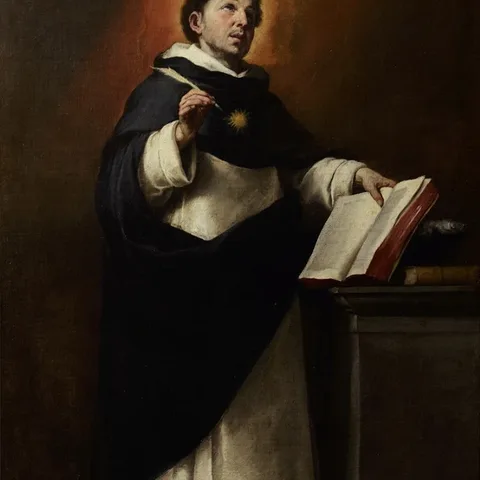
- Dominican habit with the cincture of chastity·Radiant light on the chest from an open Summa·Dove (the Holy Spirit)·Chalice and host (his Eucharistic doctrine)·Lily
- Canonization
- Canonized by Pope John XXII on 18 July 1323; declared Doctor of the Church by Pope Pius V on 15 April 1567; his Summa was placed on the altar beside the Bible and the Decretals at the Council of Trent
Prayer
Bibliography
Show 3 sources
- ↑ See Pius XI, Studiorum Ducem 11 (29 June 1923), AAS, XV ("non-modo Angelicum, sed etiam Communem seu Universalem Ecclesiae Doctorem"). The title Doctor Communis dates to the fourteenth century; the title Doctor Angelicus dates to the fift
- ↑ Thomas does not ascribe actual qualities to God Himself.
- ↑ Even when we guide objects, in Thomas's view the source of all our knowledge comes from God as well.
Profile text adapted from the Wikipedia article, licensed CC BY-SA 4.0.
Pray with this saint every day
Save St. Thomas Aquinas to your favorites, read the full profile, and get feast-day reminders in the Saints app.
Get the Saints AppFree on the App Store for iPhone and iPad