
1575-1608·Feast May 4 with the Forty Martyrs of England and Wales
St. Thomas Garnet
Jesuit Priest and Martyr
Overview
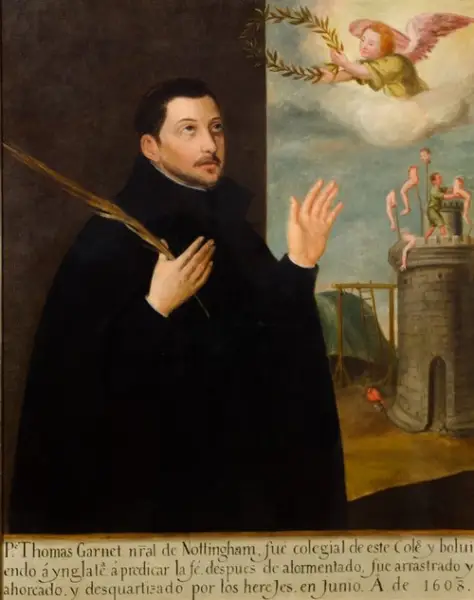
Thomas Garnet was born in Southwark on 9 November 1575 into a family the English persecution would mark deeply: his father Richard had been at Balliol when Oxford turned hard against Catholics, and his uncle Henry Garnet became superior of the Jesuits in England. Schooled at Horsham and employed as a page in a conformist household, Thomas crossed to the continent at seventeen, joining the pioneer students at the Jesuit college of Saint Omer in 1593. The next year his party was caught in the Channel and imprisoned; examined by the Lord High Admiral and dispersed among Protestant bishops, the youths were pressured to conform, and Thomas escaped — twice — before reaching Valladolid's English seminary in 1596. Ordained in 1599, he returned to England to minister covertly. Swept up after the Gunpowder Plot in 1605 while travelling as Thomas Rokewood, he was tortured in the Tower for evidence against his uncle, then expelled with forty-six priests in July 1606. He made his Jesuit novitiate at Leuven, returned to England in September 1607, and was arrested within six weeks. Offered life for the Oath of Allegiance, he refused and was hanged at Tyburn on 23 June 1608, aged thirty-two.
The Complete Life
Early Life
Thomas Garnet was born on 9 November 1575 at Southwark into a Catholic family of the London middle class at the height of the Elizabethan persecution. His father Richard had been at Balliol College, Oxford, when severity against Catholics began, and the family network produced priests and martyrs; Thomas's uncle was Henry Garnet, the Jesuit superior in England, who would himself be executed in 1606 after the Gunpowder Plot. Thomas attended Collyer's school at Horsham in Sussex and then served as a page in a conformist household connected to the earl of Arundel's family. Since the Catholic schools and colleges of England had been suppressed or taken over, the only road to education for a Catholic boy of ability ran abroad, and at seventeen, in 1593, Thomas was among the first students of the new Jesuit college of Saint Omer in Flanders, founded precisely for boys like him.
§ Early life and education
Conversion and Vocation
From Saint Omer Garnet progressed toward the priesthood. In 1595 he was judged ready for the English seminary of Saint Alban at Valladolid in Spain, and in January he left Calais in company with five others, escorted by chance by the Jesuit William Baldwin, traveling in disguise. Disaster met them in the Channel: forced by weather to shelter in the Downs, their vessel was searched by men from Queen Elizabeth's ships, and the party was discovered hiding in the hold. They were imprisoned and examined by the lord high admiral. The teenagers were eventually released or allowed to continue, and Garnet reached Valladolid, where the seminary's regime of studies and its tradition of the English martyrs formed him. He entered the Society of Jesus, and after ordination served on the staff of Saint Omer, whose first martyr, protomartyr, he would later become.
§ Early life and education
Spirituality and Teaching
The spirituality attributed to Garnet is the school piety of the exile colleges, formed at Saint Omer and Valladolid, where the students lived in the conscious company of the English martyrs, many of them alumni of the same desks. The seminaries of the continent trained their men in an explicit readiness for death, and Garnet's biographers report his acceptance of that prospect as unremarkable, the ordinary assumption of his trade. In his interrogations he observed the discipline the seminaries taught: he would suffer anything rather than betray hosts or correspondents, a silence that cost him more, in the conditions of the time, than speech would have. His few recorded sayings at execution, thanking God for the Jesuit vocation he had completed in nine years, became part of the martyrs' school literature read by later generations of Saint Omer's students.
§ Introduction
Mission and Ministry
Garnet's English ministry, like that of most young priests of the era, was brief. Sent to the mission in 1606, in the immediate aftermath of the Gunpowder Plot and of his uncle's execution, he worked in Warwickshire, in the household and district of the Catholic gentry who sheltered priests. The position of a priest in England in those years was nearly untenable: the Oates-era panic had not yet come, but the post-Plot reaction made every Catholic house liable to search and every priest a hunted man. Garnet was arrested within about a year, questioned concerning the Plot and his uncle, and, when nothing could be fixed on him, exiled rather than tried. He was deported to the continent, where he completed his Jesuit novitiate formally and served again at Saint Omer. Against the order's discipline and the advice of superiors he returned secretly to England in 1607 to resume the mission, and was taken again within months.
§ Introduction
Trial and Final Years
This second arrest was fatal. Refusing under interrogation to answer questions that would compromise others, and charged now as a convicted priest who had returned from banishment, a capital offense by statute, Thomas Garnet was tried and condemned. He was executed at Tyburn on 23 June 1608, aged thirty-two. Witnesses recorded his composure and his declaration of loyalty to the king together with his faith, the double fidelity the English martyrs attempted to profess. His death made him the protomartyr of Saint Omer and of its successor, Stonyhurst College, which have kept his memory as their first alumnus to die for the faith.
§ Introduction
Canonization
Garnet was beatified by Pope Pius XI in 1929 with the large company of English and Welsh martyrs, and he was canonized by Pope Paul VI on 25 October 1970 among the Forty Martyrs of England and Wales. Within that group of forty, chosen from nearly six hundred candidates to represent every state of the penal church, he stands for the young religious and the school network of the continent, the colleges of Saint Omer and Valladolid that supplied the mission with its men. His feast is kept on 23 June, and with the Forty Martyrs on 25 October.
§ Introduction
Legacy
Garnet's legacy is kept principally by the schools that descend from Saint Omer, above all Stonyhurst, where his cult as protomartyr has been continuous for four centuries. His life illustrates the machinery of the Elizabethan and Jacobean persecution at its ordinary working: a Catholic boy educated abroad because no school at home would take him, a young priest caught in the net cast for his uncle, banished, returning, and executed by a statute that made his presence itself the crime. For the church in England his canonization set the seal on that whole system's injustice, and his name is read among the forty in the calendar of England and Wales each October.
§ Introduction
Timeline
- 9 Nov 1575
Born into a prominent Catholic family in Southwark, nephew of the future Jesuit superior Henry Garnet
§ Introduction
- 1593
Among the first students of the new Jesuit college at Saint Omer, aged seventeen
§ St. Omer – Stonyhurst College
- Jan 1595
Sets out from Calais for the English seminary at Valladolid and is captured at sea with his companions
§ Captured in the Channel
- 1596
Escapes captivity in England and finally reaches Saint Albans seminary at Valladolid
§ Escapes
- 1599
Ordained a priest and returns to England to minister secretly to Catholic souls
§ Return to the dangers of England
- 1605
Arrested near Warwick under the alias Thomas Rokewood in the excitement after the Gunpowder Plot
§ Return to the dangers of England
- 10 Jul 1606
After seven months imprisoned and tortured in the Tower, deported with forty-six other priests under a royal proclamation
§ Imprisonment
- Sep 1607
Sent back to England, but arrested six weeks later by the apostate priest Rouse
§ Return to the Continent, Return to England and martyrdom
- 23 Jun 1608
Executed at Tyburn, aged thirty-two, for refusing the Oath of Allegiance
§ Return to the Continent, Return to England and martyrdom
- 15 Dec 1929
Beatified by Pope Pius XI
§ Introduction
- 25 Oct 1970
Canonized by Pope Paul VI as one of the Forty Martyrs of England and Wales
§ Introduction
In Their Own Words
Returning to England, I wandered... from place to place, to reduce souls which went astray and were in error as to the knowledge of the true Catholic Church.
the happiest man this day alive
The Record
- Canonization
- Canonized by Pope Paul VI on 25 October 1970 as one of the Forty Martyrs of England and Wales; protomartyr of Saint Omer and Stonyhurst College
Prayer
Bibliography
Show 2 sources
- 1 2 3 4 5 6 7 8 9 10 Pollen, John Hungerford (1909). "Ven. Thomas Garnet" . Catholic Encyclopedia . Vol. 6.
- ↑ Francis Edwards, The Gunpowder Plot: The Narrative of Oswald Tesimond (Folio Society, 1973), p. 190 fn.
Profile text adapted from the Wikipedia article, licensed CC BY-SA 4.0.
Pray with this saint every day
Save St. Thomas Garnet to your favorites, read the full profile, and get feast-day reminders in the Saints app.
Get the Saints AppFree on the App Store for iPhone and iPad