
1478-1535·Feast June 22
St. Thomas More
Lord Chancellor of England, Martyr
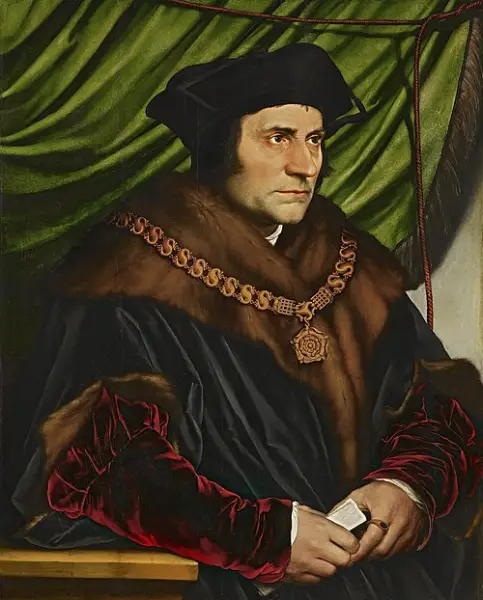
Overview
Thomas More, a Londoner born in the city on 7 February 1478 to the lawyer Sir John More, later a judge,, was schooled at St Anthony's, served as a page in the household of Archbishop Morton, and studied at Oxford under Linacre and Grocyn before his call to the bar from Lincoln's Inn in 1502. Drawn for a time to Carthusian prayer, he chose marriage and the world instead: four children by Jane Colt, who died in 1511, then a swift second marriage to the widow Alice Middleton, and a household renowned for learning and affection. Utopia, his portrait of an imaginary commonwealth, appeared in 1516; he was chosen Speaker of the Commons in 1523 and succeeded Wolsey as Lord Chancellor in 1529. As Henry VIII broke with Rome, More resigned the great seal in 1532 and kept silence in public while refusing in conscience the royal supremacy. Called in April 1534 to swear the Oath of Succession, he would not accept its repudiation of papal authority; he was lodged in the Tower, where he wrote A Dialogue of Comfort against Tribulation. Convicted of treason on evidence he denounced as false, he was beheaded on Tower Hill on 6 July 1535. Pius XI canonized him in 1935; in 2000 John Paul II named him patron of statesmen and politicians.
The Complete Life
Early Life
Thomas More was born on 7 February 1478, in the City of London, the son of the lawyer Sir John More, later a judge of the King's Bench. He was schooled at St Anthony's in the city, served as a page in the household of Archbishop John Morton of Canterbury — who is said to have predicted his greatness — and went up to Oxford around 1492, studying under the humanists Linacre and Grocyn before leaving for legal training at Lincoln's Inn and his call to the bar in 1502. As a young man he was drawn to the life of prayer, living for years near the Charterhouse and joining the Carthusians in their exercises; the choice between the cloister and the world was a real one, and he chose marriage and the world instead, wearing a hair shirt under his court dress for the rest of his life.
§ Early life
Family, Humanism, and Utopia
In 1505 he married Jane Colt; four children were born before her death in 1511, and his swift second marriage to the widow Alice Middleton gave his household its famously learned and affectionate character — his daughters given the same education as his son, his house a school of music, letters and theology. Utopia, his portrait of an imaginary commonwealth published in 1516, made him famous across Europe: a book at once playful and serious, holding up a pagan island's rational society as a mirror to Christian Europe. He entered the king's service and rose steadily: chosen Speaker of the House of Commons in 1523, high steward of Oxford and Cambridge, and in 1529, on Wolsey's fall, Lord Chancellor — the first layman to hold the great seal.
§ Introduction
Chancellor and the Break with Rome
As Chancellor, More prosecuted heretics with the severity of the age, directing polemics against Luther, Zwingli and Tyndale — a fact his admirers have had to weigh ever since. Henry VIII's break with Rome put him in an impossible position. He resigned the great seal on 16 May 1532, pleading ill health, and kept silence in public thereafter while refusing in conscience the royal supremacy. His silence was his defense: he would not affirm what he could not believe. Called on 13 April 1534 to swear the Oath of Succession, he would not accept the repudiation of papal authority embedded in it, and was lodged in the Tower of London, where he would remain fifteen months.
§ Introduction
The Tower and Execution
In the Tower More wrote A Dialogue of Comfort against Tribulation — the great book of his imprisonment — and the unfinished History of the Passion, and corresponded with his daughter Meg in letters that smuggled out his state of mind: God, he wrote, made him a wanton and set him on his lap and dandled him. Convicted of treason on 1 July 1535 on evidence he denounced as false — perjury procured by Rich — he was beheaded on Tower Hill on 6 July 1535. From the scaffold came his declaration that he died the King's good servant, with God's claim coming first. His hair shirt, which he had kept through his imprisonment, was found after his death and preserved.
§ References
Canonization
More was beatified by Pope Leo XIII on 29 December 1886 among the fifty-two English martyrs, and canonized by Pope Pius XI on 19 May 1935, four hundred years after his death, together with John Fisher — the layman and the bishop, the two consciences of the English Reformation. In 1970 Paul VI named him among the Forty Martyrs of England and Wales in the revised calendar. On 31 October 2000 Pope John Paul II declared him the heavenly patron of statesmen and politicians. His feast is 22 June.
§ Catholic Church
Legacy
No Englishman has a larger afterlife. For Catholics he is the martyr of conscience, the man who would not swear away what he believed for any office or any friendship. For statesmen he is the official patron, honored precisely because he held the highest office and lost it rather than his integrity. For humanists he is the author of Utopia and a founder of the northern Renaissance; for legal historians, a judge noted for equity. Robert Bolt's A Man for All Seasons gave the twentieth century its More — the man of wit and conscience — while historians continue to weigh the chancellor's persecution of heretics against the prisoner's principle of conscience. His books, his letters and his death together constitute one of the classic lives of the Christian West.
§ In literature and popular culture
Timeline
- 1478
Born in the City of London on 7 February, son of Sir John More
§ Introduction
- 1492
Goes up to Oxford; studies under Linacre and Grocyn before legal training
§ Early life
- 1505
Marries Jane Colt; four children are born before her death in 1511
§ Introduction
- 1516
Publishes Utopia
§ Introduction
- 1523
Elected Speaker of the House of Commons
§ Introduction
- 1529
Appointed Lord Chancellor on 26 October, succeeding Wolsey
§ Introduction
- 1532
Resigns the great seal on 16 May over the king's break with Rome
§ Notes
- 1534
Refuses the Oath of Succession on 13 April and is imprisoned in the Tower
§ Indictment, trial, and execution
- 1535
Convicted of treason and beheaded on Tower Hill, 6 July
§ Introduction
- 1935
Canonized by Pius XI on 19 May
§ Veneration
In Their Own Words
I die the king's faithful servant, and God's first.
For methinketh God maketh me a wanton, and setteth me on his lap and dandleth me.
I do nobody harm, I say none harm, I think none harm, but wish everybody good. And if this be not enough to keep a man alive, in good faith, I long not to live.
See me safe up: for in my coming down, I can shift for myself.
For men use, if they have an evil turn, to write it in marble: and whoso doth us a good turn we write it in dust.
The Record
- Major works
- Utopia (1516)·Responsio ad Lutherum (1523)·A Dialogue of Comfort against Tribulation (written in the Tower, printed 1553)·History of the Passion (unfinished, written in the Tower)
- Patron of
- Statesmen and politicians (declared 2000)
- Symbols
- Chancellor's chain of office·Axe of his execution·Hair shirt worn beneath his robes
- Canonization
- Beatified 29 December 1886 by Pope Leo XIII (with 52 English martyrs); canonized 19 May 1935 by Pope Pius XI; declared heavenly patron of statesmen and politicians by Pope John Paul II on 31 October 2000
Prayer
Bibliography
Show 12 sources
- ↑ Erasmus wrote about this monkey in his Colloquy Amicitia .
- ↑ "Sir Thomas More's first wife was instructed 'in learning and every kind of music'; his second wife, in middle age, was induced 'to learn to play apon the gittern, the lute, the clavichord and the recorders.'" Stevens, John (1961). Music
- ↑ Victorian biographer Seebohm commented "Along with great intellectual gifts was combined in the young student (More) a gentle and loving disposition, which threw itself into the bosom of a friend with so guileless and pure an affection, t
- ↑ "More held that the experience of friendship is a partial anticipation of the secure friendship of heaven, where we may hope that all will "be merry together"—not just our friends in this life but our enemies too." McEvoy, James (2006). "
- ↑ It seems this court could affirm a conviction that carried the death penalty, but not impose it. Snell, Melissa. "English Court of Star Chamber: A Brief History" . ThoughtCo . Retrieved 16 October 2023 .
- ↑ Louis Martz points out that More's repeated references to Erasmus as "darling" was his retort to Tyndale's mocking use of the word, being an adroit example of the rhetorical technique of repetition. He quipped that, unlike Erasmus, Tyndal
- ↑ The intertwining of sedition and heresy can be seen in Henry VIII 's pronouncement about the Lutherans' heresy "tending principally and chiefly to the withdrawing of the obedience of the Church of Rome, and also of the governance, regymen
- ↑ There were a succession of policies towards heretics, from the Wolsey / John Fisher approach of persuasion, the 1529–1531 William Warham approach of reform and counter-propaganda, to More's brief approach of capital punishment of key netw
- ↑ "Serious analysis precludes the repetition of protestant stories that Sir Thomas flogged heretics against a tree in his garden at Chelsea. It must exclude, too, the accusations of illegal imprisonment made against More by John Field and T
- ↑ "[More] [...] turned to waging implacable war on enemies of the Church whom he could crush without inhibition. [...] He had a positive relish for burning heretics. [...] Claims [...] that he personally tortured heretics have no evidence t
- ↑ Marius suggests that the rumours of More's cruelty started with renegade priest John Constantine, who was arrested, betrayed Bayfield, and escaped from More's house to stay with a friend in Antwerp who he also later betrayed. p.404
- ↑ I.e., "their sure-keeping"
Profile text adapted from the Wikipedia article, licensed CC BY-SA 4.0.
Pray with this saint every day
Save St. Thomas More to your favorites, read the full profile, and get feast-day reminders in the Saints app.
Get the Saints AppFree on the App Store for iPhone and iPad