
1133 – 1193·Feast December 23
St. Thorlak Thorhallsson
Bishop of Skálholt and Patron Saint of Iceland
Overview
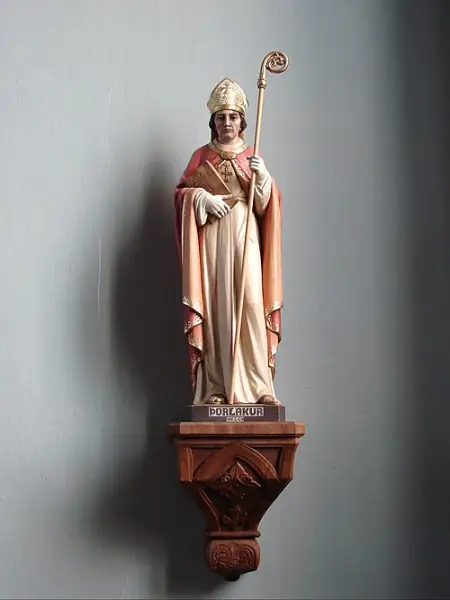
Thorlak Thorhallsson, in Icelandic Þorlákur Þórhallsson, was a bishop of Skálholt from 1178 until his death in 1193 and is the patron saint of Iceland. Born in 1133 to an agrarian family at Hlíðarendi in southern Iceland, he was ordained a deacon before his fifteenth year and a priest at eighteen. He studied in Paris with the Victorines, absorbing the Rule of Saint Augustine between about 1153 and 1159, and then read canon law at Lincoln. Returning home, he founded the first Augustinian monastery in Iceland at Þykkvabær in 1168, was elected bishop of Skálholt in 1174, and was consecrated in 1178 by Archbishop Eysteinn Erlendsson of Nidaros. He died on 23 December 1193. His life and many miracles were recorded in the Icelandic saga Þorláks saga helga, and vows were being made to him at the Althing within five years of his death. His relics were enshrined at Skálholt until the Reformation scattered them. On 14 January 1984 Pope John Paul II canonized him and named him patron of Iceland; his Mass, Þorláksmessa, is still kept on 23 December.
The Complete Life
A Farmer's Son in the See of Skálholt
In 1133 a son was born at Hlíðarendi, a farm lying within the diocese of Skálholt in the south of the island, to a family that lived by the land, whose daily round of stock and harvest formed the ordinary backdrop of his boyhood. Iceland of the twelfth century was a commonwealth without a king, a society of chieftains and free farmers bound together by the Althing and, increasingly, by the Church. Into that world the Church's pastoral network of sees and parish farms carried both the faith and the written learning of Europe, and a clever child of a farming household could rise through its ranks in a way almost nowhere else in his society allowed. The sources say little of his parents or his early teachers, but the trajectory of his youth speaks clearly: a boy marked out for the clerical life, formed in Latin and in the scriptures while his contemporaries learned the management of land and law-court. The see of Skálholt, of which his birthplace formed part, would one day be his own charge, and the countryside that reared him would become, in the memory of his people, the landscape of a saint.
§ Life
Deacon, Priest, and Student of the Victorines
Thorlak's progress through the clerical orders was strikingly fast. He was ordained a deacon before he had reached his fifteenth year, and he received priestly ordination at the age of eighteen, an age at which most men of his station were only beginning to think of a settled life. His gifts pointed beyond Iceland's modest schools. Somewhere around 1153 he left the island for Paris, the intellectual capital of Latin Europe, and joined the circle of the Victorines, the canons of Saint Victor whose school joined rigorous scholarship with the contemplative and liturgical life. There, over roughly six years until 1159, he absorbed the Rule of Saint Augustine, the way of life that would shape his later foundations and his episcopate. Nor did his education end in France: he went on to study canon law at Lincoln in England, acquiring the technical mastery of church discipline that the Icelandic Church, then defining its rights against lay magnates, would soon need in its bishops. When he sailed home he carried an education few in Iceland could match, and a rule of life he intended to plant in Icelandic soil.
§ Life
Founder and Bishop
Thorlak's return to Iceland bore its first great fruit in 1168, when he founded the first Augustinian monastery in the country, at Þykkvabær. The house introduced the canons regular, clergy who lived in community under the Rule of Saint Augustine while serving the pastoral needs of the surrounding country, a form of religious life well suited to a land of scattered farms and vast distances. His reputation for holiness and administration gathered force in the years that followed. In 1174 the chapter of Skálholt elected him its bishop, though his consecration was delayed until 1178, when Eysteinn Erlendsson, Archbishop of Nidaros, to whose province Iceland belonged, ordained him. From that year until his death Thorlak governed the southern Icelandic see, exercising the office for which his whole formation, monastic, scholarly, and legal, had prepared him. He held the bishopric through the last fifteen years of his life, and the saga tradition that grew up within a generation of his passing remembered those years as a time of pastoral care and holiness worthy of the honors the Icelanders soon began to pay him.
§ Life
The Augustinian Way in the North
The spirituality Thorlak embodied was that of the Augustinian canons: clergy united by a common rule, joining the choral office and the pursuit of learning with the active care of souls. His years with the Victorines in Paris gave this ideal its shape, and the monastery of Þykkvabær gave it an Icelandic home, the first of its kind in the island's church. The account of his life and of dozens of miracles attributed to him, preserved in the Icelandic saga Þorláks saga helga, presents a sanctity of the everyday episcopal kind, expressed in governance, preaching, and care for the faithful rather than in spectacular ascetic feats. Modern scholars note that his informal sanctification within the Icelandic Church was promoted by clerical circles of both dioceses, conspicuous in their reports of early miracles, and grounded in Latin texts about his life. In other words, the memory of Thorlak was shaped by the learned clergy who had known the Augustinian ideal he lived. A bishop who had brought the religious life to a frontier church and died universally esteemed was, in the eyes of his people, a saint already, whatever formal process might later say.
§ Canonization and veneration
Death at Skálholt
Thorlak governed Skálholt from his consecration in 1178 until his death on 23 December 1193, aged about sixty years. He died in the see he had served, in the region of Skálholt where he had been born, and his passing in the deep darkness of the Icelandic December fixed his memorial at the turning of the year: the feast of Thorlak's Mass, Þorláksmessa, is kept on the day of his death, the last day of preparations before Christmas. Devotion to him gathered at once, and with remarkable speed. His successor on the see, Páll Jónsson, told the assembled Althing that the faithful might now vow in Thorlak's name; in 1198, five years after his death, his remains were borne into the cathedral of Skálholt, where a sacred reliquary kept them for more than three centuries. The saga written of him, Þorláks saga helga, recorded his life and the miracles reported at his shrine in loving detail, ensuring that the memory of the bishop's last years, and of the holiness that marked them, survived the passing of the medieval Church that had first honored him.
§ Life
From Icelandic Cult to Papal Canonization
Thorlak's sanctity was recognized in Iceland long before Rome acted. Within five years of his death, public vows were being made to him at the Althing on his successor's authority, and the Þorláks saga helga recorded his life and dozens of miracles in detail, a text republished in Icelandic for Pope John Paul II's visit to the island in 1989. Scholars describe this informal sanctification as arranged within Icelandic ecclesiastical circles, with clerics of both dioceses prominent in the reports of early miracles and Latin texts supporting the cult. Formal recognition by the Catholic Church, however, waited until modern times. On 14 January 1984 Pope John Paul II canonized Thorlak and at the same time declared him the patron saint of Iceland, an honor that bound the medieval bishop to the national identity of a modern people. His feast is kept on 23 December, the day of his death, when Thorlak's Mass is celebrated in Iceland; the day is observed in the Faroe Islands as well, under the name Tollaksmessa, and the Evangelical-Lutheran Diocese of North America also keeps his festival as bishop and confessor.
§ Canonization and veneration
Þorláksmessa and the Golden Locker
Thorlak's memory lives most vividly in Þorláksmessa, the Mass of Saint Thorlak kept on 23 December, a date that in modern Iceland has folded into the rhythms of Christmas as the last day of preparations before the feast. The day is likewise celebrated in the Faroe Islands as Tollaksmessa. His bodily remains had a harder history. The reliquary that held them at Skálholt was broken up when the Reformation reached Iceland, and his bones were scattered across the cathedral grounds. A single relic is known to endure: a fragment of bone sealed in a lead box together with the relics of other saints, set into the sanctuary's end wall of St. Magnus Cathedral in the Faroe Islands, the recess known as the Golden Locker. Devotion has also taken new forms in modern times. A group based in New York State has advocated for Thorlak to be recognized as the patron saint of people with autism, an appeal that has brought the medieval bishop into contemporary pastoral conversations, and his patronage of Iceland, of fishermen, and of the Catholics of Scandinavia continues. He stands as the one Icelander formally raised to the altars by a pope.
§ Canonization and veneration
Timeline
- 1133
Born at Hlíðarendi in southern Iceland, within the diocese of Skálholt, to a farming household.
§ Life
- 1153
Sailed to France to join the Victorine canons of Paris, taking up the Rule of Saint Augustine.
§ Life
- 1159
Concluded his Paris studies and went on to study canon law at Lincoln.
§ Life
- 1168
Founded the first Augustinian monastery in Iceland, at Þykkvabær.
§ Life
- 1174
Elected bishop of Skálholt.
§ Life
- 1178
Consecrated bishop by Eysteinn Erlendsson, Archbishop of Nidaros, and took up the see of Skálholt.
§ Life
- 23 Dec 1193
Died at Skálholt after fifteen years as bishop.
§ Life
- 1198
Relics enshrined in the cathedral of Skálholt, five years after Bishop Páll Jónsson told the Althing that vows might now be sworn to Thorlak.
§ Saint Thorlak Thorhallsson
- 14 Jan 1984
Canonized by Pope John Paul II, who declared him the patron saint of Iceland.
§ Canonization and veneration
- 1989
Þorláks saga helga republished in Icelandic for John Paul II's visit to Iceland.
§ Canonization and veneration
The Record
- Major works
- Founded the first Augustinian monastery in Iceland, at Þykkvabær (1168)
- Patron of
- Iceland·fishermen·Catholics of Scandinavia·people with autism (advocated devotion)
- Canonization
- Canonized by Pope John Paul II on 14 January 1984, who also declared him patron saint of Iceland
Prayer
Bibliography
Show 6 sources
- Fahn, Susanne Miriam; Gottskálk Jensson (2010). "The Forgotten Poem: A Latin Panegyric for Saint Þorlákr in AM 382 4to". Gripla (21). Árni Magnússon Institute for Icelandic Studies: 19–60.
- "St. Thorlak of Iceland". Catholic News Agency. Archived from the original on 2018-03-07.
- Ásdís Egilsdóttir (ed.), Þorláks saga helga. Elsta gerð Þorláks sögu helga ásamt Jarteinabók og efni úr yngri gerðum sögunnar (Reykjavík: Þorlákssjóður, 1989).
- "St. Ansgars Bulletin No. 89" (PDF). Archived from the original on 2021-09-29.
- Rodríguez, Ketsia (3 April 2019). "St. Pius Tenth Parish creates a sensory-friendly worship space". Catholic Courier. Archived from the original on 2019-12-24.
- "Evangelical Lutheran Diocese of North America | The Festival of St. Thorlak, Bishop and Confessor". eldona.org. Archived from the original on 2024-12-23.
Profile text adapted from the Wikipedia article, licensed CC BY-SA 4.0.
Pray with this saint every day
Save St. Thorlak Thorhallsson to your favorites, read the full profile, and get feast-day reminders in the Saints app.
Get the Saints AppFree on the App Store for iPhone and iPad