
died 251·Feast January 28 (Catholicism); December 14 and August 17 (Orthodoxy)
St. Thyrsus
Martyr of Apollonia Who Overcame the Saw
Overview
Saint Thyrsus, whose name in ancient Greek means literally a thyrsus, the ivy-wreathed staff of Dionysus, is venerated as a Christian martyr who died for his faith at Apollonia in Phrygia in 251, during the persecution of the emperor Decius. Born in the third century at Smyrna in Asia, he was put to death alongside two companions: Leucius, who rebuked the governor Cumbricius and was hanged, tortured, and beheaded, and Callinicus, a pagan priest whose conversion came from watching Thyrsus endure his torments. Tradition holds that Thyrsus suffered many tortures and was condemned to be sawn in half, but that the saw grew so heavy the executioners could not use it against him. His relics were later brought to Constantinople, and from the Middle Ages his cult flourished in the Iberian Peninsula, where he is known as Santo Tirso in Portugal and San Tirso in Spain, and held a full office in the Mozarabic liturgy. Other relics reached France, where he became titular saint of the cathedral of Sisteron and, by the twelfth century, was honored with a church at Châteauponsac.
The Complete Life
A Christian of Smyrna
Thyrsus was born in the third century at Smyrna, one of the great cities of Roman Asia, the harbor town on the Aegean coast of what is now Turkey. His name carries an ironic freight: the thyrsus was the ivy-bound wand carried in the processions of Dionysus, the very emblem of the pagan cults that surrounded his upbringing. Christian communities had been rooted in Smyrna since the apostolic age, and the city that had honored its own martyred bishop Polycarp continued to produce confessors of the faith. Of Thyrsus's family, education, and standing within the Christian community of his native city, the surviving records say nothing; he enters recorded history only at the moment of his trial before a Roman court. What can be said is that the faith he carried west from Smyrna was strong enough to endure what the authorities of Phrygia would inflict upon it, and that the memory of his endurance proved strong enough to travel, over the following centuries, from Asia Minor to Constantinople, to Spain and Portugal, and to the cathedrals and village churches of southern France.
§ Saint Thyrsus
The Persecution of Decius
The trial of Thyrsus came in 251, during the persecution of the emperor Decius, the first empire-wide attempt to compel every subject of Rome to offer sacrifice to the pagan gods. At Apollonia in Phrygia he was condemned for his Christian faith together with two companions whose names the tradition preserves beside his. The first, Leucius, faced the governor Cumbricius not with silence but with reproach, denouncing the injustice of the proceedings; for this he was hanged, harrowed on his sides, and finally beheaded. The second, Callinicus, was a pagan priest whose opposition melted as he watched Thyrsus endure his torments; converted by the spectacle of the Christian's endurance, he confessed the faith he had come to persecute and was himself beheaded. Thyrsus, the central figure of the group, was subjected to many tortures and at last sentenced to death by sawing, the brutal punishment whose implement, the bucksaw, became his emblem in Christian art. The court of Cumbricius had intended three executions; it produced, in the judgment of the Church that remembered them, three martyrs and a harvest of conversions.
§ Saint Thyrsus
The Saw That Would Not Cut
Tradition states that Thyrsus endured many tortures before his final sentence, and that when the command came to saw him in half, the instrument failed. The saw, the tradition says, turned so heavy in the executioners' hands that they could neither raise it nor swing it, and the death prepared for the martyr could not be carried out. The account leaves his final moments untold, but the Church has always numbered him among those who died for the faith at Apollonia, and his death is dated to 251. The story of the immobilized saw gave Christian iconography its emblem for him: the bucksaw, an instrument of torment transformed into a sign of divine protection, appears as his attribute in the artistic tradition. With his companions Leucius and Callinicus he forms a little band of witnesses whose deaths, occurring in a single place and year, were kept together in the memory of the churches. However the account is weighed by historians, the conviction it preserves is clear: that the martyr overcame, rather than succumbed to, the death prepared for him, and that his enemies left the scene having witnessed something they could not master.
§ Saint Thyrsus
From Constantinople to Sisteron
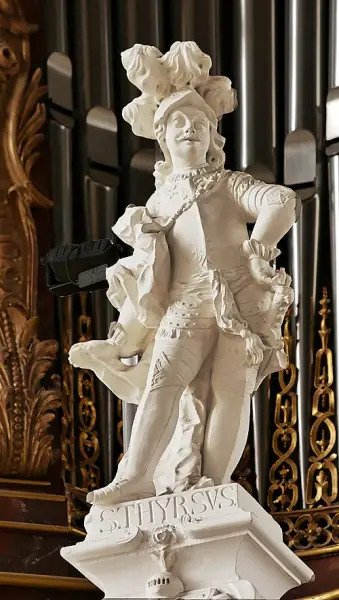
The cult of Thyrsus traveled far from the Phrygian town where he died. His relics were brought to Constantinople, the imperial capital, where his memory took root among the saints of the Eastern Church, which keeps his feast on December 14 and again on August 17. From the East his cult passed westward and became especially popular in the Iberian Peninsula from the Middle Ages onward, known at first as Santo Tirso, a name that survives in Portugal, while in Spain it took the form San Tirso. The Spanish church gave him a full office in the Mozarabic liturgy, the ancient rite that endured in parts of Iberia under Muslim rule. Some of his relics were carried into France, where the cathedral of Sisteron, in the Basses Alpes, was placed under his patronage as the Cathédrale Notre Dame et Saint Thyrse, making him the town's patron saint. In the twelfth century a church was dedicated to him at Châteauponsac. The Roman Catholic Church keeps his feast on January 28, and the statue of Saint Tirso in the Basilica of St. Paulinus at Trier shows how widely his memory traveled.
§ Veneration
Timeline
- 251
Suffered torture at Apollonia in Phrygia under the persecution of Decius and was condemned to sawing; tradition holds the saw grew too heavy to use.
§ Saint Thyrsus
- 251
Leucius rebuked the governor Cumbricius to his face, and for it he was hanged, torn with harrows along his sides, and finally beheaded.
§ Saint Thyrsus
- 251
Callinicus, a pagan priest converted by witnessing Thyrsus's martyrdom, was beheaded.
§ Saint Thyrsus
The Record
- Patron of
- Sisteron, France
- Symbols
- bucksaw
- Canonization
- Pre-congregation martyr; venerated by the Eastern Orthodox and Roman Catholic Churches
Prayer
Bibliography
Show 4 sources
- Daily Scripture Readings and Lives of the Saints for December 14, 2004. Greek Orthodox Archdiocese of America. Retrieved February 22, 2012.
- "Saint Thyrsus, Martyr – Died 251". Christian Iconography page hosted by Augusta State University. Retrieved February 22, 2012.
- "Saint of the Day for January 28". Saint Patrick Catholic Church (Washington, DC). Archived August 7, 2014, at the Wayback Machine. Retrieved February 22, 2012.
- scarlet.be/amdg/sankt/jan28.html. Archived February 24, 2007, at the Wayback Machine.
Profile text adapted from the Wikipedia article, licensed CC BY-SA 4.0.
Pray with this saint every day
Save St. Thyrsus to your favorites, read the full profile, and get feast-day reminders in the Saints app.
Get the Saints AppFree on the App Store for iPhone and iPad