
died c. 286·Feast August 11
St. Tiburtius
Roman Martyr Who Walked the Fiery Coals
Overview
Saint Tiburtius, according to Christian legend, was a Roman martyr put to death during the persecution of Diocletian. The tale is told within the legend of Saint Sebastian: Agrestius Chromatius, said to be prefect of Rome, condemned several Christians to death but was himself won over by Tranquillinus, father of the martyrs Mark and Marcellian, and then baptized by Polycarp. Tiburtius was Chromatius's only son, and he too received baptism through the persuasion of Sebastian, who stood as his godfather. During the persecution he lay hidden in his father's house until a traitor denounced him. Brought before the prefect Fabianus, he confessed his faith and confirmed it by a marvel: armed with the cross alone, he crossed a bed of glowing embers barefoot and came away unhurt. His judges ascribed the feat to magic, and he was beheaded in the year 286 at the third milestone of the Via Labicana, at the spot called ad duas lauros, at the two laurel trees. Pope Damasus I honored him in verse, the Roman Martyrology records his passion on 11 August, and his commemoration was removed from the General Roman Calendar in 1969.
The Complete Life
The Only Son of the Prefect
The story of Tiburtius unfolds inside the legend of Sebastian, the Roman soldier-martyr whose acts preserved the memory of several converts of the late third century. At the center of his story stands his father, Agrestius Chromatius, described as prefect of Rome, though the historical lists of prefects do not record either him or the later judge Fabianus. Chromatius had condemned Christians to death, but his own conversion came through an unexpected channel: Tranquillinus, the father of the martyrs Mark and Marcellian, persuaded him of the truth of the faith he had been persecuting, and the bishop Polycarp baptized him. Tiburtius was the only son of this household, and his own passage into the Church ran through the same circle of witnesses. Sebastian himself persuaded the young man to seek baptism and stood as his godfather at the font. However much of the narrative belongs to legend rather than to documented history, it sketches a coherent picture: the son of a repentant persecutor, godson of a martyr, raised in a house where the faith had entered only recently, at great cost, and against every expectation of the Roman official world.
§ Hagiography
Hidden in His Father's House
When the persecution of the emperor Diocletian broke over the Church, Tiburtius's first Christian act was to disappear. He lay hidden in his father's house, sheltered by the very prominence that had once made Chromatius a danger to believers; the household of a former prefect of Rome was, for a while, the safest hiding place in the city for a Christian son. The legend does not linger over this period of concealment, but it belongs to the pattern of the age, when thousands of Roman Christians survived by discretion while others were dragged into court. Safety did not hold. A traitor informed against him, and Tiburtius was seized and brought to trial before the prefect Fabianus before whom other confessors had already stood. The move from hiding to the courtroom was the decisive passage of his vocation. Whatever quiet practice of the faith his baptism under Sebastian's patronage had begun, it now had to be spoken aloud before a judge empowered to kill him for it, and the whole narrative of his life turns on what he said and did in that hour of exposure.
§ Hagiography
The Trial by Fire
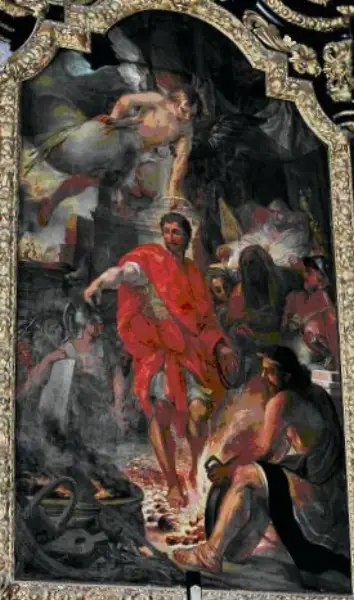
Arraigned before Fabianus, Tiburtius confessed his faith without reserve, and he confirmed his confession with a sign. The legend tells how, guarded by nothing but the cross traced over himself, he passed barefoot across the burning bed and stepped off it without a wound. The ordeal of fire, an image the Christian imagination has never tired of, placed the truth of his words beyond dispute in the eyes of the faithful: God himself had testified to the confession of his servant. The judges of the empire, however, drew the opposite conclusion. The miracle, they ruled, was ascribed to magic, and what heaven had wrought was condemned as sorcery, the standard imperial charge against the inexplicable. The scene belongs to the classic architecture of the martyr acts, in which the confessor's prodigy convicts the court of blindness rather than converting it. For the young man who had once hidden in his father's house, the walk across the coals completed his transformation: the son of the converted prefect Chromatius, godson of Sebastian, had become in his own person a confessor whose faith could no longer be doubted by friend, judge, or executioner.
§ Hagiography
Beheading at the Two Laurel Trees
Condemned as a Christian and a supposed magician, Tiburtius was led out of the city to his execution. The place was the third milestone of the Via Labicana, the road that ran southeast from Rome toward the Alban hills, at a spot identified by a landmark that gave it its name: ad duas lauros, at the two laurel trees. There, in the year 286, the sentence was carried out and the young martyr was beheaded. His body was buried nearby, in the cemetery that bore the same name of Inter duas lauros, and it is the fact of that burial, more than any other detail of his story, that the Church's own records certify. The calendar decree of 1969 observed that beyond his name, the one certainty about Tiburtius is that on an August day he was laid to rest in that burial ground beside the Via Labicana. The laurel trees have long since vanished, but the burial ground became the resting place of other martyrs as well, and the road out of Rome, lined with the tombs of the confessors, kept the memory of the young man who had walked over fire for his faith.
§ Hagiography
Damasus, the Martyrology, and 1969
Tiburtius's memory was honored in Rome from an early date. Pope Damasus I, who held the see from 366 to 384 and set his learned verse at the tombs of the martyrs, composed an epigram in the martyr's honor, invoking him directly: Kind Tiburtius, beloved of God, take care of Damasus. The Roman Martyrology keeps him on 11 August, recording at the cemetery of the two laurel trees the martyr whose praises Damasus sang, a date he shares with Saint Susanna; the two were not related, but their common feast has long associated them. His name passed from the martyrologies into the General Roman Calendar, where his commemoration stood for centuries until the reform of 1969 removed it, on the ground that beyond his name and the fact of his burial on an August day, nothing certain is known of him. The removal did not erase him. He remains in the Roman Martyrology, in art shown, as the caption of his traditional image has it, walking on the coals, and in the company of the martyrs of the Via Labicana whose burial ground Damasus adorned with poetry.
§ Hagiography
Timeline
- 286
Beheaded at the third milestone of the Via Labicana in Rome after walking unharmed over red-hot coals by the sign of the cross.
§ Hagiography
- 11 Aug 286
Laid to rest in the cemetery of Inter duas lauros along the Via Labicana, on the August day the Church later chose for his memorial.
§ Hagiography
- 1969
Commemoration removed from the General Roman Calendar, which noted that apart from his name only his burial on 11 August was known.
§ Hagiography
In Their Own Words
At Rome, in the cemetery at the two laurel trees at the third milestone on the Via Labicana, Saint Tiburtius, martyr, whose praises Pope Saint Damasus sang.
The Record
- Symbols
- walking barefoot over burning coals
- Canonization
- Pre-congregation martyr; his commemoration was removed from the General Roman Calendar in 1969
Prayer
Bibliography
Show 5 sources
- Brewer, Ebenezer Cobham. A Dictionary of Miracles: Imitative, Realistic, and Dogmatic (Chatto and Windus, 1901), p. 11.
- Meier, Gabriel. "Sts. Tiburtius and Susanna." The Catholic Encyclopedia, Vol. 14. New York: Robert Appleton Company, 1912.
- "CatholicSaints.Info » Blog Archive » Book of Saints – Tiburtius". Retrieved 2026-09-13.
- Martyrologium Romanum (Libreria Editrice Vaticana, 2001). ISBN 88-209-7210-7.
- Calendarium Romanum (Libreria Editrice Vaticana, 1969), p. 134.
Profile text adapted from the Wikipedia article, licensed CC BY-SA 4.0.
Pray with this saint every day
Save St. Tiburtius to your favorites, read the full profile, and get feast-day reminders in the Saints app.
Get the Saints AppFree on the App Store for iPhone and iPad