
c. 17 – c. 97·Feast January 26 (with St. Titus, Catholic Church); January 22 (Eastern Christianity)
St. Timothy
Paul's Beloved Coworker and First Bishop of Ephesus
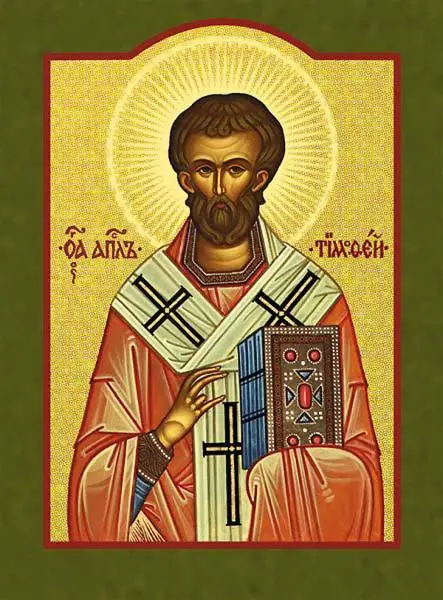
Overview
Timothy, whose Greek name carries the sense of honoring God or being honored by him, was an evangelist of the apostolic age and the first bishop of Ephesus, the most trusted of the Apostle Paul's younger coworkers. Born around AD 17 at Lystra or nearby Derbe in Lycaonia, of a Jewish Christian mother, Eunice, and a Greek father, he was raised on the Scriptures and was already a respected member of the congregation when Paul returned to his homeland with Silas. Paul circumcised him for the sake of the Jews they would evangelize and took him along, and from AD 52 onward Timothy shared Paul's journeys through Macedonia, Corinth, and Ephesus, serving as emissary, envoy, and co-sender of six New Testament letters. Paul addressed two epistles to him, urging the reserved young leader not to have a spirit of timidity. Paul left him at Ephesus in AD 64 to govern that church. The apocryphal Acts of Timothy relates that under the emperor Nerva, around AD 97, the aged bishop tried to stop a pagan procession in honor of Diana by preaching the Gospel, and was beaten, dragged through the streets, and stoned to death. He is venerated across all the great confessions as a saint and martyr.
The Complete Life
A Child of Two Peoples
Timothy was a native of Lystra, or of neighboring Derbe, cities of Lycaonia in Asia Minor where the pagan highlands met the world of the synagogue. His mother Eunice was a Jewish woman who had become a Christian believer, and his father was a Greek, so that the boy grew up between two peoples, belonging fully to the rule of neither. When Paul and Barnabas first preached at Lystra, the healing of a man crippled from his birth won many of the townspeople to the teaching; when Paul returned some years later in Silas's company, Timothy stood already as a respected figure in the congregation there, alongside Lois his grandmother and Eunice his mother, both of them Jewish believers. The second letter to him records that his mother and grandmother were eminent for their piety and faith, and tradition holds that he had known the Scriptures since childhood, a Jewish gift his Greek father's world had not cancelled. The New Testament also preserves a suggestion of his temperament: writing to Corinth, Paul counseled the community to put the young envoy at ease, for he was by nature reserved and timid, though engaged without reserve in the Lord's work.
§ Life
Circumcised for the Sake of the Mission
Timothy's commitment to the mission took a form that still startles readers. Because his father was a Greek Gentile, he had not been circumcised; Paul now ensured that this was done, as the book of Acts records, so that the young man would be acceptable to the Jews whom they intended to evangelize. The commentator John William McGarvey marveled at the scene, in which Paul circumcised Timothy with his own hand on account of certain Jews in those quarters. The act compromised nothing: the Council of Jerusalem had already ruled that gentile converts need not be circumcised, so Timothy's case was prudence for the sake of the Gospel, not submission to a party. Once joined to Paul's company he became the apostle's disciple, then his constant companion and coworker in preaching. Augustine would later praise the zeal and selflessness with which he at once left country, home, and parents behind, to follow the apostle into poverty and suffering. The grandmother and mother who had taught him the Scriptures released him; the churches of Lystra and Iconium that spoke well of him gave him up; and the mission gained the companion Paul valued above every other name.
§ Life
Envoy Across the Aegean World
In AD 52 Timothy set out with Paul and Silas on their Macedonian journey, and from that road his life became inseparable from the apostle's. Paul pressed on to Athens; Silas and Timothy lingered for a while at Beroea and Thessalonica before the two rejoined him at Corinth; from there Paul sent Timothy back to Thessalonica to inquire after the community's faith, and he returned with the good report that it stood firm. The Acts narrative next shows him during Paul's long Ephesian residence; in the closing months of AD 56 or the opening weeks of 57, Paul dispatched him to Macedonia, intending that his road should end at Corinth, where he arrived just after First Corinthians itself had been delivered. He was at Paul's side in Corinth in the winter of 57–58 when the Letter to the Romans was dispatched, and according to Acts he traveled with Paul through Macedonia shortly before Passover in AD 58, going ahead of him to await him at Troas. There the book of Acts takes its leave of him. Paul's letters from those years carry his name beside the apostle's — 2 Corinthians, Philippians, Colossians, both Thessalonian letters, and Philemon all name him as co-sender — until in AD 64 Paul left him at Ephesus to govern that church, the crowning charge of his missions.
§ Ministry
Timidity Strengthened by Grace
The letters reveal a spirituality shaped for a man not naturally bold. Paul wrote to the Corinthians that Timothy was doing the work of the Lord and asked the community to put him at ease, an admission that the young envoy was reserved and timid by disposition. His health, too, was fragile; he may have been subject to frequent ailments, and Paul advised him to use a little wine for his stomach's sake, the advice behind the Church's later custom of invoking him against stomach disorders. In the letter we call Second Timothy, written as Paul awaited death, the apostle charged his spiritual son to cast out every craven spirit and never to blush in bearing witness to the Lord; he entreated him to come before winter, to bring Mark, and to show all diligence and steadfastness against false teaching, patience under persecution, and faithful discharge of every duty of his charge, with the gravity of a man who must soon stand before the one Judge of living and dead. The letter to the Hebrews, mentioning his release from prison, shows he also suffered bonds. His greatness lay precisely here: a timid, ailing man made constant by grace became the apostle's stand-in where the churches needed courage.
§ Pastoral Epistles
Bishop of Ephesus and Martyr
The New Testament does not record Timothy's death, but other sources preserve an account of it. The Acts of Timothy, an apocryphal work of probably fifth-century date, relates that Paul consecrated him bishop during Nero's reign, on the occasion of a visit the two made together to Ephesus. Under the emperor Nerva, the same work relates, Timothy suffered a martyr's death in the course of a pagan festival: in AD 97, the bishop, then in his eightieth year, tried to break up a procession held in honor of the goddess Diana, preaching the Gospel to the crowd. The furious pagans beat him, dragged him along the streets of the very city he governed, and put him to death with stones. The old account remarks that he tried to stop the wild and violent proceedings, only to perish amid the orgy himself, a formula that places his last act squarely in the pattern of his life, the intervention of a pastor against the cruelty of a crowd. The work that records his passion contains almost as much material about John the Evangelist, his fellow resident of Ephesus, as about Timothy, but its memory of the aged bishop's death has defined his martyrdom ever since.
§ Acts of Timothy
Veneration Across the Churches
Timothy has been venerated as an apostle, saint, and martyr from the earliest period of the Church, without any formal canonization process. The Eastern Orthodox Church keeps his feast on 22 January. In the Roman rite he shares a memorial with Titus on 26 January, a placement just after the feast marking Paul's conversion that dates from the calendar reform of 1969; from the thirteenth century until that year his feast alone had been kept on 24 January, the day before the Conversion. The Evangelical Lutheran Church in America commemorates him with Titus and Silas on 26 January, while the Lutheran Church–Missouri Synod keeps his feast on 24 January. The Church of England and the Episcopal Church honor him on their calendars on 26 January together with Titus, and the Armenian Apostolic Church remembers him on the Thursday after the fifth Sunday after the feast of the Holy Cross. The Coptic Church keeps the day of his martyrdom on 23 Tobi and the relocation of his relics on 27 Tobi. Few early Christians are commemorated with such unanimity across Catholic, Orthodox, Oriental Orthodox, Anglican, and Lutheran traditions.
§ Veneration
Relics from Ephesus to Termoli
Timothy's bodily memory traveled as widely as his letters. In the 300s his remains were brought from Ephesus to Constantinople and laid in the Church of the Holy Apostles, close by the tombs of Andrew and Luke — the disciple buried among apostles. A crusading count is thought to have brought them to Italy in the thirteenth century, and around 1239 they were laid to rest in the cathedral of Termoli, on the Adriatic coast. They lay there undisturbed until restoration work in 1945 brought them to light again, a discovery that revived devotion to the first bishop of Ephesus in the modern city that guards his tomb. His patronage has always been domestic and pastoral: he is invoked against stomach and intestinal disorders, on the strength of Paul's prescription of wine for his stomach's sake. In art he is identified by the pastoral staff of a bishop. Above all, his legacy stands in the two New Testament letters addressed to him, the Pastoral Epistles through which generations of church leaders have heard the apostle's voice exhorting a young pastor, not to a spirit of timidity, but to faithfulness unto death.
§ Veneration
Timeline
- 17
Born at Lystra (or Derbe) in Galatia, son of a Jewish believer, Eunice, and a Greek father.
§ Saint Timothy
- 52
Joined Paul and Silas on their journey to Macedonia, forsaking home and parents to follow the apostle.
§ Ministry
- 54
Appeared in the Acts narrative during Paul's stay in Ephesus, which lasted from 54 to 57.
§ Ministry
- 56
Dispatched by Paul on a journey from Corinth to Macedonia, sent ahead so that he would in due course reach Corinth.
§ Ministry
- 57
Stayed with Paul at Corinth over the winter when the Letter to the Romans was dispatched.
§ Ministry
- 58
Was with Paul in Macedonia shortly before Passover and went ahead of him to await him at Troas, his last mention in Acts.
§ Ministry
- 64
Paul left him at Ephesus to govern that church.
§ Ministry
- 97
According to the Acts of Timothy, was beaten, dragged through the streets, and stoned to death at Ephesus after preaching against a procession honoring Diana.
§ Acts of Timothy
- 1239
Relics brought from the East by a count returning from the crusades were buried in the Termoli Cathedral around this year.
§ Veneration
- 1945
Remains rediscovered at Termoli during restoration work.
§ Veneration
In Their Own Words
I have no one like him.
When Timothy comes, see that you put him at ease among you, for he is doing the work of the Lord.
The Record
- Major works
- Recipient of the First and Second Epistles to Timothy·Co-sender of 2 Corinthians, Philippians, Colossians, 1 and 2 Thessalonians, and Philemon
- Patron of
- invoked against stomach and intestinal disorders
- Symbols
- pastoral staff
- Canonization
- Pre-congregation; venerated as apostle, bishop, and martyr from the earliest Church
Prayer
Bibliography
Show 6 sources
- "Saint Timothy". Encyclopaedia Britannica. 1 January 2021. Retrieved 5 February 2021.
- Eusebius (1965). "3.4". Historia Ecclesiastica (The History of the Church). Williamson, G.A., transl. Harmonsworth: Penguin, p. 109.
- Butler, Alban. "Saint Timothy, Bishop and Martyr". The Lives of the Saints. Vol. I: January.
- Brown, Raymond (1997). An Introduction to the New Testament. New York: Doubleday, p. 655.
- Ehrman, Bart. The New Testament: A Historical Introduction to the Early Christian Writings. Oxford University Press, 2003, p. 393. ISBN 0-19-515462-2.
- Calendarium Romanum (Vatican City, 1969), p. 86.
Profile text adapted from the Wikipedia article, licensed CC BY-SA 4.0.
Pray with this saint every day
Save St. Timothy to your favorites, read the full profile, and get feast-day reminders in the Saints app.
Get the Saints AppFree on the App Store for iPhone and iPad