
died 96 or 107·Feast January 26 (Catholicism); August 25 (Orthodoxy)
St. Titus
Paul's Peacemaker and Bishop of Crete
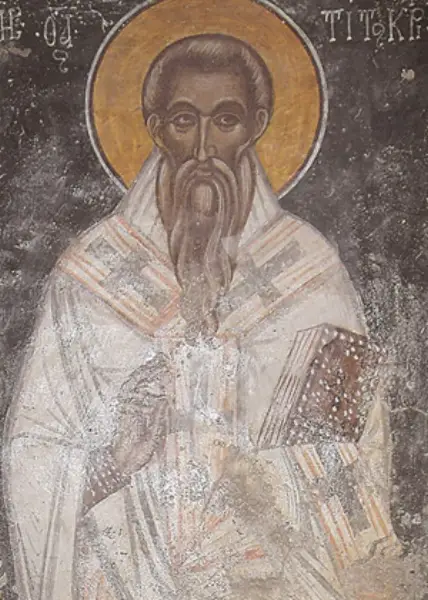
Overview
Titus labored as a missionary and church leader of the apostolic age, a companion and disciple whom Paul the Apostle trusted as his own; tradition makes him the first Bishop of Crete. Greek by birth, and in his early years perhaps a student of Greek philosophy and poetry while still young, he owed his conversion to Paul himself and became the apostle's secretary, interpreter, and most trusted troubleshooter. Around 48 or 49 he accompanied Paul to the Council of Jerusalem on the question of the Mosaic rites; in the fall of 55 or 56 he carried Paul's Severe Letter to Corinth and healed the crisis there; and he brought the collection for the poor of Jerusalem, acting throughout as peacemaker, courier, and administrator. Tradition holds that when Paul stopped at Crete after his first Roman imprisonment, he ordained Titus bishop of the island and left him to finish the work, and Titus appointed presbyters in every city, remaining there into old age and dying at Gortyna, dated to 96 or 107. Venerated as a saint before 261, he is honored on 26 January with Timothy by Catholics, Anglicans, and Lutherans, and on 25 August by the Orthodox; his skull rests in the Church of St. Titus at Heraklion, to which it was returned in 1966.
The Complete Life
A Greek Converted by Paul
Titus was a Greek, and unlike his coworker Timothy he was never circumcised, a fact that would make him a test case in the early Church's hardest controversy. Scripture records no call, no city, and no family for him; he appears in the letters already inside the apostle's confidence. Early tradition fills the silence with a probable picture: a young man who had perhaps studied Greek philosophy and poetry while still young, and who owed his conversion to Christianity to Paul himself, becoming the apostle's spiritual child in the fullest sense. The conversion bound the two men for life. Titus served Paul as secretary and interpreter, a role Jerome compared to that of Mark beside Peter, and he became the agent Paul sent wherever a church was too divided, too offended, or too confused for a letter alone to heal. A Gentile convert of Gentile missions, unbound by the Mosaic law yet wholly devoted to its greatest Hebrew interpreter, he embodied in his own person the reconciliation the Gospel had accomplished between Greek and Jew, and the churches of the first century tested that reconciliation on him first.
§ Life
The Council of Jerusalem
Titus's first recorded service brought him to the center of the dispute that could have split Christianity in two. In the year 48 or 49 he went up with Paul to the Jerusalem council convened to settle the question of the Mosaic rites, and there his uncircumcised Greek body became the very argument of the Gospel party: if Titus, a Gentile convert of Paul's own preaching, could be received as a brother without the law, then the Gospel stood for Gentiles as it stood for Jews. The council's decision, that gentile believers were not required to be circumcised, vindicated the position he represented. From that beginning his vocation unfolded as the apostle's deputy in delicate places. When the church of Corinth fell into crisis after the delivery of First Corinthians and Paul's Painful Visit, one unnamed individual had offered a serious personal insult and defied Paul's authority; so Paul, as he left Asia, dispatched Titus from Ephesus to Corinth, clothed with full powers to repair the damage. The offended community had to be confronted and then consoled; Paul chose the gentle Greek who had already carried his cause to Jerusalem. It was during this journey that Titus served as courier for the Severe Letter, a Pauline missive now lost but referred to in 2 Corinthians.
§ Life
Troubleshooter, Peacemaker, Administrator
The Corinth mission succeeded. Titus journeyed north from Corinth and met Paul in Macedonia, and the apostle, overjoyed by the report of the community's repentance, wrote the letter we know as 2 Corinthians. Titus went back to Corinth a second time, that letter in hand, and Paul himself reached the city not long afterward. There Paul entrusted him with organizing the alms collection for the Christians of Jerusalem, the great relief fund that bound the Gentile churches to the mother community. In these missions Titus showed himself, in the summary of the tradition, a troubleshooter, a peacemaker, an ecclesiastical administrator, and a missionary, the man entrusted with hard letters, hard money, and hard feelings, precisely because the churches trusted him with all three. Early church tradition tells that once Paul was freed from his first imprisonment in Rome he made a preaching stop on the island of Crete, and that other churches, needing him elsewhere, led him to consecrate his disciple Titus bishop of the island and to leave him behind to complete the work. John Chrysostom read in that appointment the measure of Paul's esteem for him.
§ Life
Ordaining Elders in Every City
The spirituality of Titus was that of a church builder rather than a solitary. Left in charge of Crete, he appointed presbyters, elders, in every city, giving the island's scattered communities the local leadership without which no church survives its founders, and he remained there into his old age, the apostle's delegate become a settled shepherd. The letter Paul addressed to him, the Epistle to Titus, sketches the character such leadership demanded: doctrine held firm, good works insisted on, households governed soberly, and the grace of God taught as the discipline that trains us to renounce ungodliness. Paul summoned him from Crete at least once, to join him at Nicopolis in Epirus, and later Titus traveled to Dalmatia, sent yet again to a field that needed him. Through all these charges he moved as a man whose authority was borrowed and therefore credible, administering what another had planted. The later honor in which the Church held him, and the esteem Paul placed him in, rested on this unglamorous fidelity: he carried letters, organized alms, ordained elders, and stayed where he was left, and by such services the apostolic church grew from a band of quarreling assemblies into an ordered communion.
§ Life
Old Age in Gortyna
The New Testament does not record Titus's death, but the tradition of the Church supplies its setting. After his service as bishop of Crete, where he had appointed presbyters in every city, he remained on the island into his old age, and there he died at Gortyna, the ancient capital of Roman Crete. The date of his death is given by tradition as 96 or 107, and though the sources cannot settle between the two years, they agree in the picture they preserve: the Greek convert who had spent his strength traveling between Jerusalem, Antioch, Corinth, Macedonia, and Crete ended his life where Paul had left him, as the bishop of a flock that had become his own. one scholar has even proposed that Titus functioned as the informal name of Timothy, a theory built on the fourth-century commentaries of Gaius Marius Victorinus and from the observation that the two men, both long-term companions of Paul, never appear together in the same books; the tradition of the churches, which honors them separately and side by side on the same feast, has not followed it. Crete kept the memory of its first bishop, and Gortyna's ruins still stand in the island he governed.
§ Possible identification with Timothy
Venerated Before 261
The cult of Titus as a saint reaches back earlier than 261; he belongs to the company of New Testament figures whose veneration dates from the earliest centuries and required no formal canonization. His feast had a long and shifting liturgical history. The Tridentine calendar of the Roman rite had carried no feast for him; when one was added in 1854 it fell on 6 February. In 1969 the Catholic Church transferred the observance to 26 January, uniting the two great disciples of Paul — Titus and Timothy — on the day immediately after the Pauline feast of the Conversion. The Evangelical Lutherans in America keep the two, with Silas as well, on that same date; the calendars of the Church of England and of the Episcopal Church honor Titus alongside Timothy on 26 January. The Eastern Orthodox Church commemorates him on 25 August and again on 4 January, and the Armenian Apostolic Church keeps him on the Thursday after the fifth Sunday after the feast of the Holy Cross. Thus the Greek convert who once embodied the admission of the Gentiles is now remembered on the same day by Catholic, Orthodox, Anglican, and Lutheran Christians alike.
§ Veneration
The Skull of Heraklion and the Order of Titus
All that survives of Titus bodily is his skull, venerated in the Church of St. Titus at Heraklion on Crete, the capital's cathedral that still bears his name. The relic's history mirrors the island's own troubles: it was carried off to Venice while the Ottomans ruled Crete, between 1667 and 1898, and was brought home to Heraklion in 1966, restored to the Cretan church whose bishop he had been from the beginning. His patronage has extended to arms he could never have imagined. The United States Army Chaplain Corps numbers him among its patrons, and has founded the Order of Titus Award in his memory — an honor conferred by the Chief of Chaplains on chaplains and chaplain assistants whose ministry shows outstanding performance, given for meritorious service in the combat ministry training that ensures soldiers receive religious support. In Crete itself he remains the island's patron, the Greek convert whom Paul left behind and whom the Cretans never gave back. The letters that name him, and the letter addressed to him, keep alive the memory of the peacemaker every divided community still needs.
§ Veneration
Timeline
- 48
Went up with Paul to the Jerusalem council that debated the Mosaic rites.
§ Life
- 55
Dispatched from Ephesus to Corinth, empowered to repair the damage left by the delivery of 1 Corinthians and the Painful Visit.
§ Life
- 96
Died at Gortyna in Crete in old age, according to a tradition that dates his death to 96 or 107.
§ Life
- 261
Venerated as a saint by this date at the latest.
§ Veneration
- 1854
Feast day added to the Catholic calendar, assigned to 6 February.
§ Veneration
- 1966
Skull relic returned to the Church of St. Titus at Heraklion after centuries in Venice.
§ Veneration
- 1969
Catholic feast moved to 26 January to celebrate Titus and Timothy together, the day after the Conversion of St. Paul.
§ Veneration
The Record
- Major works
- Delivered the Severe Letter to Corinth (2 Corinthians 7:8–9)·Carried 2 Corinthians from Macedonia back to Corinth·Organized the collection of alms for the Christians of Jerusalem·Appointed presbyters in every city of Crete
- Patron of
- Crete·United States Army Chaplain Corps
- Canonization
- Pre-congregation; venerated as a saint earlier than 261
Prayer
Bibliography
Show 7 sources
- Smith, William. Smith's Bible Dictionary, 11th printing, November 1975. New Jersey: Fleming H. Revel Company, pp. 701–02.
- Jerome, Letter 120: "Therefore Titus served as an interpreter, as Saint Mark used to serve Saint Peter, with whom he wrote his Gospel..."
- "Timothy and Titus", Catholic News Agency, 26 January 2015. Archived from the original on 28 April 2017.
- Butler, Alban. The Lives of the Saints, Vol. I (1866). 12 January 2023.
- Fellows, Richard G. "Was Titus Timothy?" Journal for the Study of the New Testament 81 (2001): 33–58.
- Pope Benedict XVI. "Timothy and Titus", L'Osservatore Romano, p. 11, 27 December 2006.
- Calendarium Romanum (Libreria Editrice Vaticana, 1969), pp. 86, 116.
Profile text adapted from the Wikipedia article, licensed CC BY-SA 4.0.
Pray with this saint every day
Save St. Titus to your favorites, read the full profile, and get feast-day reminders in the Saints app.
Get the Saints AppFree on the App Store for iPhone and iPad