
1881-1942·Feast July 27
St. Titus Brandsma
Carmelite Priest, Professor and Martyr
Overview
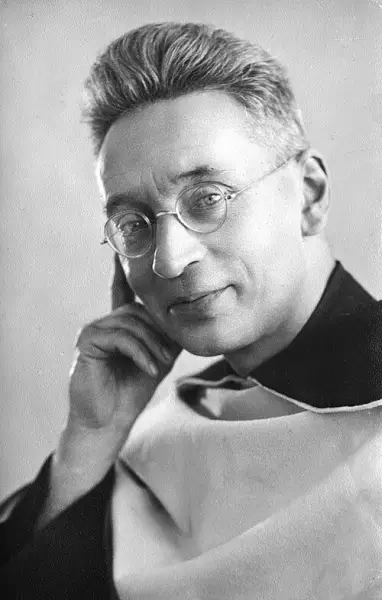
Anno Sjoerd Brandsma was born on 23 February 1881 at Oegeklooster in Friesland, to devout dairy farmers who were a Catholic minority in a Calvinist countryside; of their six children, five entered religious life. At eleven he went to the Franciscan minor seminary at Megen, and in 1898 he joined the Carmelite novitiate at Boxmeer, taking the name Titus after his father. Ordained in 1905 and doctorated in philosophy at the Gregorian in 1909, he wrote, taught, led the Dutch translation of Teresa of Ávila, founded a school at Oss, and helped found the Catholic University of Nijmegen, where he taught philosophy and mysticism from 1923 and served as rector in 1932-33. By 1935 he was ecclesiastical adviser to the Catholic press. He opposed Nazi ideology openly years before the war. After the invasion, in January 1942, he carried the Dutch bishops' ban on printing Nazi propaganda to fourteen Catholic newspaper editors and was arrested on the 19th. Passed through Scheveningen, Amersfoort and Cleves, he reached Dachau on 19 June and was killed there by lethal injection on 26 July 1942.
The Complete Life
Early Life
Anno Sjoerd Brandsma was born on 23 February 1881 at Oegeklooster, near Hartwerd in Friesland, the northern province of the Netherlands, to Titus Brandsma and Tjitsje Postma, who ran a small dairy farm. The family was devoutly Catholic in a predominantly Calvinist countryside — a minority position that gave their faith the temper of quiet stubbornness — and of their six children, all but one daughter entered religious life. It was a Frisian, bilingual, farm-bred Catholicism: at home in two languages and in a church that had to explain itself to its neighbors. From the age of eleven Anno Sjoerd pursued his secondary studies at Megen, at the Franciscan minor seminary for boys considering a vocation, before finding his way to a different order.
§ Early life
Conversion and Vocation
On 17 September 1898 Brandsma entered the Carmelite novitiate at Boxmeer, taking the religious name Titus in honor of his father. He professed first vows in October 1899, was ordained a priest in 1905, and took his doctorate in philosophy at the Pontifical Gregorian University in Rome in 1909 — a training that equipped him as a scholar precisely as his order's Dutch province was entering its intellectual revival. From 1909 to 1923 he lived at Oss, working as a writer and teacher. The Carmelite character of his vocation mattered to him deeply: he became a recognized authority on Carmelite mysticism, and from 1916 led the project of rendering the works of Teresa of Ávila in Dutch, the language of ordinary Catholics whom the devotional literature of the age had largely passed by.
§ Carmelite friar
Mission and Ministry
Brandsma's ministry was the apostolate of the Catholic mind in the Netherlands. In 1919 he founded a secondary school at Oss — the present Titus Brandsma Lyceum — and headed it for two years. In 1921 his mediation of the controversy over Albert Servaes' modernist Stations of the Cross produced his own series of meditations on the fourteen stations, a work still read. In 1923 he helped found Nijmegen's Catholic University, today Radboud University, where he taught philosophy and the history of mysticism and served as rector magnificus in 1932-33. Contemporaries remembered him less for the professor's chair than for his constant availability to everyone; by 1935 he had been made ecclesiastical adviser to the Catholic journalists of the Netherlands, and journalism — the press as the church's outreach to ordinary readers — became the practical center of his work.
§ Carmelite friar
Spirituality and Teaching
Brandsma's thought joined Carmelite mysticism to a Frisian sense of justice. He taught the history of mysticism and wrote on it accessibly, holding that the mystical tradition was not an elite ornament but the Church's deep grammar of prayer; his meditations on the Stations and his Teresa translation carried the same conviction into the hands of lay readers. Against Nazi ideology he spoke out repeatedly before the war, not as a political orator but as a philosopher who saw that a movement which made race the measure of human worth had made itself the enemy of the Catholic doctrine of the person — and he said so in print, in lectures, and in advice to editors, years before it was safe or fashionable.
§ Carmelite friar
Trial and Final Years
After the German invasion of the Netherlands, the Dutch bishops issued a ban on printing Nazi propaganda in the Catholic press, and in January 1942 Brandsma was chosen to carry it personally to the editors of Catholic newspapers across the country — a pastoral errand through fourteen offices. He was arrested at Boxmeer on 19 January. He was passed through Scheveningen and Amersfoort and Cleves, interrogated, and shipped to Dachau, the camp where the Germans concentrated the clergy of Europe, arriving on 19 June 1942. He was killed there by lethal injection on 26 July, aged sixty-one. Witnesses from the camp remembered his kindness to the men around him and his refusal of hatred to the end.
§ Imprisonment and death
Canonization
Brandsma was beatified by Pope John Paul II at Saint Peter's on 3 November 1985 as a martyr of the faith. On 15 May 2022, in Saint Peter's Square, Pope Francis canonized him — a Dutch Carmelite professor, eighty years after his death, in a ceremony that gave the Church its newest journalist-martyr. The miracle accepted for the canonization concerned the healing of a Carmelite priest, and the event was received in the Netherlands as a national as much as a religious memory. His feast is kept on 27 July, the day after his death, and his patronage of Catholic journalists was confirmed by the devotion of the press associations that had promoted his cause.
§ Introduction
Legacy
Brandsma is the patron of Catholic journalists and of Catholic Esperantists — he had promoted that constructed language as a bridge between peoples — and of Friesland and Oss. The Titus Brandsma Memorial at Nijmegen keeps his memory at the university he helped found, and his life is cited wherever the Church discusses its journalists' duty under authoritarian pressure: he did not write against Nazism in a moment of crisis but spent a decade preparing the argument, and then walked the bishops' letter from editor to editor knowing what it would cost him.
§ Introduction
Timeline
- 23 Feb 1881
Born Anno Sjoerd Brandsma at Oegeklooster, near Hartwerd in Friesland, to dairy-farming parents
§ Early life
- 17 Sep 1898
Entered the Carmelite novitiate at Boxmeer, taking the religious name Titus after his father
§ Carmelite friar
- Oct 1899
Professed his first vows as a Carmelite
§ Carmelite friar
- 1905
Ordained a priest
§ Carmelite friar
- 1909
Awarded a doctorate in philosophy by the Pontifical Gregorian University in Rome
§ Carmelite friar
- 1916
Initiated and led a project translating the works of Teresa of Ávila into Dutch
§ Carmelite friar
- 1919
Founded a secondary school at Oss, the present Titus Brandsma Lyceum, and headed it for two years
§ Carmelite friar
- 1923
Took the chair of philosophy and mysticism at Nijmegen's Catholic University, which he had helped establish
§ Carmelite friar
- 1932
Served as rector magnificus of the university for the 1932-33 academic year
§ Carmelite friar
- 1935
Named ecclesiastical adviser to Catholic journalists and toured the United States and Canada lecturing
§ Carmelite friar
- 19 Jan 1942
Arrested at the Boxmeer monastery after delivering the Dutch bishops' ban on printing Nazi documents to fourteen editors
§ Imprisonment and death
- 19 Jun 1942
Arrived at Dachau concentration camp after confinement at Scheveningen, Amersfoort and Cleves
§ Imprisonment and death
- 26 Jul 1942
Died at Dachau from a lethal injection given by an SS nurse as part of medical experiments
§ Imprisonment and death
- 3 Nov 1985
Beatified as a martyr by Pope John Paul II in Saint Peter's Basilica
§ Veneration and canonization
- 25 Nov 2021
Pope Francis recognized a miracle obtained through his intercession, advancing his cause to canonization
§ Veneration and canonization
- 15 May 2022
Canonized by Pope Francis before more than 50,000 people in St. Peter's Square
§ Veneration and canonization
In Their Own Words
I not only see the riches of the nature of the water, its immeasurable potentiality; I see God working in the work of his hands and the manifestation of his love.
The Record
- Major works
- Carmelite Mysticism Historical Sketches·Meditations on the Stations of the Cross (arising from the Servaes controversy)·Dutch translation of the works of Teresa of Ávila (project initiated 1916)
- Patron of
- Catholic Esperantists (International Union of Catholic Esperantists)·Journalists (ecclesiastical adviser to the Catholic press)
- Canonization
- Beatified by Pope John Paul II in November 1985; canonized by Pope Francis on 15 May 2022
Prayer
Bibliography
Show 12 sources
- ↑ Rees, Joseph (1971). Titus Brandsma: A Modern Martyr . London: Sidgwick and Jackson. pp. 15– 16.
- 1 2 3 4 5 6 "Bl. Titus Brandsma" . Carmelites Friars . Archived from the original on 24 July 2012 . Retrieved 28 February 2013 .
- ↑ Dölle, Constant (2002). Encountering God in the Abyss: Titus Brandsma's Spiritual Journey . Leuven: Peeters. p. 11. ISBN 9042911638 .
- ↑ Dölle, Constant (2002). Encountering God in the Abyss: Titus Brandsma's Spiritual Journey . Leuven: Peeters. p. 14. ISBN 9042911638 .
- ↑ Glueckert, Leopold G. (2002). Friar Against Fascism . Carmelite Press. p. 1.
- ↑ Gluekert, Leopold (2002). Friar Against Fascism . Darien, IL: The Carmelite Press. p. 1.
- ↑ Rees, Joseph. Titus Brandsma: A Modern Martyr . 49–50.
- ↑ Dölle, Constant (2002). Encountering God in the Abyss: Titus Brandsma's Spiritual Journey . Leuven: Peeters. pp. 67– 68. ISBN 9042911638 .
- ↑ Brandsma, Titus; Servaes, Albert; Huls, Jos (2003). Ecce Homo: Schouwen van de weg van liefde/Contemplating the Way of the Cross . Leuven: Peeters.
- ↑ Glueckert, Leopold G. (2002). Friar Against Fascism . Carmelite Press. p. 2.
- ↑ Dölle, Constant (2002). Encountering God in the Abyss: Titus Brandsma's Spiritual Journey . Leuven: Peeters. p. 48. ISBN 9042911638 .
- ↑ "Titus Brandsma: Journalist, martyr, saint of the 20th Century - Vatican News" . www.vaticannews.va . 14 May 2022 . Retrieved 28 March 2023 .
Profile text adapted from the Wikipedia article, licensed CC BY-SA 4.0.
Pray with this saint every day
Save St. Titus Brandsma to your favorites, read the full profile, and get feast-day reminders in the Saints app.
Get the Saints AppFree on the App Store for iPhone and iPad