
died 689·Feast July 8
St. Totnan
Irish missionary martyred at Würzburg
Overview
Totnan was an Irish missionary of the seventh century who left his homeland to carry the Christian faith to the Franconians on the European mainland. He joined Saint Kilian and Saint Colman on an expedition that would bind Ireland and Franconia together in memory: the three set out for Rome, gained the approval of Pope Conon, and then pressed north to Würzburg, where they began to preach. Their work bore early fruit when Duke Gozbert of Würzburg accepted Christianity, but the mission soon ran into mortal danger. Kilian confronted the duke over his marriage to his brother's widow, Geilana, and the offended duchess answered by dispatching soldiers to the square where the missionaries preached. There Totnan died by beheading alongside his two companions, probably on 8 July 689. His relics were afterwards honored as a source of cures, moved into the new cathedral at Würzburg in the mid-eighth century, and his name remains attached to the bishopric he helped to found with his blood. He is honored as a martyr and apostle of Franconia.
The Complete Life
Mission to the Franconians
In 686 Totnan joined the expedition led by Saint Kilian, traveling in the company of Saint Colman and nine other Christians from Ireland toward Rome. The party presented itself to Pope Conon, who received the missionaries, and the group then moved north into the territory of the Franks, making for Würzburg on the Main. When the travelers reached the town, the three principals stayed there while the rest of their companions dispersed to preach through the surrounding district, an arrangement that made Würzburg the center of the mission and its hinterland a field for the Gospel. The preaching of the Irish missionaries found a hearing at the highest level of local society: Duke Gozbert of Würzburg became a Christian. Yet the household of the duke concealed the seed of the mission's destruction, for his wife Geilana remained a pagan. Totnan's part in the work was that of companion and witness — the apostolate of the three was exercised in common, in the open square of the town, where they proclaimed Christian teaching to duke and townsfolk alike. It was precisely this public preaching that set the mission on its collision course with the ducal house, and that made Totnan a martyr of the Franconian apostolate alongside the two colleagues with whom he had left Ireland.
§ Saint Totnan
Martyrdom at Würzburg
The crisis of the mission came through the conscience of a Christian prince. Saint Kilian informed Duke Gozbert that he was violating Christian scripture by living in marriage with his brother's widow, Geilana. The rebuke achieved its immediate end in the duke's own conscience, but it awakened a deadly resentment in Geilana, who had never accepted the faith the missionaries preached. While Gozbert was away, she resolved to remove the preachers whose words had condemned her marriage. She dispatched her troops into the marketplace of Würzburg, where the three missionaries were preaching, and there the three missionaries were beheaded. Totnan died on 8 July 689, with the two companions of his journey, in the very place where their apostolate had been exercised. In the pattern of the early Irish missions, the death of the preacher completed the preaching: the missionaries who had come as strangers to Franconia ended their course as its martyrs, and the manner of their end fixed their memory permanently in the church of the region they had evangelized.
§ Saint Totnan
Relics and Remembrance
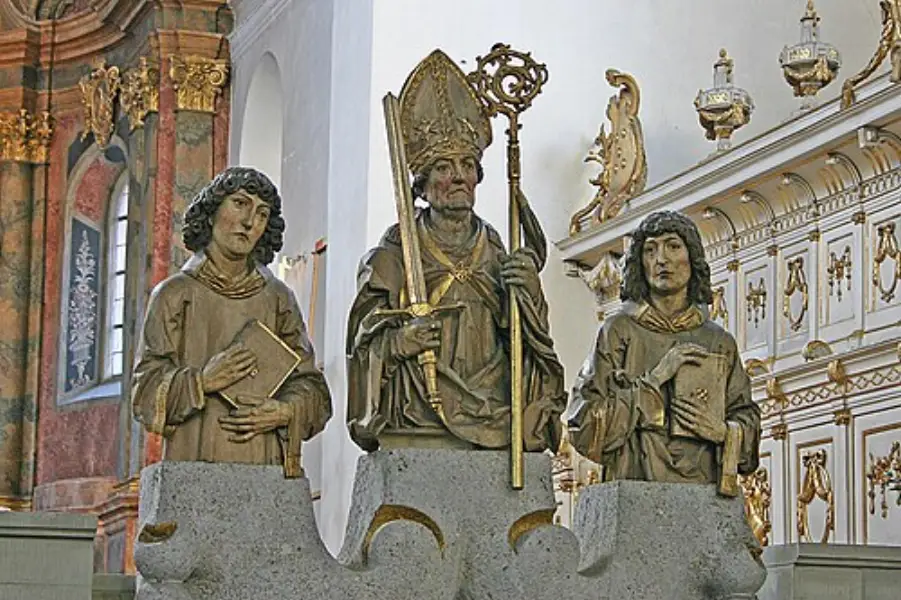
The blood of the three missionaries proved fruitful ground for the church of Würzburg. Once the missionaries were dead, the faithful honored their remains as bringing cures to the sick, and healing was sought at the shrine of the men who had died in the town's marketplace. The cult of the martyrs received institutional form within a lifetime of the mission's consolidation: in 752 Burchard of Wessex became the first bishop of Würzburg, and he had the three martyrs' remains moved into the new cathedral, which took Saint Kilian as its dedicatee. From that point the martyrs stood at the heart of the diocese's identity. The see of Würzburg afterward claimed Totnan as one of its patron saints, an office he holds with his companions, and his image watched over the city from his statue on the Alte Mainbrücke, the old bridge over the Main. The sculptor Tilman Riemenschneider's group of Kilian, Colman, and Totnan in the Neumünster church preserved the three together as the church of Franconia remembers them: apostles, bishops of souls, and martyrs whose feast is kept on 8 July, the anniversary of their death.
§ Legacy
Timeline
- 686
Set out from Ireland for Rome in company with Kilian, Colman, and nine fellow Christians, appearing before Pope Conon.
§ Saint Totnan
- 8 Jul 689
Beheaded in the main square of Würzburg on the orders of Duchess Geilana, together with Kilian and Colman.
§ Saint Totnan
- 752
Burchard of Wessex, first bishop of Würzburg, transferred the relics of the three martyrs into the new cathedral dedicated to Saint Kilian.
§ Legacy
The Record
- Patron of
- Bishopric of Würzburg
- Symbols
- depicted with Kilian and Colman·sword or palm of martyrdom
- Canonization
- Pre-congregation canonization; venerated as a martyr from the early medieval period.
Prayer
Bibliography
Show 5 sources
- Celtic Saints website
- Catholic Ireland website
- Melton, J. Gordon (15 January 2014). Faiths Across Time: 5,000 Years of Religious History. ABC-CLIO. p. 552. ISBN 978-1-61069-026-3.
- Book of Saints, by the Monks of Ramsgate
- Lives of the Saints, by Father Alban Butler
Profile text adapted from the Wikipedia article, licensed CC BY-SA 4.0.
Pray with this saint every day
Save St. Totnan to your favorites, read the full profile, and get feast-day reminders in the Saints app.
Get the Saints AppFree on the App Store for iPhone and iPad