
6th century·Feast June 15
St. Trillo
Breton abbot and church-founder in Wales
Overview
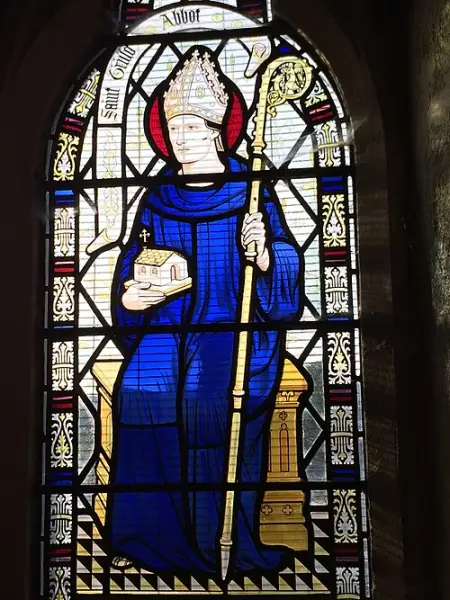
Trillo was a saint of the early sixth century, nobly born in Brittany, who crossed the sea to Wales and gave his name to two of its churches. The father of these saints was the Briton Ithel Hael, and Trillo with his brothers, the saints Tegai and Twrog, placed himself under Saint Cadfan as disciple and student; in time Cadfan received him into the religious life. As an abbot and a founder of churches, Trillo was noted above all for holiness of life. The churches he founded stand in north Wales: Llandrillo in Denbighshire and Llandrillo yn Rhos at Rhos-on-Sea in Conwy County Borough, both of which took their name from their founder. He was buried on Bardsey Island, the burial place of saints off the Llŷn peninsula. His memory endured in the communities that bore his name: the parish church of Llandrillo preserves scenes from his life in stained glass commissioned in the 1920s, and even a tram of the Great Orme Tramway carries his name in his honor. His feast is kept on 15 June.
The Complete Life
A Noble Son of Brittany
Trillo came of a family that itself gave saints to the church. According to Robert Williams's Enwogion Cymru, the biographical dictionary of eminent Welshmen, his days fell in the opening years of the sixth century, and his father was Ithel Hael. His birth was noble, and it was in Brittany that he was born and raised; but his family's connection with the church of Wales ran deep, for two of his brothers were also numbered among the Welsh saints, Tegai and Twrog, each of whom left his own name on Welsh foundations. The movement of which Trillo formed part belonged to the age in which saints from Brittany and Ireland crossed to Britain and planted monastic communities along the Welsh coast. For a young man of his station, the decision to go to Wales as a religious student meant exchanging the expectations of rank for the discipline of a monastery, and it was this exchange, made early and made permanently, that set the course of his life as abbot and founder.
§ Saint Trillo
Disciple of Saint Cadfan
In Wales Trillo attached himself to Saint Cadfan, one of the founders of Welsh monasticism, becoming his disciple and student. The relationship was formative: Cadfan, who had come from Brittany himself, presided over a school in which the sons of British and Breton nobility were formed in the religious life, and Trillo was among those whom he admitted to it. Under such a master the young noble learned what his biographer's tradition sums up as holiness — the quality for which Trillo was noted once his formation was complete. He progressed from student to professed religious and in time to abbot, exercising authority over a monastic community. The progression from Cadfan's school to Trillo's own foundations illustrates how the Welsh church of the sixth century multiplied itself: disciples became abbots, abbots became founders, and each new foundation carried the name of the saint who established it and the tradition of the master who had formed him.
§ Saint Trillo
Founder and Patron
Trillo's enduring work was the founding of churches in north Wales, and two foundations in particular carry his memory. The first is Llandrillo in Denbighshire, whose parish church still serves the community whose name it bears — the church, or enclosure, of Trillo. The second is Llandrillo yn Rhos at Rhos-on-Sea in Conwy County Borough, the church of Trillo in the cantref of Rhos, planted on the coast between the hills and the sea. Both dedications mark the areas in which his mission was exercised and in which he was honored as patron and founder. As abbot he stood at the head of the religious life these communities nurtured; as founder he was remembered as the saint under whose protection each place lived. Centuries after his death the tie between the saint and his churches remained alive: when the parishioners of Llandrillo wished to commemorate their former parish priest in the 1920s, they commissioned stained glass depicting the stories of Trillo's own life, so that the founder's history remained visibly part of the worship of his people.
§ Saint Trillo
Bardsey and Remembrance
Trillo was buried on Bardsey Island, the island off the Llŷn peninsula that medieval tradition called the holy island and the burial place of saints, and his grave there placed him in the company of the holiest men of the Welsh church. His cult survived in the two parishes that bore his name and spread into the wider landscape of his adopted country in forms his own century could not have imagined. The parish church at Llandrillo keeps his story in glass, so that the congregation hears the legends of its founder in colored light each time it gathers. On the Great Orme at Llandrillo yn Rhos, tram car no. 7 of the Great Orme Tramway is named St Trillo in his honor, a secular tribute to a saint whose name the coast has never forgotten. His feast is kept on 15 June, and under that date the church of Wales remembers the Breton noble who became a Welsh abbot and gave two of its communities both their churches and their identity.
§ Saint Trillo
The Record
- Major works
- Church of Llandrillo, Denbighshire·Church of Llandrillo yn Rhos, Rhos-on-Sea
- Patron of
- Llandrillo, Denbighshire·Llandrillo yn Rhos, Rhos-on-Sea
- Symbols
- abbot's crosier·church model
- Canonization
- Pre-congregation canonization; venerated from the early medieval period in Wales.
Prayer
Bibliography
Show 1 sources
- Williams, Robert (1852). Enwogion Cymru: A Biographical Dictionary of Eminent Welshmen, from the Earliest Times to the Present, and Including Every Name Connected with the Ancient History of Wales. W. Rees.
Profile text adapted from the Wikipedia article, licensed CC BY-SA 4.0.
Pray with this saint every day
Save St. Trillo to your favorites, read the full profile, and get feast-day reminders in the Saints app.
Get the Saints AppFree on the App Store for iPhone and iPad