
7th century·Feast May 1
St. Ultan
Irish monk of Fursey's mission to East Anglia
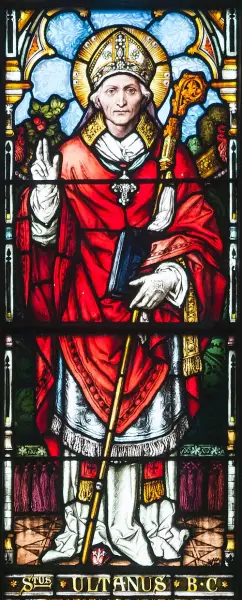
Overview
Ultan was an Irish monk and abbot of the seventh century, a brother of the better-known saints Fursey and Foillan and a companion of their missionary wanderings from Ireland to East Anglia and on to Merovingian Gaul. He was born into a holy and princely line, the son of Gelges, herself a daughter of King Áed of Connacht, probably Áed mac Echach. Around 633 he joined the mission that his brother Fursey led from Ireland through British territory into the kingdom of King Sigeberht of East Anglia, where the monks settled at Cnobheresburg, a monastery set within the walls of an old Roman shore-fort by the sea, commonly identified with Burgh Castle in Norfolk. After serving a probation in that community, Ultan withdrew to live as a hermit, and when Fursey joined him around 643 the brothers spent a year together in a life of manual labor, contemplation, and philosophy. In 651, with the monastery threatened by the pagan King Penda of Mercia, Ultan fled East Anglia with his brother Foillan, carrying the monastery's books and treasures to safety. In Gaul the brothers were received by Saint Gertrude of Nivelles and her mother Itta, and about 653 Ultan helped teach psalmody to the nuns of Nivelles. Bede records the mission in his Ecclesiastical History, and Ultan is venerated in both the Catholic and Eastern Orthodox churches, his feast kept on 1 May.
The Complete Life
A Royal and Holy Family
Ultan belonged to a family in which sanctity and royal blood were joined. His brothers were Saint Fursey — also called Fursa — and Saint Foillan; through them he belonged to the family of the royal woman Gelges, whose father was King Áed of Connacht, probably Áed mac Echach. The household produced at least three recognized saints, and the tradition that preserved their lives treats the brothers as a single company whose missions were bound together: what one began, the others carried forward. Of Ultan's own childhood and education in Ireland the sources preserve no separate account, but the world that formed him is clear enough — the monastic schools of seventh-century Ireland, which sent a stream of missionary monks to Britain and the continent. From that world he emerged as a monk, and in time an abbot, formed in the disciplines of prayer, study, and manual labor that the Irish church had perfected and that his family would transplant, through him and his brothers, to East Anglia and to Merovingian Gaul.
§ Saint Ultan
Probation and the Hermit Life
Ultan's monastic vocation passed through two distinct stages, each characteristic of Irish spirituality. The monastery the missionaries established in East Anglia occupied the precincts of an ancient Roman fort of stone beside the shore, the site named Cnobheresburg, and there Ultan served a probation of several years, learning under discipline the life he would later live in freedom. When that probation was complete, he withdrew into solitude in East Anglia to live as a hermit, pursuing the contemplative quiet that Irish monks prized as the school of the holiest souls. The hermit life did not sever him from his family's common work: around 643 his brother Fursey, having handed his duties at the monastery to Foillan, came to join Ultan, taking nothing with him. For a year the two brothers lived by the labor of their hands, devoted to contemplation and philosophy. The episode shows the two poles of Ultan's vocation — solitary prayer and the shared service of the missionary church — held together, as they would be for the rest of his life, until events compelled him back into the common cause.
§ Saint Ultan
East Anglia and the Mission of Fursey
The mission to which Ultan attached himself around 633 was led by his brother Fursey and traveled from Ireland through British territory into East Anglia, where King Sigeberht received the missionaries and endowed their monastery; King Anna and his nobles later re-endowed it. The site, commonly identified with Burgh Castle near the mouth of the river Yare, placed the monks within walls that Roman soldiers had built centuries before, and from that stronghold the Irish mission worked among the East Angles. It was in the service of this mission that Ultan made the passage from probationary monk to hermit and back to the brotherhood's common life. The mission's fortunes turned with the politics of the age: heathen raids were troubling the kingdom, and Fursey crossed to Gaul around 644, and in 651, with the monastery under attack from King Penda of Mercia and King Anna himself in exile, the community fled. A record preserved at Nivelles shows that Foillan and his brethren, Ultan among them, escaped with the help of King Anna, bearing away the monastery's treasured possessions and its books — a rescue that carried the learning of the East Anglian mission to the continent.
§ Saint Ultan
Exile and Service at Nivelles
Ultan's last years were spent in Merovingian Gaul, in the orbit of the noble women who became the mission's protectors. After unhappy dealings with Erchinoald, the exiled brethren were received by Saint Gertrude of Nivelles and her mother Itta, and from that household the Irish mission found a new base in the lands of the Rhine and the Meuse. Foillan established a monastery at Fosse — the present Fosses-la-Ville, close to Namur — encouraged and supported by Itta, though he was murdered by bandits not long afterwards while journeying from Nivelles to Fosse. Ultan's own service in the new land, according to Grattan Flood's account, was musical: about 653 the abbess Gertrude sent for Foillan and Ultan to teach psalmody to her nuns, and the two Irish monks granted her request and raised a neighboring monastery at Fosse, within the diocese of Liège. The teacher of chant to a Frankish convent was a fitting final work for the brother who had carried the books of Cnobheresburg out of a burning war. The date and circumstances of his own death are not recorded in the surviving account.
§ Musician
The Witness of Bede
Ultan's memory rests on the testimony of the greatest historian of the age. The Venerable Bede, in his Ecclesiastical History of the English People, relates the mission in which Ultan joined his brother Fursey, and so preserved the Irish monk's name in the historical record of the conversion of the English. The record kept at Nivelles independently attests his presence among the brethren who fled East Anglia in 651, confirming the account of the mission's continental afterlife. Medieval tradition gave him the title of missionary, and the church honors him in that company: he is venerated in both the Catholic Church and the Eastern Orthodox Church, and his feast is kept on 1 May. His legacy is that of a mission accomplished in common — the brothers Fursey, Foillan, and Ultan carried Irish monasticism from Ireland to East Anglia and thence to Gaul, and every stage of that journey bore fruit in monasteries, in books saved from war, and in the chant that Frankish nuns learned from an Irish teacher's voice.
§ Saint Ultan
Timeline
- 633
Joined Fursey's mission from Ireland through British territory to East Anglia, to the kingdom of King Sigeberht.
§ Saint Ultan
- 643
Fursey joined Ultan in his hermit life, and the brothers lived for a year together by the labor of their hands.
§ Saint Ultan
- 644
Fursey left East Anglia for Gaul, entrusting the monastery and its brethren to Foillan.
§ Saint Ultan
- 651
Fled East Anglia with Foillan during King Penda of Mercia's attack, carrying the monastery's precious property and books, and was received at Nivelles by Gertrude and Itta.
§ Saint Ultan
- 653
At Gertrude's summons, taught psalmody to the nuns of Nivelles alongside his brother Foillan.
§ Musician
In Their Own Words
About the year 653, St. Gertrude, of Brabant, (daughter of Pepin, Mayor of the Palace), abbess of Nivelle, in Brabant, sent for St. Foillan and St. Ultan, brothers of our celebrated St. Fursey (Patron of Perrone), to teach psalmody to her nuns. These two Irish monks complied with her request, and built an adjoining monastery at Fosse, in the diocese of Liege.
The Record
- Major works
- Foundation of the monastic life carried from Cnobheresburg to Nivelles, with its books and treasures
- Patron of
- musicians and teachers of psalmody
- Symbols
- monastic habit·book or psalter
- Canonization
- Pre-congregation canonization; venerated as a missionary saint from the early medieval period.
Prayer
Bibliography
Show 7 sources
- Attwater, Donald and Catherine Rachel John (1993). The Penguin Dictionary of Saints (3rd ed.). New York: Penguin Books. ISBN 0-14-051312-4.
- Bede, Historia ecclesiastica gentis Anglorum, ed. and tr. Colgrave, Bertram; Mynors, Roger AB (1969). Bede's Ecclesiastical History of the English People. Oxford Medieval Texts. Oxford: Clarendon Press. ISBN 0-1982-2202-5.
- Whitelock, Dorothy (1972). "The Pre-Viking Age Church in East Anglia". Anglo-Saxon England. 1: 1–22. doi:10.1017/s0263675100000053.
- Flood, William H. Grattan (1906). A History of Irish Music. Dublin. p. 12.
- Colgrave, B. and Mynors, R. A. B., Bede's Ecclesiastical History of the English People (Clarendon Press, Oxford 1969), 268–277: Bede, HE iii.18.
- Dahl, Louis, The Roman Camp and the Irish Saint at Burgh Castle (Jarrold, London 1913).
- Additamentum Niuialense de Fuilano, ed. Bruno Krusch, Monumenta Germaniae Historica, SRM IV (Hannover 1902), p. 449-451.
Profile text adapted from the Wikipedia article, licensed CC BY-SA 4.0.
Pray with this saint every day
Save St. Ultan to your favorites, read the full profile, and get feast-day reminders in the Saints app.
Get the Saints AppFree on the App Store for iPhone and iPad