
died c. 383 (traditional)·Feast October 21
St. Ursula
Virgin martyr of Cologne and her companions
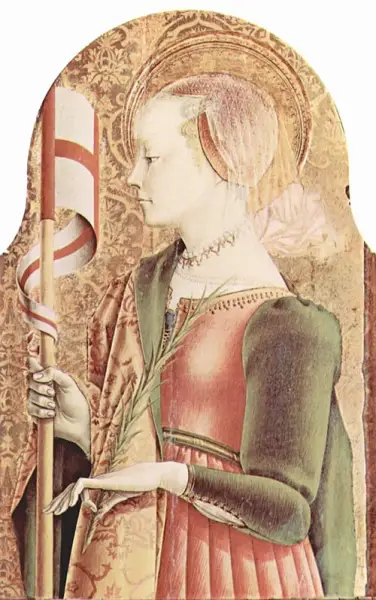
Overview
Ursula, whose Latin name means little she-bear, was a Romano-British virgin and martyr, perhaps of royal birth, put to death with a company of holy virgins at Colonia Agrippina — the modern Cologne — at an uncertain date that tradition places around 383. She is venerated in the Catholic, Eastern Orthodox, and Anglican churches, with her feast on 21 October. The historical record is thin: an inscription of about 400 in Cologne's Church of Saint Ursula records a senator's restoration of a basilica on the spot where holy virgins were killed, but the first source naming Ursula herself belongs to the tenth century. The medieval legend that made her famous tells of a princess consecrated to Christ, forced by her father King Dionotus of Dumnonia into betrothal to the pagan governor Conan Meriadoc of Armorica, and granted a three-year delay during which she undertook a pilgrimage to Rome with a great company of virgins. Returning, they were caught in the Hunnish siege of Cologne and massacred; their leader was slain by an arrow from the Huns' chieftain. Whatever the truth of the story, the cult grew prodigious: the figure of eleven thousand martyred virgins arose by the late ninth century, the Basilica of Saint Ursula enshrined mountains of bones, the Ursuline order took her name for its work of educating girls, and explorers gave her virgins' name to islands and capes on two oceans.
The Complete Life
A Princess of Dumnonia
The woman remembered as Ursula was, in the world's terms, a Briton of the Roman era and perhaps a king's daughter. Her Latin name means little she-bear, and tradition makes her a princess of Dumnonia in south-west Britain in the late fourth century, daughter of the semi-legendary King Dionotus. Before the story of her death could be told, the legend had to account for a consecration: Ursula had already promised herself to Christ when her father demanded that she marry Conan Meriadoc, the pagan governor of Armorica. She could not refuse a royal command, but she managed to hold the wedding at bay for three years. That interval, granted between obedience and devotion, became the space in which her legend unfolds — the years of pilgrimage during which her small band of virgins swelled, in the telling, to a multitude. However the story is judged, it preserves the shape of a fourth-century Christian woman caught between a family's dynastic plans and a vow that preceded them, and it was this collision of claims, the earthly and the heavenly, that the medieval world found unforgettable.
§ Legend of St Ursula and the Eleven Thousand Companions
The Pilgrimage of the Virgins
The three years Ursula won from her father became a pilgrimage that the legend described as pan-European in scope. She set out accompanied by ten virgins, each of whom in turn would eventually be attended by a thousand more, and the company made its way toward Rome. There Ursula persuaded the Pope — named Cyriacus in the legend, unknown to the pontifical records, though a Pope Siricius appears from late 384 — and Sulpicius, bishop of Ravenna, to join the pilgrims on their return journey. The destination was Cologne, and the company reached it only to find the city under siege by the Huns. The vocation that emerges from this strange narrative is twofold: Ursula's first vow, made to Christ, held fast through her father's demand; and her second calling, taken up in the years of delay, drew a great company of women out of their homelands across the known world to the shrines of the faith. The legend's arithmetic — ten virgins, each commanding a thousand — is the medieval way of saying that her example multiplied itself, and the Church of the later centuries accepted the symbol as the number eleven thousand.
§ Legend of St Ursula and the Eleven Thousand Companions
Martyrdom at Cologne
The legend brings Ursula and her companions to Cologne as the city endures a Hunnish siege, and there, at the walls of the threatened town, the pilgrimage ends in massacre. All the virgins are beheaded, and their leader dies by a different instrument: the Huns' chieftain himself fatally shoots Ursula with an arrow, in about 383 by the traditional reckoning, though the date varies among the tellings. A final marvel completes the story — when the Huns attempt to plunder the companions' ships, they discover eleven legions of soldiers aboard, a sight that frightens them out of Cologne altogether. Behind the embellishment stands an older and plainer memory: a group of holy virgins died at Colonia Agrippina at an uncertain date, and the Christians of the city marked the place of their death. Within about a generation a senator named Clemantius restored the ancient basilica that stood there, recording in an inscription of about 400 that the church rose on the spot where the holy virgins were killed — the first and most solid testimony to the martyrdom the legend would later adorn.
§ Legend of St Ursula and the Eleven Thousand Companions
Legend, Doubt, and the Martyrology
The fame of Ursula grew faster than the evidence for her, and the church has long known it. A story much like hers surfaced in the tenth century's first half, though it named the group's leader Pinnosa or Vinnosa; after Pinnosa's relics went from Cologne to Essen about 947, Ursula's role came to the fore, and in 970 the first Passio Ursulae named her as the leader. Serious medieval writers already doubted: neither Jerome nor Gregory of Tours mentions her, and the great hagiographers of the early Middle Ages do not enter her under 21 October, her feast day. The eleventh-thousand figure itself seems to have arisen from misread Latin — eleven martyred virgins mistaken for eleven thousand, or a girl's name miscounted as a multitude. When the calendar was reformed in 1969, the commemoration of Ursula and her companions was removed, on the grounds that their Passio is entirely fabulous and not even their names are known. Yet they remain in the Roman Martyrology, which records with careful reserve the virgin saints who died at Cologne at some uncertain time, honored in the basilica dedicated to the innocent young girl Ursula who is regarded as their leader.
§ Official stance of the Catholic Church
An Empress of Memory
However small the historical kernel, the harvest of Ursula's cult has been vast. The Basilica of Saint Ursula in Cologne enshrines the collected bones of her companions in walls of ribs and femurs arranged in swirls and Latin words, and its seventeenth-century Golden Chamber displays sculpted heads in silver and cloth of gold. In art she commanded the greatest painters of her cult's centuries: Memling built the wooden shrine in Bruges that tells her story in arched panels, Carpaccio painted her dream and her pilgrims' meeting with the Pope in Venice, Claude Lorrain her embarkation, and Caravaggio, in his last known work, her martyrdom. Hildegard of Bingen composed chants in her honor, and Angela Merici's Ursulines, founded in 1535 to educate young girls, carried her name through the schools of the world and made her patron of schoolgirls. Explorers scattered her companions' memory across the maps — Columbus's Virgin Islands in 1493, Magellan's Cape Virgenes, the Eleven Thousand Virgins of Saint-Pierre and Miquelon — while at Llangwyryfon in Wales the only British church dedicated to her bears a village name that means Church of the Virgins. Pilgrims still keep her feast on 21 October in Binangonan in the Philippines and at the castellers' fair of Valls in Catalonia.
§ Veneration
Timeline
- 383
According to the legend, the Hunnish leader fatally shot Ursula with an arrow during the massacre of the virgins at Cologne; the date varies in the sources.
§ Legend of St Ursula and the Eleven Thousand Companions
- 400
The Clematius Inscription, the oldest witness to a cult of martyred virgins at Cologne, told how Senator Clemantius rebuilt the basilica over the place of their death.
§ History
- 848
Wandelbert of Prüm stated in his martyrology that thousands of saints were slaughtered on the banks of the Rhine.
§ Misreading of Latin
- 947
The relics of Pinnosa, leader of the martyred virgins in the older tenth-century legend, were transferred from Cologne to Essen.
§ Tenth-century legend
- 970
The first Passio Ursulae appeared, replacing Pinnosa with Ursula as the group's leader in the telling.
§ Tenth-century legend
- 1105
The second Passio Ursulae was written, whose words Deo notus Geoffrey of Monmouth may later have misread.
§ Misreading of Latin
- 1183
Children's skeletons, some only months old, came to light beside one of the sacred virgins, casting further doubt on the relics.
§ Skeletal remains
- 1277
The body of Cordula, said to be the last of Ursula's companions to die, was discovered at the Johanniterkirche in Cologne.
§ Cordula, Ursula's companion
- 1493
Sailing past Caribbean islands, Christopher Columbus gave them the name Virgin Islands in Ursula's honor.
§ Places named after her companions
- 21 Oct 1520
Ferdinand Magellan rounded and named Cape Virgenes at the entrance to the Straits of Magellan after Ursula's virgins.
§ Places named after her companions
- 1521
The Portuguese explorer João Álvares Fagundes gave the name Eleven Thousand Virgins to the islands now called Saint-Pierre and Miquelon.
§ Places named after her companions
- 1535
Angela Merici founded the Order of Ursulines, devoted to the education of young girls, spreading Ursula's name across the world.
§ Veneration
- 1969
The commemoration of Saint Ursula and her companions was removed from the General Roman Calendar because their Passio is entirely fabulous.
§ Official stance of the Catholic Church
In Their Own Words
this legend, with its countless variants and increasingly fabulous developments, would fill more than a hundred pages. Various characteristics of it were already regarded with suspicion by certain medieval writers, and since [Caesar] Baronius have been universally rejected.
At Cologne in Germany, commemoration of virgin saints who ended their life in martyrdom for Christ in the place where afterwards the city's basilica was built, dedicated in honour of the innocent young girl Ursula who is looked on as their leader.
The Record
- Patron of
- Cologne·England·Binangonan, Rizal (Philippines)·Gozo Island·archers·orphans·female students
- Symbols
- arrow·banner·cloak·clock·maiden shot with arrows·ship·companions being martyred
- Canonization
- Pre-congregation canonization; venerated since late antiquity at Cologne, though her Passio was judged entirely fabulous in the 1969 calendar reform.
Prayer
Bibliography
Show 11 sources
- Spiteri, Charles (19 October 2021). "Celebrating St Ursula, patron of Gozo". Times of Malta. Retrieved 20 October 2021.
- Calendarium Romanum (Libreria Editrice Vaticana, 1969), p. 143.
- Martyrologium Romanum (Libreria Editrice Vaticana, 2004), p. 582.
- Missale Romanum (Typis Polyglottis Vaticanis, 1970), p. 113.
- Holladay, Joan A. (1997). "Relics, Reliquaries, and Religious Women: Visualizing the Holy Virgins of Cologne". Studies in Iconography. 18: 67–118.
- Cusack, Carole M. (1999). "Hagiography and History: the Legend of Saint Ursula". In This Immense Panorama: Studies in Honour of Eric J. Sharpe. Sydney Studies in Religion 2. pp. 89–104.
- Poncelet, Albert (1912). "St Ursula and the Eleven Thousand Virgins". In Herbermann, Charles (ed.). Catholic Encyclopedia. Vol. 15. New York: Robert Appleton Company.
- Archer, Thomas Andrew; Grieve, Alexander James (1911). "Ursula, St". In Chisholm, Hugh (ed.). Encyclopædia Britannica. Vol. 27 (11th ed.). Cambridge University Press. p. 803.
- Montgomery, Scott B. (2009). St. Ursula and the Eleven Thousand Virgins of Cologne: Relics, Reliquaries and the Visual Culture of Group Sanctity in Late Medieval Europe. Peter Lang. ISBN 9783039118526.
- Levison, Wilhelm (1927). "Das Werden der Ursula Legende". Bonner Jahrbücher. 132: 1–164.
- Quigley, Christine (2001). Skulls and Skeletons: Human Bone Collections and Accumulations. Jefferson, N.C.; London: McFarland. p. 169.
Profile text adapted from the Wikipedia article, licensed CC BY-SA 4.0.
Pray with this saint every day
Save St. Ursula to your favorites, read the full profile, and get feast-day reminders in the Saints app.
Get the Saints AppFree on the App Store for iPhone and iPad