
c. 225 – 269·Feast February 14
St. Valentine
Bishop and martyr of Terni, patron of love
Overview
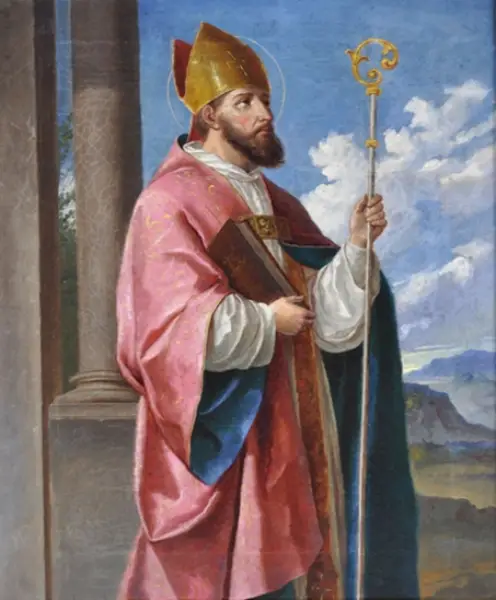
Valentine was a third-century Roman clergyman — remembered as either a priest of Rome or the bishop of Terni, the ancient Interamna in Umbria — who ministered to persecuted Christians and died a martyr's death in the imperial capital. Born around 225, he was seized during the persecution of the Church, tried before the emperor Claudius Gothicus, and executed outside the Flaminian Gate on 14 February 269, his body buried on the Via Flaminia. The date of his death has been kept as his feast since at least the eighth century in the West, while the East honors him in July. The oldest accounts already twinned his memory with that of another Valentine, and hagiographers still debate whether one martyr or two stand behind the records, but the Catholic Church's official Martyrology lists a single Valentine for 14 February: a martyr who died on the Via Flaminia. Around his bones grew a devotion of extraordinary reach — a basilica on the Flaminian road, relics scattered from Dublin to Lesbos, and a medieval association with courtly love that turned his feast into the world's day of lovers. He is patron of affianced couples and happy marriages, of beekeepers, of those who suffer epilepsy, and of the city of Terni.
The Complete Life
A Priest or Bishop of the Roman Church
Valentine was born around 225 at Terni, the ancient Interamna, an important town of Umbria in central Roman Italy. The sources that survive cannot fully untangle his identity: the most ancient register of Rome's martyrs, the Chronography of 354, passes him over in silence, and the sixth-century Martyrologium Hieronymianum knows of a Valentinus martyred in Rome and another in Africa, without further detail. Hagiographical tradition, including the Catholic Encyclopedia, speaks of three saints of the name connected with 14 February — a Roman priest, the bishop of Interamna, and a third who suffered in the Roman province of Africa with companions of whom nothing else is known. Both of these were laid to rest on the Via Flaminia beyond Rome, though at differing distances from the walls, and while their extant martyrdom accounts are late and contain legendary elements, scholars suggest a common nucleus of fact may underlie both, and that they may refer to a single person. The official biography of the Diocese of Terni identifies its bishop simply: born and living in Interamna, he found himself in Rome on a temporary stay when the persecution overtook him. What is certain is that the man honored on 14 February was a clergyman of the third-century Roman church.
§ Identification
Minister to the Persecuted
Valentine's work was that of a clergyman who ministered to persecuted Christians in the Roman Empire, serving the faithful at a time when profession of Christ could cost a man his freedom and his life. The fullest of the legends makes his vocation visible in a Roman house arrest: while detained by Judge Asterius, Valentinus debated the faith with his captor, and the judge set him a test — the restoration of sight to his adopted blind daughter. If Valentinus succeeded, Asterius would do whatever he asked. The priest prayed to God, laid his hands on the child's eyes, and her vision returned. Humbled, the judge asked what he must do, and received the answer of a missionary rather than a suppliant: the idols in the house were to be broken, the judge was to fast for three days, and then to receive baptism. Asterius obeyed, and his fasting and prayer bore fruit beyond his own household — he freed every Christian prisoner under his authority, and he, his family, and the forty-four adults of his household were baptized. Whether the episode is history or edifying tale, it pictures the ministry for which Valentine died: a man whose prayer healed, whose words converted, and whose presence turned prisons into churches.
§ Hagiography and testimony
Evangelization and the Marriage of Christians
The legends give Valentine's mission two faces. The first is evangelization carried out at personal risk: arrested again for continuing to evangelize, he was passed from the prefect of Rome into the hands of the emperor Claudius Gothicus. The second, preserved in a popular legend, is the defense of Christian marriage — the priest who defied the emperor's order and secretly performed Christian weddings for couples, so that the husbands could escape conscription into an army that was short of soldiers. So that these men would remember their promises and the love of God, the legend says, Valentine cut hearts from parchment and gave them to the persecuted Christians, a gesture remembered as a possible origin of the hearts that mark his feast. Such stories grew around the martyr because his cult demanded them, but they preserve the memory of a churchman who stood between the Christian household and the power of the state — blessing unions the empire would not recognize, strengthening converts the empire sought to break, and refusing, at every stage, to let fear govern the gospel he served.
§ Hagiography and testimony
Trial and Martyrdom, 14 February 269
Valentine's arrest led him from house detention to the courts of the empire. Brought before the prefect of Rome, he was passed upward to the emperor Claudius Gothicus, who took a liking to the prisoner until Valentine tried to persuade him to embrace Christianity. The emperor refused and condemned him to death, commanding that he either renounce his faith or be beaten with clubs and beheaded. Valentine refused, and the sentence was carried out outside the Flaminian Gate on 14 February 269 — a death the Golden Legend records more briefly as execution for refusing to deny Christ, in the year 269, after the martyr had restored sight and hearing to his jailer's daughter. An embellishment to the account relates that before his execution Valentine sent a farewell message to the judge's daughter, subscribed from your Valentine — words later writers would credit with inspiring the love letters of his feast day. His body was buried on the Via Flaminia; the Terni tradition adds that his disciples retrieved it by night and carried it home to Interamna, where the cathedral city of Umbria still claims its bishop's remains.
§ Hagiography and testimony
From the Eighth Century to the Modern Calendar
Valentine's cult is among the oldest attested in the Latin church: his burial on the Via Flaminia was marked from an early date, and 14 February has been observed as the Feast of Saint Valentine since at least the eighth century. A later Passio credited Pope Julius I with building the ancient basilica of S. Valentini extra Portam over the martyr's sepulchre, though the church really took its name from a fourth-century tribune who had donated the land. Medieval Europe kept his acts everywhere — the abstracts of the two Valentines, of Rome and of Terni, stood in nearly every church and monastery. His liturgical rank rose and fell with the church's reforms: kept in the General Roman Calendar as a simple feast until 1955, when Pius XII reduced it to a commemoration, and removed from the calendar entirely in the 1969 revision, though he remains listed in the Roman Martyrology and his observance continues where the older Missal is used. The Church of England, which had him in its pre-Reformation calendars, restored his commemoration as bishop and martyr in the 1661–62 Book of Common Prayer, and the Orthodox churches honor him on 6 and 30 July.
§ Saint Valentine's Day
The Saint of Lovers and His Relics
The Valentine known to the world was made in the later Middle Ages, when his feast of 14 February first became associated with romantic love — an association scholars trace to Geoffrey Chaucer and his circle in fourteenth-century England, building on the belief that birds paired in mid-February, and not, as the eighteenth-century antiquarians supposed, on the supersession of the pagan Lupercalia. From that union of martyr and springtime came a devotion without parallel: pilgrims still travel to the Whitefriar Street Carmelite Church in Dublin, where Cardinal Odescalchi's gift of the saint's partial remains arrived in 1835, to pray for love and write petitions in a book kept beside the shrine. His flower-crowned skull is exhibited at Santa Maria in Cosmedin in Rome, and his relics lie from Madrid's church of St Anton to Košice, Chełmno, Savona, Roquemaure, Vienna, Balzan, Lesbos, and the Gorbals of Glasgow. The modern parish church of Saint Valentine in Rome, built in 1960 for the Olympic Village, continues his cult in the city of his death, while Terni keeps its bishop and the world keeps his day.
§ Associated Christian relics
Timeline
- 225
Born at Terni (Interamna) in Roman Italy, according to the traditional dating.
§ Saint Valentine
- 14 Feb 269
Martyred in Rome under Claudius Gothicus, executed outside the Flaminian Gate and buried on the Via Flaminia.
§ Hagiography and testimony
- 1260
Jacobus de Voragine's Legenda Aurea, compiled around this date, gave the brief vita of Valentine executed for refusing to deny Christ in the year 269.
§ Hagiography and testimony
- 1288
The martyr's remains left the old Flaminian basilica for the church of Santa Prassede in the days of Pope Nicholas IV.
§ Associated Christian relics
- 1493
In the Nuremberg Chronicle, Valentine appears as a learned Roman priest whose preaching converted Asterius's daughter and forty-nine others before his death.
§ Hagiography and testimony
- 1661
Valentine's commemoration as bishop and martyr returned to the Church of England's 1661–62 Book of Common Prayer.
§ Saint Valentine's Day
- 27 Dec 1835
Cardinal Carlo Odescalchi sent the partial remains of Saint Valentine to Father John Spratt of the Carmelites in Dublin, under Pope Gregory XVI.
§ Associated Christian relics
- 1969
The revision of the General Roman Calendar removed Valentine's universal celebration, leaving his feast to local calendars, though he remains in the Roman Martyrology.
§ Saint Valentine
- 2003
A further relic of the saint came to light in Prague, in the Vyšehrad basilica of St. Peter and St. Paul.
§ Associated Christian relics
In Their Own Words
abstracts of the acts of the two saints were in nearly every church and monastery of Europe
to remind these men of their vows and God's love, Saint Valentine is said to have cut hearts from parchment
The Record
- Major works
- Basilica of Saint Valentine on the Via Flaminia, built over his burial place
- Patron of
- affianced couples·happy marriages·love·beekeepers·against fainting·against plague·against epilepsy·Terni·Lesvos (for Catholics)
- Symbols
- birds·roses·bishop with a crippled person or child with epilepsy at his feet·bishop with a rooster nearby·bishop refusing to adore an idol·bishop being beheaded·priest bearing a sword·priest holding a sun·priest giving sight to a blind girl
- Canonization
- Pre-congregation canonization; honored as a martyr since the early centuries, with his feast observed on February 14 since at least the eighth century.
Prayer
Bibliography
Show 12 sources
- De Rossi, Johannes Baptista; Duchesne, Ludovicus, ed. (1894). Martyrologium Hieronymianum: ad fidem codicum adiectis prolegomenis. Ex Actibus Sanctorum Novembris, Tomi II, pars prior. Bruxellis. S. Valentinus, p. 20.
- De Voragine, Jacobus. The Life of Saint Valentine. In Legenda Aurea, compiled around 1275.
- Delehaye, Hippolyte (1911). "Valentine". Encyclopædia Britannica. Vol. 27 (11th ed.). pp. 850–851.
- Hülsen, Christian (1927). Le chiese di Roma nel medio evo: cataloghi ed appunti. Florence. CXV, 640 p.
- Thurston, Herbert (1933). St. Valentine, Martyr. In Alban Butler's Lives of the Saints, Vol. II, pp. 214–217. New York.
- Aigrain, René (1953). Hagiographie: Ses sources, ses méthodes, son histoire. Paris.
- Amore, Agostino. S. Valentino di Roma o di Terni?, Antonianum 41 (1966), pp. 260–277.
- Oruch, Jack B. "St. Valentine, Chaucer, and Spring in February", Speculum 56 (July 1981), pp. 534–565. doi:10.2307/2847741.
- Kelly, Henry Ansgar (1986). Chaucer and the cult of Saint Valentine. Leiden, the Netherlands. 185 p.
- Martyrologium Romanum. Libreria Editrice Vaticana, 2001, p. 141 (February 14). 773 p.
- Schoepflin, Maurizio and Seren, Linda (2000). San Valentino di Terni: storia, tradizione, devozione. Morena (Roma). 111 p.
- Saint Valentine: Biography. Diocese of Terni. 2009.
Profile text adapted from the Wikipedia article, licensed CC BY-SA 4.0.
Pray with this saint every day
Save St. Valentine to your favorites, read the full profile, and get feast-day reminders in the Saints app.
Get the Saints AppFree on the App Store for iPhone and iPad