
died c. 304·Feast October 19 (15 Paopi in the Coptic Orthodox Church)
St. Varus
Soldier and Martyr of Egypt
Overview
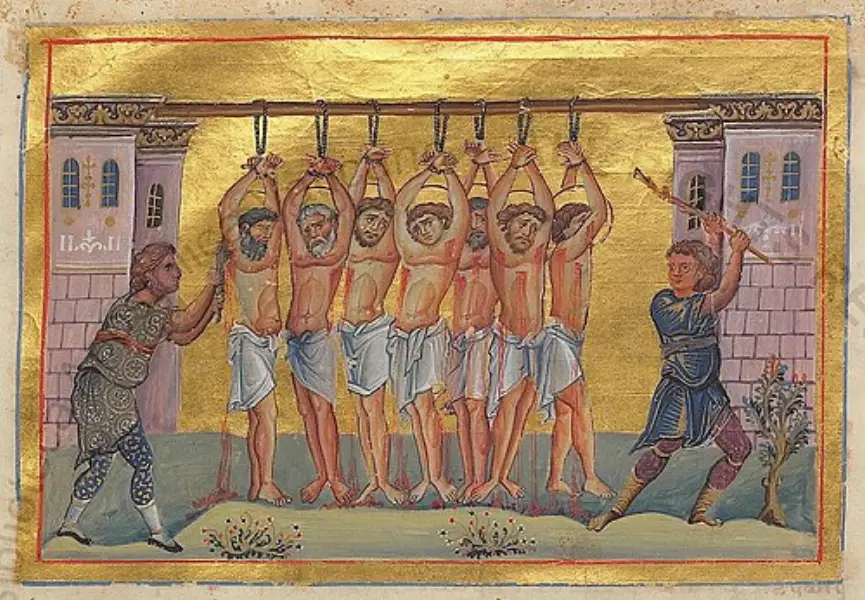
Varus was a soldier of the Roman army stationed in Upper Egypt during the great persecution of the early fourth century, remembered by the Church as a martyr who died at Alexandria around the year 304. According to his Acts, an account regarded as generally reliable and authentic, he was assigned to guard seven monks who had been condemned for their faith and were awaiting execution. Varus was himself a Christian, though his faith at that stage was weak. As he watched the condemned men endure their sufferings, and after witnessing the death of one of them, his wavering conviction was transformed into courage. He openly joined the monks, accepting their fate as his own. For this he was seized and tortured, and his body was hung from a tree until he died. His cult traveled far from Egypt: he became widely honored in Russia as a martyr and intercessor, especially through accounts linking him with Blessed Cleopatra and her son, and he is commemorated each year in the Coptic, Eastern Orthodox, and Roman Catholic traditions.
The Complete Life
A Soldier in Upper Egypt
Varus served as a soldier in the Roman army, posted to Upper Egypt at the close of the third century, in the years when the imperial authorities were moving against the Church with renewed severity. His duty brought him a charge unusual even among the grim assignments of that era: he was set to watch over seven monks who had been condemned to die for their faith and were awaiting the carrying out of the sentence. The account of his life, preserved in Acts that tradition judges generally reliable and authentic, records that Varus was already a Christian when he received this posting. His faith, however, was weak. Standing day after day beside men who had surrendered everything rather than deny Christ, he found himself confronted with a courage unlike anything his military discipline had asked of him. The monks were not teachers who lectured him; they were prisoners whose approaching deaths preached on their behalf. The old record says nothing of his family, his origins, or his years of service. What it preserves is the fact that mattered to later generations of believers: a soldier with a faint heart was placed, whether by chance or by providence, within sight of men about to die for God.
§ Biography
The Martyrdom of a Guard
The turning point came through suffering he had been meant only to observe. As the seven monks advanced toward death, Varus stood at his post, and the faith he had held faintly began to burn. When one of the monks perished before his eyes, something in the soldier broke and reformed at once: the account relates that his faith became reinvigorated, and he chose to cast his lot with the condemned. He joined them openly, confessing the same Christ for whom they died and claiming the same fate as his own. The response of the authorities was swift and ruthless. Varus was tortured for his confession, and when the torment had run its course his body was hung from a tree, a death the Church fixed at Alexandria around the year 304. In the eyes of the tradition, the execution he had been ordered to guard became the most decisive sermon of his life. He had arrived at his posting as a keeper of prisoners; he left it, in the memory of the Church, as a fellow martyr, having learned at last what his faith was worth by watching men pay for theirs with everything they had.
§ Biography
A Martyr Honored in Russia
The memory of Varus spread far beyond the land of his death. The Orthodox East and the Roman Catholic Church keep his feast on 19 October, while Coptic Christians remember him on 15 Paopi; Russia above all honored the martyr as an intercessor, drawing on the tales told of Blessed Cleopatra and her child. One such tale describes Varus appearing to Cleopatra in a vision with her deceased boy in his arms, offering to "give him back to you". The son, however, told his mother that he was happy where he was and did not wish to return, and the story adds that Varus prayed for her parents. A later devotion has invoked him on behalf of those who die outside the Church, resting on a "Canon to the Martyr Varus"; but scholars of the Orthodox liturgical tradition have shown that this canon is a modern composition, absent from the Menaion until the twentieth century and of priestless Old Believer origin, and that the earliest lives of Varus and Cleopatra never describe Cleopatra's relatives as unbaptized. Public liturgical prayer for the unbaptized remains outside Orthodox practice, though private prayer at home is permitted as a consolation for the grieving.
§ Veneration
The Record
- Patron of
- Invoked by some for deceased relatives who died unbaptized, a modern and disputed devotion
- Symbols
- Soldier holding a cross
- Canonization
- Pre-congregation; an early Christian martyr venerated by the Coptic, Eastern Orthodox, and Roman Catholic Churches
Prayer
Bibliography
Show 4 sources
- "Canon to the Martyr Varus".
- Nefyodov, Fr. John. "On the Other Service to St. Varus in the Green Menaion".
- Bufeev, Protopresbyter Konstantin. "About the Holy Martyr Varus and Church Prayer for the Non-Orthodox".
- "The Cult of St. Varus".
Profile text adapted from the Wikipedia article, licensed CC BY-SA 4.0.
Pray with this saint every day
Save St. Varus to your favorites, read the full profile, and get feast-day reminders in the Saints app.
Get the Saints AppFree on the App Store for iPhone and iPad