
c. 100 – c. 143·Feast November 14; July 26
St. Venera
Virgin, Martyr, and Missionary of Sicily
Overview
Venera, remembered under the names Veneranda, Veneria, Venerina, Parasceve, and Il Ahba, stands among the honored martyrs of the second century. Born in Gaul around the year 100, she was formed in the Scriptures from childhood and, after the death of her parents, gave her considerable wealth to the poor and set out as a missionary. One version of her legend brings her to Sicily, where she lived as a hermit near Grotte, nursed the sick, and won the love of the common people; another follows her preaching through Calabria, Campania, and across Magna Graecia. Arrested on her way to Rome by the prefect Antonius, she endured red-hot iron, the cross, and a cauldron of burning oil and sulphur without harm, converting her tormentors and finally the prefect himself. Later tortured under the ruler Themius and then under the prefect Asclepius in Gaul, she was decapitated, traditionally on July 26, 143. Her relics were eventually gathered to the Cathedral of Acireale in Sicily, where she is chief patroness, and her cult was formally approved by the Sacred Congregation of Rites in 1668. She is invoked against eruptions of Mount Etna and against earthquakes.
The Complete Life
A Daughter of Noble Christians
The oldest connected account of Venera's origins comes from the Catalogo Sanctorum of Petrus de Natalibus, who wrote between 1369 and 1372 and recorded, in its sixty-first chapter, a virgin martyr named Veneranda. According to de Natalibus she was born in Gaul in the second century and put to death in Rome under the emperor Antoninus Pius. A fuller legend supplies her family: her parents were two noble Christians, Agatho and Hippolyte. When their daughter was born the mother wished to call her Venera, but the father, unwilling that his child should bear any echo of the goddess Venus, renamed her Veneranda, a rough Latin rendering of the Greek name Paraskevi, which means Friday or Preparation. The girl grew up studying the Scriptures and the lives of the martyrs, and her faith took root early and deeply. When her parents died she inherited their means, and she made of her inheritance an act of belief: she dedicated herself wholly to the service of the poor and the sick, distributing her wealth across Sicily while beginning to preach the Gospel on the Italian mainland, in Calabria and in Campania, in an age when a woman's voice carried the faith at real personal risk.
§ Background
Called to Preach and to Heal
One version of her legend tells that as a girl Venera studied the Gospel with zeal, and that the study became a summons: she left her home in Gaul to spend her life as a missionary of the faith she had learned. Her road led to Sicily, and to the country around Grotte, where she settled near what is now the Corso Garibaldi and lived as a hermit in a cave. There she preached to the people of the district and tended the sick with such tenderness that she became well loved among the local populace. The legend preserves a touching detail of her charity: it was said that her visits left behind them a scent of roses, a sweetness that survived her going as a sign of the grace she carried. In the parallel tradition that makes her Veneranda the daughter of Agatho and Hippolyte, the same vocation appears in another form: after the death of her parents she gave herself to the poor and the sick and dispersed her fortune across Sicily, preaching as she went. Both strands agree on the essentials, a woman of prayer and mercy whose healing hands and fearless speech made the Gospel credible to the towns of the island.
§ Background
Torture Refused, Tormentors Converted
The account of her apostolate turns on two great trials. Traveling toward Rome, Venera was arrested by the prefect Antonius, who first tried persuasion, tempting her with offers of marriage and advantage, and then turned to torture when she would not renounce her faith. She was made to wear a helmet of red-hot iron; she was nailed to a cross; a great block of sandstone was laid upon her chest. Nothing prevailed. Not only did she survive, but the men assigned to torture her abandoned their task as converts to her faith. Antonius then had her placed in a cauldron of boiling oil and sulphur, where she remained seven days without harm. When the prefect asked whether magic protected her, Venera invited him to approach the cauldron and see for himself; he refused, and she scooped the burning sulphur and oil in her bare hand and threw it in his face, blinding him. Antonius thereupon freed her and himself became a Christian. She went on to preach through Magna Graecia, and her fame brought her before a ruler named Themius, or Theotimus, who inflicted on her the tortures suffered by St. Agatha, including the slicing of her breast, and set her against a dragon, which she vanquished. Themius too was converted.
§ Background
The Palm Won in Gaul
From the lands of the eastern Mediterranean the legend returns Venera to the country of her birth. She traveled back to Gaul, where the prefect Asclepius arrested her and put her once more to torture for the faith. The torments were renewed and exhausted against her in vain, and the sentence at last pronounced was beheading. Before she died, the account relates a last act of triumph: she brought down a temple of Apollo with a recited prayer, a sign that the old gods yielded to the word on her lips even as her own death approached. Her corpse was cast out to the weather after the execution, as the bodies of the condemned were, yet it stayed miraculously undecayed, a final vindication of the woman who had endured fire, stone, and the blade without surrendering her confession. The date of her martyrdom is traditionally given as July 26, 143, when she would have been in her early forties. In the reckoning of the tradition her mission had come full circle, from Gaul where she first heard the Gospel to Gaul where she sealed it, leaving behind in Sicily and southern Italy a devotion that would outlast the empire that killed her.
§ Background
The Relics of the Saint
Once she had won death in Gaul, the faithful, so the story runs, bore her remains to Ascoli Piceno, where they received veneration until the fourth century. Then a priest named Anthimus took the relics to Rome, arriving on November 14, a date that survives in one of her two feasts. Toward the close of the middle ages the city of Acireale reclaimed the relics, though portions associated with the saint had already been distributed across Sicily and Italy. The seventeenth century brought a flowering of her cult: early in that century the relics passed from the Church of Jesus and Mary into the cathedral of Acireale, her chief shrine, and in 1668 the Sacred Congregation of Rites officially approved her veneration. Records of the basilica of Santa Maria a Pugliano in Ercolano show that Pope Alexander VII, in the same century, donated relics of Veneranda and of a Saint Maximus to the Procurator General of the Carmelites in Rome, whence they went to Fr. Simone dello Spirito Santo at the Carmelite house of Torre del Greco, rooting her devotion deeply through the Ercolano region. Painters honored her as well; Lazzaro Bastiani portrayed her enthroned in a great altarpiece of the 1470s.
§ Veneration
Patroness of Towns and Refuge in Disaster
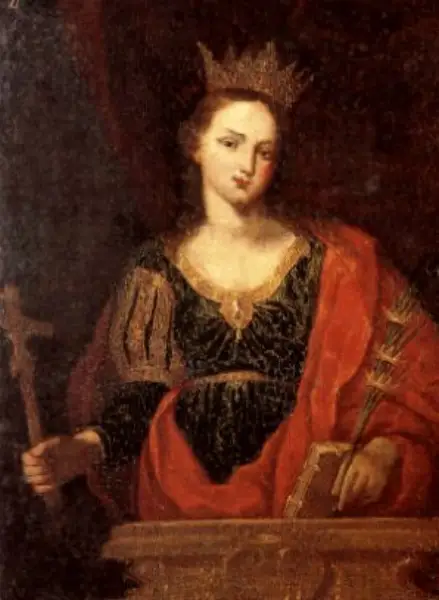
Venera's name is fixed upon the map of the western Mediterranean. She is the chief patroness of Acireale in Sicily, and places bearing her name confess her influence: the Maltese town of Santa Venera, though the origin of its dedication is disputed, and the Sicilian communities of Grotte, Santa Venerina, and Avola, whose patron she is. In her Sicilian homeland she is invoked against volcanic eruptions, and specifically against those of Mount Etna, as well as against earthquakes, an intercession sought by people who live in the shadow of the mountain. Santa Veneranda is also the patron saint of the Arbresh town of Carfizzi in Calabria. In Ercolano two churches are dedicated to her, and a painting there gives her name in Greek as Aghia Paraskebe, Saint Paraskevi, attesting to the ancient identification of Veneranda with the martyr Paraskevi of Rome, who is celebrated on the same day, July 26; the two names have traveled together through the centuries as one saint under two tongues. Her iconography gathers her triple honor in a single emblem: a martyr's palm woven through a threefold crown, marking her as virgin, apostle, and martyr at once, thrice crowned for a single fidelity.
§ Veneration
Timeline
- 100
Born in Gaul, according to the account of Petrus de Natalibus, into a noble Christian family.
§ Introduction
- 26 Jul 143
Martyred by beheading, traditionally on July 26, after renewed torments under the prefect Asclepius in Gaul.
§ Introduction
- 1369
Petrus de Natalibus records a virgin martyr named Veneranda in the Catalogo Sanctorum.
§ Introduction
- 1470
Lazzaro Bastiani paints St Veneranda Enthroned, among the earliest known depictions of the saint.
§ Veneration
- 1600
Her relics move early in the 17th century from Rome's Church of Jesus and Mary into the cathedral of Acireale, and her cult flowers anew.
§ Veneration
- 1668
The Sacred Congregation of Rites officially approves her cult.
§ Veneration
The Record
- Patron of
- Acireale, Sicily·Santa Venera, Malta·Grotte, Sicily·Santa Venerina·Avola, Sicily·against volcanic eruptions, especially of Mount Etna·against earthquakes
- Symbols
- crown·book·palm·cross·a palm of martyrdom interlaced with a triple crown, signifying virgin, apostle, and martyr
- Canonization
- Pre-congregation martyr; her cult was officially approved by the Sacred Congregation of Rites in 1668
Prayer
Bibliography
Show 6 sources
- "Chiesa Madre - Parrocchia Santa Venera". Grotte.info. 2011. Retrieved October 25, 2011.
- Stracke, Richard (2015-10-20). "St. Catherine of Alexandria and St. Veneranda". Christian Iconography.
- "Santa Venera". Preghiere a gesue maria.it. Archived from the original on October 18, 2011. Retrieved October 26, 2011.
- "Santa Veneranda". Santi e beati. 2006. Retrieved October 25, 2011.
- Paulist Fathers, Catholic World, Volume 101 (Paulist Fathers, 1915). Original from Harvard University. Digitized Nov 1, 2007, p. 577.
- "Saint Venera: virgin, martyr and preacher", Citta di Avola.
Profile text adapted from the Wikipedia article, licensed CC BY-SA 4.0.
Pray with this saint every day
Save St. Venera to your favorites, read the full profile, and get feast-day reminders in the Saints app.
Get the Saints AppFree on the App Store for iPhone and iPad