
died c. 537·Feast November 1
St. Vigor
Bishop of Bayeux and Destroyer of Idols
Overview
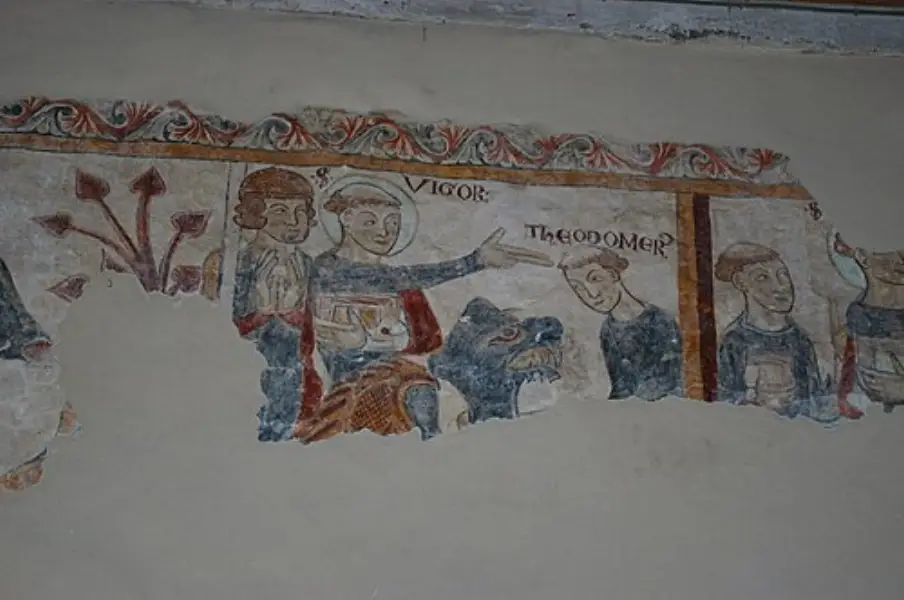
Vigor, whose Latin name appears as Vigorus and in French as Saint Vigeur, was a French bishop and Christian missionary who died around 537. Born into the nobility of Artois, he was educated at Arras under Saint Vedast, and when his father refused permission for him to become a priest he left home with nothing, accompanied only by an acolyte named Theodimir. He settled as a hermit preacher at Reviers in Calvados and labored as a missionary among the still largely pagan countryside of northern Gaul. Around 514 he was named bishop of Bayeux, where he opposed paganism fervently, destroyed a temple that remained in use within the city, and built a church on its site; he is also credited with founding the monastery that came to be called Saint-Vigor-le-Grand. At Bayeux his memory was honored from the earliest generations, and his cult spread with the Norman conquest to England, where two medieval churches honor him. His relics were carried in turn to Le Mans, to the Abbey of Saint-Riquier, and to Norman foundations, and his life was written in the Vita Vigoris at the beginning of the eleventh century. His feast falls on All Saints' Day, November 1.
The Complete Life
A Nobleman's Son from Artois
Vigor was born into the nobility of Artois, a region of the Frankish north where Christianity and the old pagan ways still stood side by side in the generation after the baptism of Clovis. His family destined him, as noble families did, for the continuation of their name and lands, and when the young man's calling to the priesthood became known his father refused approval, the customary authority of a Gallo-Roman or Frankish paterfamilias set against the claims of the Church. The boy's education, however, had already been placed in the hands of one of the great bishops of the age: he studied at Arras under Saint Vedast, the apostle of the region whose own long episcopate had restored a shattered church. Under such a teacher the purpose of Vigor's life hardened beyond his father's power to bend. The sources say nothing of his mother, his siblings, or the size of the family estate, but the outline is clear enough: a son of the warrior aristocracy of northern Gaul, formed in a bishop's school, whose heart had been given to a service his family would not bless. The conflict between paternal authority and religious vocation would be resolved in the most dramatic way the age allowed.
§ Life
Flight from Home and the Hermit of Reviers
Denied his father's consent, Vigor took the path many called candidates took when family stood against the Church: he fled the paternal roof without a single possession, so that his renunciation might be total and his dependence on God complete. One companion shared his flight, an acolyte named Theodimir, whose presence suggests that the young man's holiness had already drawn followers before he had any office to offer them. The fugitive made his way into the lands between the Seine and the Orne, and at Reviers in Calvados he settled as a hermit, living a life of prayer and preaching in a country where the Gospel was thinly planted. The hermitage became a mission station. Vigor worked as a missionary among the surrounding population, and the reputation formed in these years, a noble's son living as a preacher in the wilds of the Bessin, reached the ears of the church's authorities. In due course, around the year 514, he was named bishop of Bayeux, one of the ancient sees of Normandy. The man who had fled his father's house rather than abandon his calling now bore the burden of an entire diocese, charged with the conversion of its countryside.
§ Life
Bishop of Bayeux, Enemy of Idols
As bishop, Vigor prosecuted the conversion of Normandy with the same fervor that had marked his years as a hermit preacher. The sources summarize his episcopate in acts of deliberate confrontation with paganism: he fervently opposed the old cults, and in the city of Bayeux itself he tore down a heathen shrine still active in the city, raising a Christian church upon its grounds so that the place of idolatry became a place of worship. This was the characteristic gesture of the missionary episcopate in Gaul, to occupy rather than merely condemn, to plant the altar where the false god had stood. He is also reputed to have founded a monastery, the house that came to be known as Saint-Vigor-le-Grand, which anchored monastic life in his diocese and carried his name in its very title. His fame entered other saints' lives as well; he is mentioned in the vita of Saint Paternus, a sign that his reputation among the churchmen of Neustria was solid and early. Under his care Bayeux became a center from which the faith spread through the villages of the Bessin, and the memory of the bishop who fought the temples survived long after the temples themselves were gone.
§ Life
The Cult of a Bishop of Bayeux
At Bayeux, his old see, devotion to Vigor began almost immediately, and the documentary record of his sanctity starts early enough to command respect. A Le Mans record of 834, noting one of his relics, gives the first dated proof of his cult, evidence that his fame had crossed the diocesan boundary within three centuries of his death. Around 987 his relics came to the Abbey of Saint-Riquier in Ponthieu, one more translation in the great movement of bones that marked the Carolingian and early Capetian church. The written life followed: Saint-Ouen Abbey at Rouen held a copy of the Vita Vigoris, whose composition the historian John Howe dates to the beginning of the eleventh century, a late but substantial witness to the traditions preserved at Bayeux. In 1032 Duke Robert the Magnificent established an abbey in Vigor's honor, raising it on ground where Norse raiders had wrecked an earlier house, and so binding the saint's name to the rebuilding of Norman monasticism. No formal canonization process stood behind any of this; the continuous veneration of the churches themselves, from Bayeux to Le Mans to Ponthieu, was his canonization.
§ Veneration
A Norman Saint in England
The successful Norman conquest of England carried Vigor's cult across the Channel with the armies and clergy of Duke William. An eleventh-century Worcester breviary preserves his office, most likely through Bishop Samson or Theulf, both of whom had served as canons at Bayeux before their translation to English sees, and who brought their native saint's office with them. Two English churches received his dedication in the middle ages: one at Fulbourn in Cambridgeshire, where he is still honored in the parish's title, St Vigor with All Saints, and one at Stratton-on-the-Fosse in Somerset. In his homeland his memory remained equally fixed in the landscape: churches and communes from the Manche to the Maine bear his name, from Saint-Vigor-des-Monts to the eglise St Vigor at Neau, and an eglise Saint-Vigor stands at Marly-le-Roi in the Ile-de-France. His feast falls on All Saints' Day, November 1, and because the greatest solemnity of the year claims the date, his celebration has often been transferred to another day, a liturgical fate shared by few other saints. He remains one of the characteristic missionary bishops of the Frankish church, remembered wherever Norman piety planted his name.
§ Veneration
Timeline
- 514
Named bishop of Bayeux after his years as a hermit preacher at Reviers in Calvados.
§ Life
- 537
Died around this year, closing an episcopate marked by the destruction of pagan temples and the founding of monasteries.
§ Introduction
- 834
His cult as a saint is attested by the mention of a relic of Vigor at Le Mans.
§ Veneration
- 987
His relics are brought to the Abbey of Saint-Riquier in Ponthieu around this date.
§ Veneration
- 1032
Duke Robert the Magnificent establishes a monastery in honor of Saint Vigor, rebuilding on ground where Norse raiders had wrecked an earlier house.
§ Veneration
The Record
- Major works
- Founded the monastery later known as Saint-Vigor-le-Grand·Built a church on the site of a destroyed pagan temple in Bayeux
- Canonization
- Pre-congregation; venerated at Bayeux from an early date, his cult attested by a relic mentioned at Le Mans in 834
Prayer
Bibliography
Show 8 sources
- "Saint Vigor". Nominis.
- "History of Fulbourn churches". Fulbourn and the Wilbrahams Parish Churches.
- Farmer, David. "Vigor", The Oxford Dictionary of Saints. 5th ed., OUP, 2011. ISBN 9780199596607.
- Howe, John. "The Date of the 'Life' of St. Vigor of Bayeaux", Analecta Bollandiana, Volume 102, Issue 3-4, pp. 303-312. doi:10.1484/J.ABOL.4.01478
- Herrick, Samantha Kahn. "Reshaping the Past on the Early Norman Frontier: The 'Vita Vigoris'", The Haskins Society Journal 12: 2002. Studies in Medieval History, (Stephen Morillo, ed.) Boydell Press, 2003, p. 133 et seq. ISBN 9781843830085.
- Desile, Albert. L'abbaye de Cerisy-la-Foret liberee de ses entraves, La Manche Libre, 1957.
- Higgitt, John. The Murthly Hours: Devotion, Literacy and Luxury in Paris, England and the Gaelic West, University of Toronto Press, 2000, p. 8. ISBN 9780802047595.
- "Church of St. Vigor". Historic England.
Profile text adapted from the Wikipedia article, licensed CC BY-SA 4.0.
Pray with this saint every day
Save St. Vigor to your favorites, read the full profile, and get feast-day reminders in the Saints app.
Get the Saints AppFree on the App Store for iPhone and iPad