
1581-1660·Feast September 27
St. Vincent de Paul
Priest, Apostle of Charity
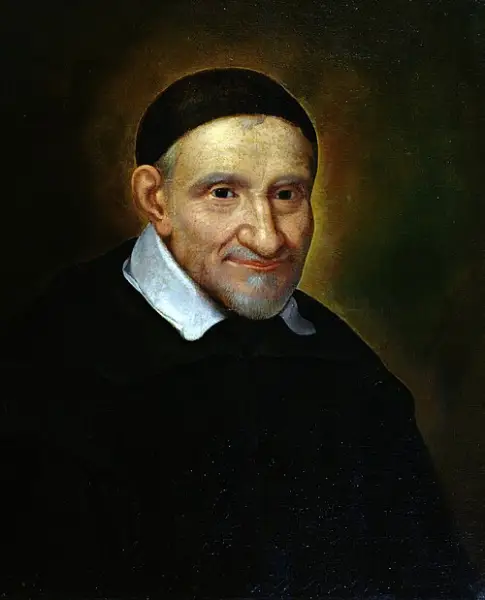
Overview
Vincent de Paul was born on 24 April 1581 at the village of Pouy, in Gascony, the son of peasant farmers; his father sold the family's oxen to send the gifted boy to the seminary at Dax. Ordained at nineteen in 1600 — below the age Trent required — he studied at Toulouse and Paris, and by his own account spent his early priesthood hoping for a comfortable position. Two years as a slave in Tunis after Barbary pirates took the ship he had boarded at Marseille in 1605 changed him; he escaped with his last master, an apostate priest, back to France in 1607. Under Pierre de Bérulle's direction he served as parish priest at Clichy and chaplain-tutor to the Gondi family, and the confession of a dying peasant on their estates broke his ambitions open for good. From 1617 he organized the wealthy women of Paris into Confraternities of Charity that fed the poor, ransomed galley slaves and funded missions to the countryside; appointed chaplain to the galleys in 1622, he never forgot the convicts. He founded the Congregation of the Mission (the Vincentians or Lazarists) in 1625 for the evangelization of villages and the reform of a lax clergy, pioneered seminary training, and with Louise de Marillac founded the Daughters of Charity in 1633. He died in Paris on 27 September 1660, leaving a family of works of charity that now spans the globe.
The Complete Life
Early Life
Vincent de Paul was born on 24 April 1581 at the village of Pouy in Gascony, the son of peasant farmers; his father sold the family's oxen to send the gifted boy to the seminary at Dax. Ordained at nineteen in 1600 — below the age Trent would require — he studied at Toulouse and Paris, and by his own account spent his early priesthood hoping for a comfortable position.
§ Early life and education
Conversion and Vocation
Two years as a slave in Tunis after Barbary pirates took the ship he had boarded at Marseille in 1605 changed him; he escaped with his last master, an apostate priest, back to France in 1607. Under Pierre de Bérulle's direction he served as parish priest at Clichy and chaplain-tutor to the Gondi family, and the confession of a dying peasant on their estates broke his ambitions open for good: from that encounter he dated his vocation to the poor, and 1617, the year it happened, he later called the true beginning of his life.
§ Abduction and slavery
Mission and Ministry
From 1617 he organized the wealthy women of Paris into Confraternities of Charity that fed the poor, ransomed galley slaves and funded missions to the countryside. Appointed chaplain to the galleys in 1622, he never forgot the convicts — he was one of the first to treat them as men. He founded the Congregation of the Mission, the Vincentians or Lazarists, in 1625 for the evangelization of villages and the reform of a lax clergy, pioneered seminary training for priests, and with Louise de Marillac founded the Daughters of Charity in 1633 — sisters who lived among the poor rather than cloistered, an innovation that changed religious life for women. His charities extended to foundlings, the mad, the aged and the war-torn provinces of Lorraine.
§ Introduction
Spirituality and Teaching
Vincent's spirituality is entirely practical: God is found in the poor, and prayer exists to send one back to them. His conferences and letters — some thousands — teach a humility he enforced on himself, a distrust of high position he had once sought, and the discipline of seeing Christ in the person in front of you, the unlovely, the dying and the slave. His principle that the poor are our lords and masters is the sentence his whole foundation rests on.
Trial and Final Years
He died in Paris on 27 September 1660, worn out by fifty years in which he had organized what no individual charity could attempt. His body lies in the motherhouse of the Lazarists in Paris, incorrupt, and his heart is venerated at the motherhouse of the Daughters of Charity.
§ Introduction
Canonization
Vincent was beatified by Benedict XIII on 13 August 1729 and canonized by Clement XII in 1737. His feast is 27 September in the general calendar, and Leo XIII named him patron of all charitable societies, with the Society of St. Vincent de Paul taking his name in 1833.
§ The Society of Saint Vincent de Paul
Legacy
Vincent de Paul founded modern organized charity: the confraternity, the congregation, the uncloistered sisterhood, the seminary, the conference — the forms every later Catholic social work assumed. The Vincentian family today runs universities, missions and parishes across the world, and his name has become the common noun for practical love of the poor. Few saints have left more institutions and said less about themselves.
§ Introduction
Timeline
- 24 Apr 1581
Born to peasant farmers in the village of Pouy in Guyenne and Gascony
§ Introduction
- 1597
Enrolls in theology at the University of Toulouse
§ Early life and education
- 23 Sep 1600
Ordained a priest at age nineteen at Château-l'Évêque, near Périgueux
§ Early life and education
- 12 Oct 1604
Receives his Bachelor of Theology degree from the University of Toulouse
§ Early life and education
- 1605
Sailing from Marseille he is captured by Barbary pirates and sold into slavery in Tunis
§ Abduction and slavery
- 29 Jun 1607
After escaping with his master he lands at Aigues-Mortes and returns to France
§ Abduction and slavery
- 1609
Sent back to France from Rome on a mission to King Henry IV
§ Return to Europe
- 1612
Appointed parish priest of the Church of Saint-Médard in Clichy
§ Return to Europe
- 1617
Begins serving poor families in Paris and organizes wealthy women into the first Ladies of Charity
§ Foundations of the Vincentian Family
- 1622
Named a chaplain to the royal galleys, ministering to the convicts who rowed them
§ Congregation of the Mission
- 1625
Founds the Congregation of the Mission, the Vincentians or Lazarists
§ Congregation of the Mission
- 1633
Together with Louise de Marillac he establishes the Daughters of Charity
§ Foundations of the Vincentian Family
- 1643
Becomes spiritual adviser to Anne of Austria after she is made sole Regent for Louis XIV
§ Return to Europe
- 27 Sep 1660
Dies in Paris
§ Introduction
- 1705
The Superior General of the Congregation of the Mission asks that his canonization process be opened
§ Death and veneration
- 1712
His body is exhumed and found largely incorrupt, fifty-three years after his death
§ Death and veneration
- 13 Aug 1729
Declared Blessed by Pope Benedict XIII
§ Death and veneration
- 16 Jun 1737
Canonized by Pope Clement XII
§ Death and veneration
In Their Own Words
The reason why God is so great a lover of humility is because He is the great lover of truth; and humility is nothing but truth, whilst pride is nothing but lying.
The most powerful weapon to conquer the devil is humility. For, as he does not know at all how to employ it, neither does he know how to defend himself from it.
It is our duty to prefer the service of the poor to everything else and to offer such service as quickly as possible. If a needy person requires medicine or other help during prayer time, do whatever has to be done with peace of mind. Offer the deed to God as your prayer. Do not become upset or feel guilty because you interrupted your prayer to serve the poor. God is not neglected if you leave him for such service. One of God’s works is merely interrupted so that another can be carried out. So when you leave prayer to serve some poor person, remember that this very service is performed for God. Charity is certainly greater than any rule. Moreover, all rules must lead to charity.
You will find out that Charity is a heavy burden to carry, heavier than the kettle of soup and the full basket. But you will keep your gentleness and your smile. It is not enough to give soup and bread. This the rich can do. You are the servant of the poor, always smiling and good-humored. They are your masters, terribly sensitive and exacting master you will see and the uglier and the dirtier they will be, the more unjust and insulting, the more love you must give them. It is only for your love alone that the poor will forgive you the bread you give to them.
However great the work that God may achieve by an individual, he must not indulge in self-satisfaction. He ought rather to be all the more humbled, seeing himself merely as a tool which God has made use of.
The Record
- Major works
- Founder of the Congregation of the Mission (Vincentians / Lazarists)·Co-founder with St. Louise de Marillac of the Daughters of Charity·Founder of the Confraternities and Ladies of Charity
- Patron of
- All works of charity·The Vincentian Family·The Society of Saint Vincent de Paul (named in his honour)
- Canonization
- Beatified by Pope Benedict XIII on 13 August 1729; canonized by Pope Clement XII on 16 June 1737
Prayer
Bibliography
Show 12 sources
- 1 2 Attwater, Donald (1982) The Penguin Dictionary of Saints p. 337, Aylesbury.
- 1 2 3 4 5 6 Coste, Pierre (1931). Monsieur Vincent: Le Grand Saint du grand siècle [ Mr. Vincent: The Great Saint of the Great Century ] (PDF) (in French). Paris: Desclée de Brouwer – via DePaul University .
- 1 2 Butler's Lives of the Saints , (Michael Walsh, ed.), (1991) p. 304, HarperCollins Publishers, New York.
- 1 2 3 4 Dégert, Antoine (1913). " St. Vincent de Paul ". In Herbermann, Charles (ed.). Catholic Encyclopedia . Vol. 15. New York: Robert Appleton Company.
- ↑ "Saint Vincent de Paul – The story of his captivity – We are Vincentians" . vincentians.com . 24 December 2016 . Retrieved 18 November 2025 .
- ↑ Poole, Stafford C.M. (1999) "Pierre Coste and Catherine Laboure: The Conflict of Historical Criticism and Popular Devotion," Vincentian Heritage Journal: Vol. 20: Iss. 2, Article 3, pp. 257.
- ↑ Poole, Stafford C.M. (1992) "The Formative Years of a Saint: Vincent de Paul: 1595–1617," Vincentian Heritage Journal: Vol. 13: Iss. 2, Article 1, pp. 98.
- 1 2 "Saint Vincent de Paul – Fiction or historical fact? A serious problem for the critics – We are Vincentians" . vincentians.com . 25 December 2016 . Retrieved 18 November 2025 .
- ↑ O'Donnell C. M., Hugh. "Vincent de Paul: His Life and Way", Vincent de Paul and Louise de Marillac: Rules, Conferences, and Writings , (Frances Ryan and John E. Rybolt, eds.), Paulist Press, 1995 ISBN 9780809135646 .
- 1 2 3 4 "St. Vincent de Paul", Franciscan Media ISBN 978-0-86716-887-7 .
- ↑ "St. Vincent de Paul", Catholic News Agency .
- ↑ McNeil, Betty Ann (1996). The Vincentian Family Tree: A Genealogical Study . Chicago: Vincentian Studies Institute.
Profile text adapted from the Wikipedia article, licensed CC BY-SA 4.0.
Pray with this saint every day
Save St. Vincent de Paul to your favorites, read the full profile, and get feast-day reminders in the Saints app.
Get the Saints AppFree on the App Store for iPhone and iPad