
1350-1419·Feast April 5
St. Vincent Ferrer
Dominican Priest, Missionary and Preacher
Overview
Vincent Ferrer was born at Valencia on 23 January 1350, fourth child of a notary from Palamos, and named after the city's patron, Vincent Martyr. At eighteen he entered the Dominican Order, resisting even his parents' pleas to leave and become a secular priest; he then read nothing but Scripture for three years until he knew it by heart. Ordained at Barcelona in 1379, he became a Master of Sacred Theology, lectured in philosophy, took his doctorate at the University of Lleida, and wrote a treatise on dialectic. Through the Western Schism he served Cardinal Pedro de Luna, and when that cardinal became the Avignon antipope Benedict XIII, Vincent worked as his apostolic penitentiary while labouring, in vain, to persuade him to resign for the unity of the Church. From about 1398 he gave himself to twenty-one years of itinerant preaching through Aragon, Castile, France, Switzerland, Italy and the British Isles, drawing enormous crowds; biographers held that though he spoke only Valencian he was given the gift of tongues. He also sat on the commission of nine that chose Ferdinand of Antequera as king of Aragon in 1412. Too ill to reach Spain, he died at Vannes in Brittany on 5 April 1419.
The Complete Life
Early Life
Vincent Ferrer was born in Valencia on 23 January 1350 — the fourth child born to the notary Guillem Ferrer, of Palamós, and his wife Constança Miquel; his birth gathered legends, among them a dream in which the father foresaw his son's worldwide fame. His name came from the city's patron, Vincent Martyr. As a boy he fasted on Wednesdays and Fridays and gave alms to the poor; he began classical studies at eight and theology and philosophy at fourteen. At eighteen he entered the Dominican Order, resisting even his parents' pleas to leave and become a secular priest, and then read nothing but Scripture for three years until he knew it by heart — the foundation of all his later preaching.
§ Early life
Scholar of a Divided Church
Ordained a priest at Barcelona in 1379, Vincent became a Master of Sacred Theology, lectured in philosophy, took his doctorate at the University of Lleida, and wrote a treatise on dialectic — the De suppositionibus dialecticis — a reminder that the great preacher began as a logician. His life then became entangled with the Western Schism. He served Cardinal Pedro de Luna, and when that cardinal was elected the Avignon antipope Benedict XIII in 1394, Vincent worked as his apostolic penitentiary while laboring, in vain, to persuade him to resign for the unity of the Church. That he held the antipope's office and pleaded for the antipope's abdication at once is the key to his whole position: obedience to the obedience he had given, and grief at its consequences. Around 1398 he withdrew from the court and gave himself to the mission that made him famous.
§ Western Schism
Twenty-One Years of Preaching
From about 1398 Vincent spent twenty-one years as an itinerant preacher, through Aragon, Castile, France, Switzerland, Italy and the British Isles, drawing enormous crowds — the largest assemblies of the century before printing. He preached penance in the shadow of the schism and, as his followers read his sermons, in the expectation of an imminent end; he followed the friars' method, arriving in a town, preaching daily, reconciling enemies, and moving on. Biographers held that though he spoke only Valencian he was given the gift of tongues. His preaching was long credited with the conversion of thousands of Jews of Spain and the south of France; other sources, though, describe it as countenancing coercion, with synagogues turned into churches by force — a record that his cult has had to weigh honestly. In 1412 he sat on the commission of nine that chose Ferdinand of Antequera as king of Aragon at the Compromise of Caspe.
§ Introduction
Final Years
Vincent's last years were spent in France, in the service of the dukes of Brittany, preaching through the west. He died at Vannes in Brittany on 5 April 1419, and was buried in Vannes Cathedral, where his tomb remains. The schism he had labored against outlived him by only a few years, ending at Constance's work in 1429 at Martin V's settlement of the last lines; Vincent had refused to live to see it resolved in his own obedience.
§ Introduction
Canonization
The canonization followed on 3 June 1455 under Pope Callixtus III, thirty-six years after Vincent's death — one of the earlier formal canonizations of the modern process. His feast is 5 April. He was proclaimed patron of builders, of reconciliation, and, in the popular devotion of Valencia, the city's own; the Valencians keep his feast with the processions of his birthplace.
§ Introduction
Legacy
Vincent Ferrer is the great preacher of the late middle ages, the friar whose voice held together what the schism had torn — the model for every later itinerant mission preacher. His surviving sermons are a major source for the religious history of the fifteenth century, and their eschatological urgency has been much studied. In Valencia he is the civic patron, his statue on the bridges and his feast in April; the order keeps him as the patron of its preaching mission. His record toward the Jews of Spain — persuasion entangled with coercion — stands as the unsolved problem of his legacy, and modern treatments of his cult address it directly.
§ Introduction
Timeline
- 23 Jan 1350
Born at Valencia to the notary Guillem Ferrer and his wife Constansa Miquel
§ Introduction
- 1368
Enters the Order of Preachers at eighteen despite family pleas, completing his year of probation
§ Early life
- 1379
Ordained a Catholic priest at Barcelona after publishing a treatise on Dialectic Suppositions
§ Early life
- 1391
Riots during his preaching lead to a Toledo synagogue being made the Church of Santa Maria la Blanca
§ Conversion of Jews and controversy
- 1394
His patron Pedro de Luna becomes antipope Benedict XIII; Vincent serves him as apostolic penitentiary
§ Western Schism
- 28 Jun 1412
As a Valencia representative at the Compromise of Caspe, proclaims Ferdinand of Castile king of Aragon
§ Compromise of Caspe
- 1413
Attends the Disputation of Tortosa, called by Benedict XIII to convert Jews through debate
§ Conversion of Jews and controversy
- 5 Apr 1419
Dies at Vannes in Brittany, too ill to return to Spain, and is buried in Vannes Cathedral
§ Death and legacy
- 3 Jun 1455
Canonized by Pope Callixtus III at Santa Maria sopra Minerva in Rome
§ Death and legacy
The Record
- Major works
- Treatise on Dialectic Suppositions (De suppositionibus dialecticis)·Sermons (surviving corpus of his preaching)
- Patron of
- Fishermen of Brittany (invoked in storms)·Orphanages in Spain
- Symbols
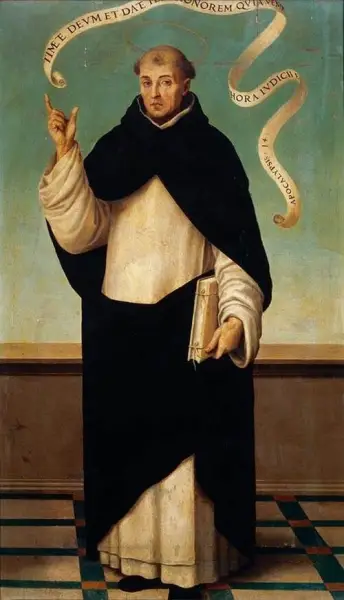
- Black-and-white Dominican habit·Raised finger of the preacher·A book of Scripture, which he had committed to memory
- Canonization
- Canonized by Pope Callixtus III on 3 June 1455
Prayer
Bibliography
Show 12 sources
- ↑ "Sant Vicent Ferrer, patró de l'antic Regne de València" , by Àngel Canet Català, Vilaweb , 31 March 2008, reprinted in Normalització , (in Catalan) . The author of this article references El gran llibre dels sants , by Roger Costa Solé,
- ↑ Como una red. Sermones de Vicent Ferrer , by Josep-Antoni Ysern i Lagarda, University of Valencia , (in Spanish) . Consulted 18 December 2016.
- ↑ "Notas sobre esta historia", in Historia de la portentosa vida y milagros del Valenciano Apostol de Europa San Vicente Ferrer , by Francisco VIDAL Y MICÒ and Serafin Thomas MIGUEL, Valencia, 1733, p. 453 (in Spanish) . Consulted 18 Decemb
- ↑ Dress, Clayton J. The Late Medieval Age of Crisis and Renewal, 1300–1500: A Biographical Dictionary . Greenwood Press, 2001. ISBN 0-313-30588-9 . (p. 490)
- 1 2 "Minnaji O.P., Cora. "Biography: The Life of St. Vincent Ferrer: The Wonder Worker". The Church of St. Vincent Ferrer, NYC" . Archived from the original on 19 December 2013 . Retrieved 1 February 2014 .
- 1 2 3 4 5 Reinhart, Albert. "St. Vincent Ferrer". The Catholic Encyclopedia Vol. 15. New York: Robert Appleton Company, 1912. 10 May 2021 This article incorporates text from this source, which is in the public domain .
- 1 2 "St. Vincent Ferrer" . Catholic News Agency . Archived from the original on 10 January 2019 . Retrieved 28 August 2020 .
- ↑ "Black friar" . Oxford English Dictionary (online ed.). Oxford University Press. (Subscription or participating institution membership required.)
- 1 2 3 "The Lives or the Fathers, Martyrs and Other Principal Saints by Rev. Alban Butler" . Ewtn.com . Retrieved 17 December 2012 .
- 1 2 Media, Franciscan (5 April 2016). "Saint Vincent Ferrer" . Archived from the original on 8 October 2020 . Retrieved 17 September 2020 .
- ↑ Hogan, Stanislaus M. (1911). Saint Vincent Ferrer : O.P . Kelly – University of Toronto. London : Longmans, Green.
- ↑ Pelle, Stephen (2016). "An Old Norse Homily and Two Homiletic Fragments from AM 624 4 to ." GRIPLA 27, pp. 263–281 [238]. Online at Google Share (Sep. 2025).
Profile text adapted from the Wikipedia article, licensed CC BY-SA 4.0.
Pray with this saint every day
Save St. Vincent Ferrer to your favorites, read the full profile, and get feast-day reminders in the Saints app.
Get the Saints AppFree on the App Store for iPhone and iPad