
c. 290 – c. 303·Feast June 15
St. Vitus
Boy Martyr and Holy Helper
Overview
Vitus, called also Guy or Guido, was a Sicilian Christian who won the martyr's crown, dying, according to his hagiography, during the Diocletianic Persecution around the year 303, at the age of twelve or thirteen. His earliest known documentation stands in the Martyrologium Hieronymianum, which records in Sicily the feast of Vitus, Modestus, and Crescentia; in the earliest sources these companions belonged to separate traditions that only later were joined, while Modestus and Crescentia are, in all likelihood, invented figures. The developed legend makes Vitus the young son of a senator of Lucania who resisted his father's tortures, fled with his Christian tutors to Rome, cast out a demon from the emperor Diocletian's son, and died under torture when he refused to apostatize. Veneration spread rapidly through southern Italy, Sicily, and Rome, and by the middle ages Vitus was counted among the Fourteen Holy Helpers, invoked especially against epilepsy and the nervous disorder still called Saint Vitus' Dance. His relics passed through St-Denis and Corvey to Prague, where his cathedral remains the spiritual heart of Bohemia, and his feast of June 15 is kept as Vidovdan, a day of nation-shaping memory, in Serbia.
The Complete Life
The Child of a Senator's House
The historical Vitus is almost invisible behind his legend: when he lived cannot be fixed with certainty, and his earliest testimony is a martyr's name in the Martyrologium Hieronymianum. The narrative that the middle ages received, taking shape in the sixth and seventh centuries and drawing on other legends, especially that of Potitus, supplies the boyhood. In this account Vitus was the son of a senator of Lucania, though the Sicilian tradition claims his birth for Mazzara del Vallo about the year 290; some versions make him seven years old at the crisis of his life, others twelve. He was a Christian in a pagan household, and when his father discovered the faith of his heir he set himself to break it, subjecting his own child to various forms of torture in the effort to turn him away from Christ. The boy did not turn. Two members of his household stood by him: his teacher Modestus and Modestus's spouse Crescentia, the boy's own nurse, both Christians, and under their care the child's resolution only deepened. Historians caution that Modestus and Crescentia were originally figures of a different tradition and are probably fictitious; but the figure of the young confessor who outlasted his father's cruelty stands at the core of the cult from its beginning.
§ Martyrdom
Flight with His Tutors
When persuasion and torture alike failed to shake the boy, the legend moves to flight. Vitus escaped his father's house with his tutor Modestus and Crescentia, the tutor's wife, and the three Christians made their way from Lucania, pursued by the anger of a senator whose son had chosen Christ over the gods of the family. The fugitives' destination in the older forms of the story was the far shore of Italy and ultimately Rome, the heart of the empire and, in the year of the great persecution, the arena of its most terrible assault on the Church. The choice of the child to keep his faith against his own father gave the legend its enduring force: Christian readers saw in Vitus the fulfillment of Christ's warning that a man's foes should be they of his own household, and in his flight the paradox of the Gospel, that the one who loses his life finds it. That a child should stand where grown confessors trembled became the wonder that spread his name. The hagiography leaves no doubt about the boy's own will; his tutors guided and sustained him, but the confession was his, sealed first against his father's roof and afterwards against the emperor's power.
§ Martyrdom
The Exorcist Before the Emperor
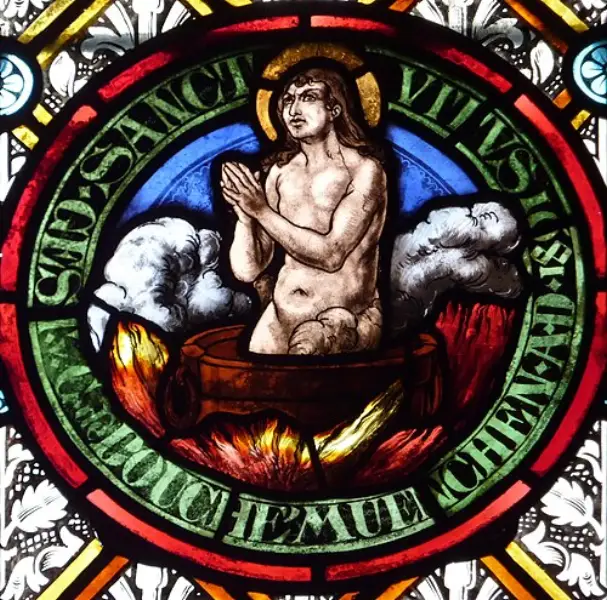
In Rome the legend sets its young hero before the greatest Christian drama of the age. The emperor Diocletian had a son possessed by a demon, and the boy Vitus was brought from hiding to drive out the evil spirit. He succeeded: the exorcism was performed, and the imperial household witnessed the power of the name of Christ acting through a child. Yet the miracle won Vitus no safety. Because he remained faithful to Christianity and refused the emperor's demand to sacrifice to the gods, he and his tutors were seized and tortured. The iconography of his passion preserves the torments of the legend: boiling tar and molten lead were poured about him in a great cauldron, yet he stepped out of it untouched, an escape commemorated in the cauldron that accompanies his image and in the lion and rooster of his attributes. At the last, by the hand of an angel, the three confessors were borne back from Rome to Lucania, where the torments finished their work. On the third day after, the martyr stood in a vision before the noble matron Florentia, who searched out the bodies where they lay and buried them, giving the martyr's story its quiet ending in a Christian grave.
§ Martyrdom
The Testimony of the Martyrologium
The veneration of Vitus rests on early and unambiguous evidence. The Martyrologium Hieronymianum records under one day, in Sicily, the names of Vitus, Modestus, and Crescentia; the note appears in the three most important manuscripts of that document, which shows that it stood in their common exemplar, a text of the fifth century. The same martyrology lists under the same day another Vitus at the head of nine martyrs at Eboli in Lucania, and it is easily possible that the same martyr stands in both entries. J. P. Kirsch argued that this fifth-century testimony to public veneration proves the three to be historical martyrs, though no historical account of their lives or of the details of their passion survives. In Rome their cult appeared very early: Pope Gelasius I at the end of the fifth century mentions a sanctuary honoring Vitus, and by the 600s one of the city's deaconry chapels bore his name. Pope Gregory the Great speaks of a monastery dedicated to him in Sicily. The names of Modestus and Crescentia were added to the Roman Calendar in the eleventh century and remained until 1969, when, judged merely fictitious personages, they were omitted, while Vitus himself stays in the Roman Martyrology under June 15.
§ Veneration
Dancer, Helper, and Lord of Vidovdan
Few saints have entered popular culture so deeply. German congregations danced before his statue on his feast, a joyous custom that caught on so widely that the name Saint Vitus' Dance attached itself to the neurological disorder Sydenham's chorea, and the dancing made him patron of dancers and entertainers in general. He is invoked against lightning strikes, animal attacks, oversleeping, snake bites, and storms, and stands among the Fourteen Holy Helpers as the aid in times of trouble. In Slavic lands his veneration was immense; his name, Sveti Vid, may have replaced the worship of the ancient god of light Svetovid, and in Serbia his feast day, Vidovdan, carries the weight of national memory: the Battle of Kosovo was fought on that day, and on it in 1914 the Austrian royal couple was assassinated, while Vitus served as patron saint of the Kingdom of Serbia. In Bulgaria he is known as Vidovden, especially among the Shopi of the west; in Hungary as Szent Vid since the early middle ages; in Croatia 123 churches are dedicated to him and he is patron of Rijeka. His relics crowned Prague, where the St. Vitus Cathedral guards the hand-bone given by Henry I in 925, and a weather rhyme keeps his day in the almanacs.
§ Veneration
Timeline
- 290
Born around this year at Mazzara del Vallo in Sicily, according to his hagiography.
§ Introduction
- 303
Dies in Lucania under the Diocletianic Persecution, aged about twelve or thirteen, after torture; three days later the matron Florentia finds the bodies and buries them.
§ Martyrdom
- 492
Pope Gelasius I, whose pontificate runs from 492 to 496, mentions a shrine dedicated to Vitus at Rome.
§ Veneration
- 756
The relics of St. Vitus reach the monastery of St-Denis, carried, so tradition says, by Abbot Fulrad.
§ Veneration
- 836
Abbot Warin solemnly transfers relics of Vitus to the abbey of Corvey in Germany, from which his veneration spreads through Westphalia and northern Germany.
§ Veneration
- 925
The German king Henry I gifts a hand-bone of St. Vitus to Duke Wenceslaus of Bohemia, beginning the relic's sacred history in Prague.
§ Veneration
- 1355
Emperor Charles IV carries further relics of Vitus from Pavia to Prague.
§ Veneration
The Record
- Patron of
- actors·comedians·dancers·dogs·against epilepsy·against rheumatic chorea (Saint Vitus' Dance)·against snake bites·against storms·against lightning strikes·against animal attacks·against oversleeping·Rijeka, Croatia·Prague, Czech Republic·Czechoslovakia·Serbia·Sicily: Mazara del Vallo, Ciminna, and Vita·Forio, Ischia·Sapri, Campania·the Gooi, Netherlands·Zeven, Lower Saxony·Vacha, Germany·St. Vith, Belgium
- Symbols
- Depicted in a cauldron·a rooster·a lion·a raven·a palm-leaf
- Canonization
- Pre-congregation; public veneration attested by the Martyrologium Hieronymianum, whose common exemplar appeared in the fifth century
Prayer
Bibliography
Show 8 sources
- Watkins, Basil. The Book of Saints: A Comprehensive Biographical Dictionary. 8th rev. ed. (Bloomsbury, 2016), p. 758.
- Attwater, Donald. The Avenel Dictionary of Saints (Avenel Books, 1981), p. 338.
- Farmer, David Hugh. The Oxford Dictionary of Saints. 5th rev. ed. (Oxford University Press, 2011), s.v. "Vitus (Guy), Modestus, and Crescentia".
- "Saint Vitus". Saints.sqpn.com. Archived from the original on 8 August 2012. Retrieved 23 December 2013.
- "Prague. The Crown of Bohemia, 1347-1437". Metropolitan Museum of Art. 2005. ISBN 9781588391612. Retrieved 11 August 2022.
- Djordjevic, Dimitrije (Spring 1990). "The role of St. Vitus Day in modern Serbian history" (PDF). Serbian Studies. 5 (3). North American Society for Serbian Studies: 33-40. Archived (PDF) from the original on 9 October 2022.
- Herbermann, Charles, ed. (1913). "Sts. Vitus, Modestus, and Crescentia". Catholic Encyclopedia. New York: Robert Appleton Company.
- Delehaye, Hippolyte (1911). "Vitus, St". Encyclopaedia Britannica. Vol. 28 (11th ed.). p. 152.
Profile text adapted from the Wikipedia article, licensed CC BY-SA 4.0.
Pray with this saint every day
Save St. Vitus to your favorites, read the full profile, and get feast-day reminders in the Saints app.
Get the Saints AppFree on the App Store for iPhone and iPad