
died c. 569·Feast November 2
St. Vulgan
English evangelizer and hermit of northern Gaul
Overview
Saint Vulgan, also remembered as Wulgan, stands among the shadowy evangelizers of the early medieval Channel coast. Tradition makes him a seventh-century English churchman, and some accounts give him the title Archbishop of Canterbury, who left his homeland to preach among the people of northern Gaul. Crossing the sea, he is said to have come ashore near Wissant and to have carried the Gospel through the country around Boulogne and Thérouanne before withdrawing to a life of solitude at the Abbey of Saint-Vaast. His cult took root at Lens in Pas-de-Calais, where he was honored as patron and where his remains were claimed by the canons in the eleventh century. The surviving evidence is so slight that his very existence has been questioned, and even the year traditionally given for his death, 569, is uncertain. Yet his memory proved durable. A collegiate church was raised in his honor at Lens in 1028, the Black Book of Saint-Ouen Abbey at Rouen preserved a written Life of the saint, and parish churches at Estourmel and Framecourt still bear his name. Local celebration falls on 2 November.
The Complete Life
A Missionary from England
The little that tradition preserves of Vulgan's early manhood places him in seventh-century England, and certain accounts accord him the rank of Archbishop of Canterbury before his departure overseas. Whatever the truth of that dignity, the move he is remembered for was not an elevation but a renunciation: he crossed the English Channel as a missionary and came ashore in the region of Wissant, on the coast of what is now northern France. From that landing point his preaching is said to have ranged through the countryside surrounding Boulogne and Thérouanne, ancient population centers of the Pas-de-Calais where the faith had to be planted and tended amid uncertain conditions. The pattern of his labor, arriving from abroad and working the smaller towns and villages between the great sees, matches that of other insular evangelizers whose names survive only in local cult. No writings of his are recorded and no dated acts of his ministry remain; what endures is the geography of his mission, traced by the places that later honored him, and the memory of an Englishman who gave himself to the spiritual care of a Gallic landscape.
§ Life
Hermit at Saint-Vaast and Death at Lens
After his years of preaching, tradition relates that Vulgan withdrew from active ministry and embraced the solitary life at the Abbey of Saint-Vaast, the great monastery at Arras. There the evangelizer of Boulogne and Thérouanne is said to have ended his days in prayer and penance. His death is placed at Lens, and the year commonly attached to it, 569, sits uneasily beside the seventh-century setting the same tradition gives him; medieval chroniclers themselves seem to have been uncertain, and modern scholars allow that the saint may never have existed at all. What is certain is that by the eleventh century his grave was claimed at Lens: the Gesta episcoporum cameracensium, written between 1041 and 1043, recorded that his remains lay there, though the claim may have served the canons' desire to demonstrate the antiquity of their chapter. Later memory told of relics carried from Lens to the stronghold of La Ferté at the bidding of the Norman duke Robert I — a story set down at Saint-Ouen Abbey in the seventeenth century and of doubtful reliability. However fragmentary, the record shows a cult attached to a real place of burial.
§ Life
Patron of Lens and Its Churches
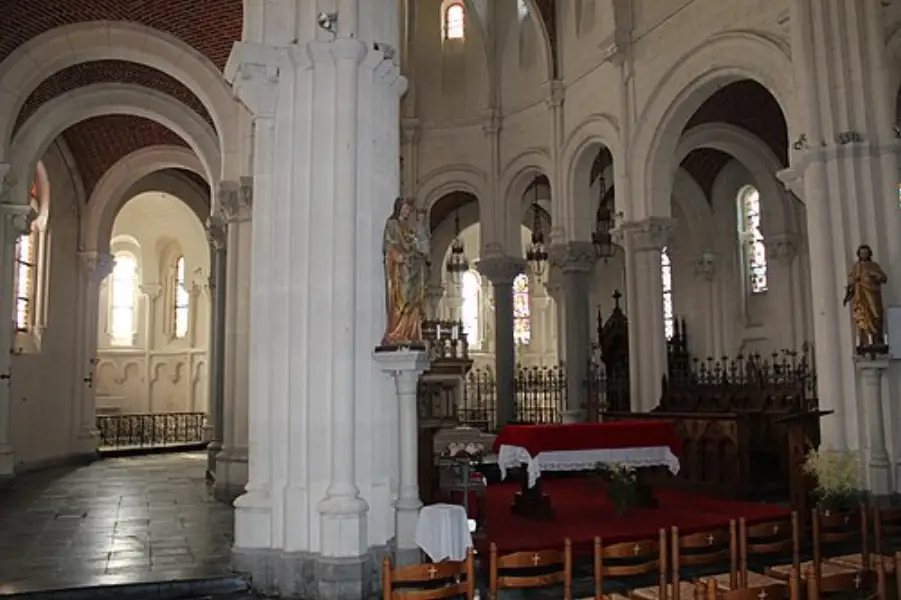
The city and the Chapter of Lens adopted Saint Wulgan as their tutelary patron, and his name was built into the very stones of the region. Eustace I, Count of Boulogne and Lord of Lens, founded a collegiate church dedicated to him in 1028; its treasury, before the building was lost in the French Revolution, held a piece of the True Cross dispatched from Syria by Godfrey of Bouillon, the saint's own body, much of the remains of Saint Chrysole, a portion of Saint Lambert's head, and two bones of Saint Willibrord. The twelfth-century Black Book of Saint-Ouen Abbey at Rouen preserved a Life written under Abbot Nicolas of Normandy. Smaller sanctuaries kept his memory alive as well: the tiny priory church of Framecourt bears a keystone dated 1685, and at Estourmel in the Archdiocese of Cambrai a church of the saint, rebuilt in 1866 after its predecessor's destruction, rises with Romanesque arcades and a tower forty-one meters high. When war laid Lens waste in the twentieth century, the Société des Mines de Lens raised a new chapel in his honor at Grand-Condé in 1921, replaced in 1962 by the church of Notre-Dame-des-Mines-et-Saint-Wulgan, where his statue still stands beside Our Lady of Mines.
§ Legacy
Timeline
- 569
Tradition places his death at Lens in Pas-de-Calais, though the date is disputed.
§ Life
- 1028
Eustace I, Count of Boulogne and Lord of Lens, founded a collegiate church in the saint's honor.
§ Legacy
- 1041
The Gesta episcoporum cameracensium recorded that his remains rested at Lens.
§ Life
- 1866
The former church of Saint-Vulgan at Estourmel was torn down and the present building raised in its place.
§ Legacy
- 1 Nov 1921
A chapel honoring Saint Wulgan, built by the Société des Mines de Lens, was inaugurated at Grand-Condé.
§ Legacy
- Mar 1962
The new church of Notre-Dame-des-Mines-et-Saint-Wulgan was opened at Lens in March.
§ Legacy
The Record
- Patron of
- patron saint of Lens, Pas-de-Calais
- Canonization
- Pre-congregation; venerated as a saint by Catholic and Orthodox churches since the early medieval period
Prayer
Bibliography
Show 10 sources
- Petit, Anne; Desprez, Jean Claude (13 February 2020), "L'histoire peu ordinaire de l'église Notre-Dame des Mines de Lens", Le lensois normand
- Saints du Pas-de-Calais, Diocèse d'Arras
- "Saint Vulgan", Nominis
- Feuchère, P. (1952), "Les origines urbaines de Lens-en-Artois", Revue belge de Philologie et d'Histoire (30–1–2): 91–108
- Mériaux, Charles (2006), Gallia irradiata: saints et sanctuaires dans le nord de la Gaule du haut Moyen Âge, Franz Steiner Verlag, ISBN 978-3-515-08353-9
- Montaubin, Pascal (2019), Saint-Vulgan - Base des collégiales séculières de France (816-1563)
- Deramecourt, Augustin Victor (1884), Le clergé du diocèse d'Arras, Boulogne & Saint-Omer pendant la Révolution, 1789-1802, vol. 1
- Commission départementale des monuments historiques (1908), Épigraphie du département de Pas-de-Calais
- Eglise Saint-Vulgan d'Estourmel, Office de tourisme du Cambrésis
- Henriques, Laura (10 November 2020), "A weekend in Lens and its surroundings", Culture & Adventure, KAUSA Communication & Design
Profile text adapted from the Wikipedia article, licensed CC BY-SA 4.0.
Pray with this saint every day
Save St. Vulgan to your favorites, read the full profile, and get feast-day reminders in the Saints app.
Get the Saints AppFree on the App Store for iPhone and iPad