
c. 710 – 777/779·Feast February 25
St. Walpurga
Anglo-Saxon missionary and abbess of Heidenheim
Overview
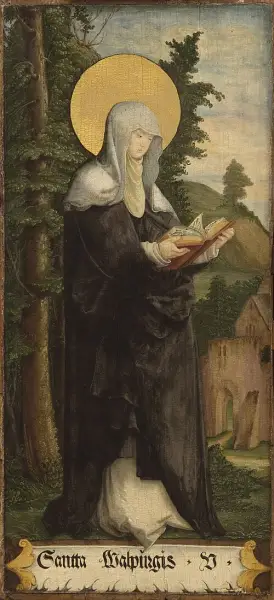
Walpurga — Wealdburg in Old English, Walburga, Valborg, or Valpuri in the tongues of other lands — was an Anglo-Saxon missionary laboring in the Frankish Empire, one of the notable women of the eighth-century German mission. Born around 710 at Crediton in Devonshire, the daughter of Richard the Pilgrim and Wuna of Wessex, she grew up with two brothers, Willibald and Winibald, who would join her in the service of their uncle Boniface's missionary enterprise in Germany. Educated under the abbess of the double monastery at Wimborne in Dorset, she spent twenty-six years in that community before crossing to the Continent to labor beside her brothers in evangelizing the still-pagan German peoples. At Heidenheim am Hahnenkamm, in the monastery her brother Willibald founded, she took the habit and, after his death in 751, ruled the community as abbess, later assuming oversight of the whole house on Winibald's death as well. She died on 25 February, in 777 or 779, and was buried at Heidenheim. Canonized by Pope Adrian II in 870, she is remembered above all at Eichstätt, where her relics rest and where an oil that gathers at her shrine has drawn pilgrims for more than a thousand years.
The Complete Life
A Noble House of Wessex
Walpurga was born around the year 710 in Dumnonia, the region roughly corresponding to modern Devon, at a time when it was being drawn into Anglo-Saxon England. Her father was Richard the Pilgrim, a likely Brittonic underking of the West Saxons, and her mother was Wuna of Wessex. Two brothers, Willibald and Winibald, grew up beside her, and the three children would each in turn give their lives to the Church on the Continent. In 721 Richard set out with his two sons on pilgrimage to Rome, leaving his eleven-year-old daughter in Dorset under the care of the abbess who ruled the double monastery of Wimborne. The separation became permanent within a year: word reached Wimborne that Richard had died at Lucca. His sons saw to his burial in the Basilica of San Frediano and completed the journey to Rome, where both fell gravely ill. Hygeburg, the biographer who recorded Willibald's travels, attributed their sickness to the Black Death, while the nineteenth-century hagiographer Francis Mershman suggested malaria. The orphaned girl left at Wimborne thus learned early that the life of a pilgrim family was also a life of loss.
§ Early life
Formation at Wimborne
The years at Wimborne made the nun. There Walpurga was educated, took the veil, and spent twenty-six years as a member of the community, formed in the disciplines of prayer and learning that distinguished one of the great double monasteries of Anglo-Saxon England. The house was celebrated for the skill of its nuns in copying and ornamenting manuscripts, and no less for its mastery of Opus Anglicanum, the fine English needlework that worked gold and silver thread into rich velvet or linen, often set with jewels and pearls. Such embroidery was in demand across Europe, and a convent capable of producing it stood at the height of English craftsmanship. In this atmosphere of scholarship and artistry the young woman who had been entrusted to the abbess grew into religious maturity. When her brothers went out one by one to the missions of the Continent, she remained in the cloister, and the greater part of her life passed within the walls of the Dorset house. The call to Germany, when it came, found her neither untrained nor untested: she brought to the Frankish mission a formation of more than two decades in one of the most accomplished religious houses of her homeland.
§ Religious career
To Germany with Boniface
In 737 Boniface — Walpurga's uncle through her mother, and the apostle of Germany — being then in Rome, called his nephews to share his missionary labors among the German peoples. Winibald reached Thuringia on 30 November 740 and, after ordination to the priesthood, was placed in charge of seven churches. Willibald made his way to Eichstätt, where Boniface ordained him on 22 July 741 for missionary work in the surrounding country. Walpurga then left England herself, journeying with her two brothers into Francia — the country now known as Württemberg and Franconia — to help Boniface preach the faith among the German peoples still wedded to the old gods. Some later writers credited her with an account in Latin of her brother Willibald's travels in the Holy Land and even with his vita, but these works have been shown to be the composition of Hugeburc of Heidenheim. Her own field of labor was the double monastery of Heidenheim am Hahnenkamm, founded by Willibald, where she became a nun. In that frontier house, amid a population still being converted, she carried the discipline of Wimborne into the German mission, the one member of her remarkable family whose vocation flowered within the cloister rather than on the road.
§ Religious career
Abbess of Heidenheim
Willibald appointed his sister as his successor at Heidenheim, and when he died in 751 Walpurga became abbess of the monastery. Nine years afterwards, when Winibald too died in 760, his office likewise passed to her, and she became superintendent of the Heidenheim house, gathering under her authority responsibilities that her two brothers had held between them. She directed the community through the remaining years of her life, ruling the monastery that stood at the center of the evangelization of the region. She died on 25 February, in a year the records give variously as 777 or 779, and was buried at Heidenheim, where she had spent the closing decades of her life. The date of her death carried her name in the Catholic calendar of saints. From Heidenheim her cult spread outward through Franconia and beyond, but the monastery remained the place of her memory: it was there that she had labored, there that she had governed, and there that her body rested until its translation to Eichstätt. The twice-orphaned girl of Wimborne ended her days as the head of a religious house and the chief memorial of her family's mission.
§ Death
Canonization and the Oil of Eichstätt
Walpurga's remains were brought from Heidenheim to Eichstätt in 870, the very year in which Pope Adrian II inscribed her among the saints; her canonization was kept on 1 May. At Eichstätt her bones were set into a rocky niche from which, so it was said, there began to flow an oil of miraculous healing power. The substance, known as Walpurgis oil, was reported to flow from her bones especially between October and February, and was regarded as effective against disease; pilgrims came to her shrine to seek its benefits. In the nineteenth century Cardinal Newman declared the oil a credible miracle. The written records of her cult reach back almost to the translation itself: Wolfhard von Herrieden's Miracula S. Walburgae Manheimensis, datable to 895 or 896, and a late tenth-century Vita secunda associated with Aselbod, bishop of Utrecht, are the two earliest miracle narratives. In the fourteenth century Phillipp von Rathsamhaüsen, bishop of Eichstätt from 1306 to 1322, composed a Vita S. Walburgae that introduced the miracle of the tempest-tossed boat, an episode Peter Paul Rubens painted in 1610 for the altarpiece of the church of St. Walpurgis in Antwerp. Her canonized cult thus joined an unbroken chain of testimony from ninth-century Eichstätt to the modern world.
§ Veneration
Walpurgis Night and a Cult Across Europe
Walpurga's feast is kept on 25 February, but her canonization day of 1 May was also celebrated through the high Middle Ages, particularly in the eleventh century under Anno II, Archbishop of Cologne. From that observance comes Walpurgis Night, the eve of May Day, still a fixture of continental folklore marked with dancing, and in Sweden the celebration of Valborg falls on the last day of April. The earliest image of the saint, in the early eleventh-century Hitda Codex made at Cologne, shows her holding stylized stalks of grain, an attribute sometimes mistaken for a palm branch although she was not martyred; scholars have read the grain as a Christian transformation of the pagan Grain Mother, whose presence peasants explained in corn dollies at harvest. Her name was carried across Europe: Benedictine abbeys stand at Eichstätt in Bavaria and at Virginia Dale in Colorado, home to some twenty contemplative nuns, while Benedictine sisters established St. Walburg Monastery in Covington, Kentucky, in 1859, giving rise to Villa Madonna Academy and Thomas More University. The Church of St. Walburge in Preston, England, rises in a spire of 309 feet, the tallest of any parish church in the country, and St. Walburg's Hospital, a 220-bed institution, was built in southern Tanzania in 1959. In Antwerp, the ancient church of St. Walburga that served the city for more than seven centuries was confiscated and demolished under French and Dutch rule, its altarpiece by Rubens eventually finding reuse in the Cathedral of Our Lady, while a new church of the same name was raised in 1936 and declared a monument in 1995.
§ Legacy
Timeline
- 710
Born at Crediton in Devonshire, in the kingdom of Wessex.
§ Early life
- 721
Placed, aged eleven, in the keeping of Wimborne Abbey's double monastery and its abbess as her father departed for Rome.
§ Religious career
- 737
Her uncle Boniface, then in Rome, recruited her brothers to assist his missionary work in Germany.
§ Religious career
- 30 Nov 740
Her brother Winibald arrived in Thuringia to begin monastic and missionary labors.
§ Religious career
- 22 Jul 741
Her brother Willibald was ordained by Boniface at Eichstätt and began missionary work in the region.
§ Religious career
- 751
Succeeded her brother Willibald as abbess of the monastery of Heidenheim am Hahnenkamm upon his death.
§ Religious career
- 760
Succeeded her brother Winibald as superintendent of the Heidenheim monastery on his death.
§ Religious career
- 25 Feb 777
Died at Heidenheim and was buried there; the records leave the year uncertain between 777 and 779.
§ Death
- 870
Canonized by Pope Adrian II.
§ Veneration
- 870
Her remains were translated from Heidenheim to Eichstätt.
§ Death
- 895
Wolfhard von Herrieden composed the Miracula S. Walburgae Manheimensis, one of the two earliest collections of her miracles.
§ Veneration
The Record
- Patron of
- Eichstätt·Antwerp·Zutphen·Weilburg·Oudenarde·Veurne·Arnhem·against hydrophobia (rabies)·in storms·sailors
- Symbols
- stalks of grain
- Canonization
- Canonized in 870 by Pope Adrian II
Prayer
Bibliography
Show 9 sources
- Morgan, Ann (15 August 2008). "Local landmarks: St Walburge's". BBC
- Meyrick, Thomas (1873). A Life of Saint Walburge
- Mershman, Francis (1912). "Sts. Willibald and Winnebald". The Catholic Encyclopedia. Vol. 15. New York: Robert Appleton Company
- Casanova, Gertrude (1912). "St. Walburga". The Catholic Encyclopedia. Vol. 15
- Butler, Alban (1866). "Saint Winebald, Abbot and Confessor". Lives of the Fathers, Martyrs, and Principal Saints
- Head, Pauline (2002). "Who is the Nun from Heidenheim? A Study of Hugeburc's 'Vita Willibaldi'". Medium Ævum. 71 (1): 29
- Chisholm, Hugh, ed. (1911). "Walpurgis, St". Encyclopædia Britannica. Vol. 28 (11th ed.). Cambridge University Press. pp. 290–291
- Heiland, Susanne (July 1969). "Two Rubens Paintings Rehabilitated". The Burlington Magazine. 111 (796): 421–427
- Berger, Pamela C. (1985). The Goddess Obscured: Transformation of the Grain Protectress from Goddess to Saint. pp. 61–64
Profile text adapted from the Wikipedia article, licensed CC BY-SA 4.0.
Pray with this saint every day
Save St. Walpurga to your favorites, read the full profile, and get feast-day reminders in the Saints app.
Get the Saints AppFree on the App Store for iPhone and iPad